











 Secure payments
Standard refund policy
Trade Assurance
Secure payments
Standard refund policy
Trade Assurance
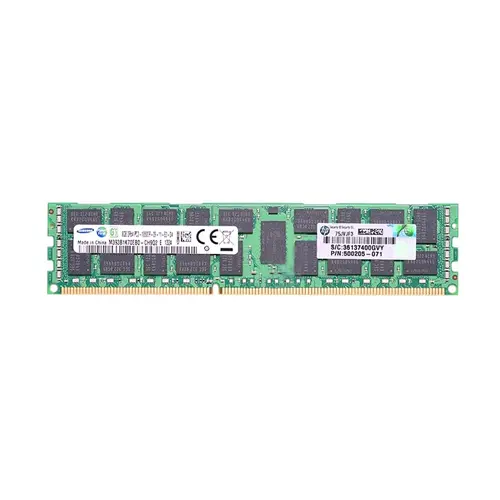
| Model | M393B1K70EB0-CH9Q2 |
|---|---|
| Product Type | Memory Module |
| Compliance Standards | EU RoHS,FCC |
| Memory Capacity | 8 GB |
| Memory Technology | DDR3 |
| Product Voltage | 1.5V |
| RAM Speed | 1333MHz |
| RAM Standard | DDR3-1333/PC3-10600 |
| Error Identifying | ECC |
| Signal Type | Registered |
| Column Access Strobe (CAS) | CL9 |
| Rank | Dual Rank x4 |
| Quantity of Pins | 240-pin |
| RAM Genre | RDIMM |
Designed for legacy server platforms, this 8GB DDR3-1333 Registered DIMM with ECC provides the data integrity and system stability required for virtualization, in-memory databases, and other mission-critical workloads. Its dual-rank x4 organization and registered signaling enhance signal integrity under heavy loading, enabling reliable operation in densely populated memory configurations where consistent latency and error-free data handling are paramount.
1. ECC error correction automatically detects and corrects single-bit memory faults, shielding critical server workloads from silent data corruption that could crash a database or hypervisor.
2. Registered signal buffering stabilizes electrical loads across large memory populations, allowing the server to scale to higher DIMM counts without compromising signal integrity for demanding in-memory applications.
3. Dual Rank x4 organization leverages bank-level parallelism to sustain high throughput under concurrent access patterns, essential for maintaining low latency in virtualized environments with mixed tenant workloads.
4. The 1333MHz clock speed delivers 10.6 GB/s of peak bandwidth per channel, efficiently feeding modern multi-core server processors during heavy data streaming and real-time analytics tasks.
5. An 8GB capacity per module strikes a practical balance between memory density and cost, enabling cost-effective scaling for mid-range virtualization hosts or replicated web server fleets.
The M393B1K70EB0-CH9Q2 is a server DDR3 RDIMM engineered for environments where reliability defines value. Four key attributes translate directly into operational confidence. First, ECC actively corrects single-bit memory errors caused by cosmic rays—critical in a virtualized cluster where one flipped bit can silently corrupt a guest OS or hypervisor state, triggering costly downtime. Second, the Registered buffer allows multiple DIMMs per channel without signal degradation, meaning you can scale to higher memory capacities essential for large VM footprints. Third, the Dual Rank x4 architecture interleaves memory accesses, boosting sustainable bandwidth for latency-sensitive applications like in-memory databases. Finally, the CL9 timing at 1333MHz ensures predictable, low-latency data retrieval, accelerating database queries and transaction processing. For a financial trading platform or a VM farm, these characteristics mean that a stray particle won’t become a revenue loss and that heavy load won’t degrade system stability—your infrastructure stays up and accurate.
General Virtualization
This registered DDR3-1333 ECC module provides stability for virtual machine hosts. Equip dual-socket servers with six to twelve modules per CPU (48 GB–96 GB total) to comfortably run 10–20 light VMs. Always install in matched sets per memory channel to leverage triple-channel or quad-channel configurations for balanced throughput.
In-Memory Database
Databases like Redis or SAP HANA demand high capacity and data integrity, making ECC essential. Populate all memory channels with 8 GB dual-rank RDIMMs, aiming for 128 GB–256 GB per node using 16–32 modules. This density keeps datasets resident in memory while registered buffers maintain signal integrity under heavy load.
High-Performance Computing (HPC)
For compute clusters running simulations, bus speed and rank interleaving matter. Deploy one 8 GB module per channel in quad-channel systems for maximum bandwidth, or scale to two modules per channel if capacity is prioritized. Dual-rank x4 design helps hide latency during large-memory-footprint parallel jobs, while ECC protects multi-day computations.
Rigorously tested, compatible with Dell PowerEdge R720, HP DL380p Gen8, and Lenovo RD430.
Q: Can I mix this M393B1K70EB0-CH9Q2 with other memory modules of different brands or speeds?
A: Mixing brands or speeds with registered ECC memory is strongly discouraged. It can degrade signal integrity and cause system instability. For validated server performance, populate each channel with identical Samsung modules.
Q: Is this memory compatible with my Intel Xeon E5-2600 v2 system?
A: Yes, this DDR3-1333 ECC RDIMM is compatible with Intel Xeon E5-2600 v2 platforms and similar DDR3-based servers. Verify your board supports 1.5V, 240-pin registered modules and appropriate memory capacity per slot.
Q: What is the recommended DIMM population order for optimal performance?
A: Populate identical DIMMs starting with the slots farthest from each CPU. Follow your server manual’s balanced configuration: typically fill the first bank of each channel to maintain symmetric memory ranks and maximize ECC bandwidth.
Q: Does this module support overclocking or XMP profiles?
A: No. As a server-grade DDR3 ECC Registered DIMM, it operates strictly at JEDEC standard 1333MHz with CL9 timings. Overclocking and XMP profiles are not supported, ensuring maximum stability in mission-critical environments.
Q: What warranty and typical failure rate can I expect?
A: This Samsung module includes a one-year warranty. It exhibits a typical annualized failure rate (AFR) below 0.2% under normal server conditions, reflecting the high reliability required for 24/7 enterprise workloads.