











 Secure payments
Standard refund policy
Trade Assurance
Secure payments
Standard refund policy
Trade Assurance
| Product Type | Memory Module |
|---|---|
| Compliance Standards | CE,WEEE,RoHS |
| Memory Capacity | 8 GB |
| Memory Technology | DDR3 |
| RAM Speed | 1333 |
| RAM Standard | DDR3-1333/PC3-10600 |
| Error Identifying | Non-ECC |
| Signal Type | Unbuffered |
| Column Access Strobe (CAS) | CL9 |
| Rank | Dual Rank x8 |
| Quantity of Pins | 204-pin |
| RAM Genre | SoDIMM |
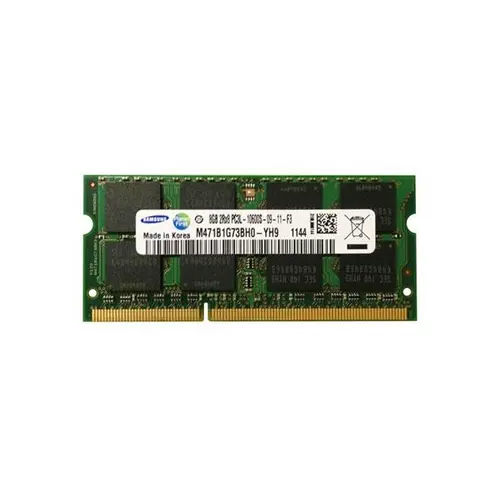
This unbuffered, Non-ECC DDR3-1333 SODIMM with a dual-rank x8 organization and CL9 latency is tailored for upgrading aging notebooks and mobile workstations, delivering stable plug-and-play compatibility and improved multitasking responsiveness through rank interleaving without the power overhead of registered modules.
1. The SoDIMM form factor guarantees a no-fuss drop-in upgrade for ultrabooks and compact laptops, letting users instantly revive system responsiveness without technical know-how.
2. This generous capacity eliminates swap-file slowdowns during typical work-from-anywhere scenarios, from video calls to heavy browser tab loads.
3. DDR3 technology ensures broad compatibility with a vast fleet of older notebooks, delivering a dependable, low-cost refresh that sidesteps platform migration headaches.
4. The measured speed bin keeps power draw conservative, prolonging battery life during untethered use while still accelerating everyday application loads perceptibly.
5. Dual-rank organization interleaves accesses across internal banks, subtly lifting multitasking fluidity on lightweight portables without a thermal or power penalty.
This SODIMM module is designed exclusively for notebook platforms, where every milliwatt of power and millimeter of space counts. Its Non-ECC, Unbuffered architecture eliminates the additional buffering and error-correction circuitry that server memory demands, directly reducing electrical load and extending precious battery life. For a field engineer running CAD software on a mobile workstation, that means sustained performance without the battery drain that would otherwise force a hunt for a power outlet mid-task. The 204‑pin small‑outline form factor is engineered for effortless drop‑in upgrades, even in ultra‑thin laptops with tightly sealed chassis; no compatibility guesswork, just a straightforward capacity boost. Meanwhile, the 8 GB capacity organized as a Dual Rank x8 configuration enables rank interleaving, which heightens responsiveness when multiple memory pages are open simultaneously—think of a researcher keeping several large reference documents, a data set, and a presentation active without stuttering. Paired with a CL9 latency at 1333 MT/s, the module keeps initial access times short, so applications launch swiftly and the system feels snappy during real‑world multitasking, whether you are compiling code, editing video, or simply running dozens of browser tabs on a thin‑and‑light notebook.
Laptop Upgrade
When upgrading an older laptop with a single 8 GB DDR3‑1333 module, the simplest capacity doubling is to add a second identical 8 GB SoDIMM (ideally matching M471B1G73BH0-YH9 or equivalent dual‑rank x8, CL9) for 16 GB total. This dual‑channel configuration improves integrated graphics performance and multitasking responsiveness. If only one slot is accessible, replace the existing module with a compatible 8 GB stick and keep the old one as a spare.
Mobile Workstation
For memory‑hungry professional workloads such as CAD, 3D rendering, or large data analysis, populate both SoDIMM slots with 8 GB modules to reach a reliable 16 GB maximum. Although 16 GB may be the practical ceiling for many DDR3‑era mobile platforms, this dual‑channel setup reduces swapping under heavy multitasking. Always verify the chipset’s maximum supported capacity and ensure both modules have identical dual‑rank/x8 organization and timing to maintain stability.
Ultrabook Power Saving
Ultrabooks and thin‑and‑light notebooks benefit greatly from low‑voltage DDR3L (1.35 V) memory, which extends battery runtime compared to standard 1.5 V DDR3. While the described 8 GB DDR3‑1333 SoDIMM is a regular‑voltage part, replacing it with a DDR3L‑1333 module of the same capacity and rank can reduce power draw by about 10‑15 % in active scenarios. If the system supports both voltages, a single 8 GB DDR3L stick offers the best balance of capacity and energy efficiency for everyday mobility.
Rigorously tested, compatible with laptops like Dell Latitude E6430, ThinkPad T430, EliteBook 8470p.
Q: Can I mix this M471B1G73BH0-YH9 with other memory modules of different brands or speeds?
A: Mixing modules of different brands or speeds is not recommended, as it may cause instability. For optimal compatibility, use identical DDR3-1333 SO-DIMMs with matching capacity, rank, and timings.
Q: Is this memory compatible with my system?
A: This 8 GB DDR3-1333 SO-DIMM fits notebooks with 204-pin slots supporting PC3-10600. Please verify your laptop's memory type, maximum capacity, and generation before purchasing.
Q: What is the recommended DIMM population order for optimal performance?
A: For laptops with two slots, install a matched pair of identical modules to enable dual-channel mode. If only one is used, populate the primary slot as indicated in your system manual.
Q: Does this module support overclocking or XMP profiles?
A: No, this is a standard JEDEC-compliant DDR3-1333 module. It does not support overclocking or XMP profiles and operates at its rated speed with CL9 latency.
Q: What warranty and typical failure rate can I expect?
A: This module carries a 1-year warranty. Typical failure rates are extremely low, well within industry standards, ensuring reliable long-term operation under normal conditions.