











 Secure payments
Standard refund policy
Trade Assurance
Secure payments
Standard refund policy
Trade Assurance
| Model | M393B1K70BH1-CH9Q1 |
|---|---|
| Product Type | Memory Module |
| Compliance Standards | EU RoHS,FCC |
| Memory Capacity | 8 GB |
| Memory Technology | DDR3 |
| Product Voltage | 1.5V |
| RAM Speed | 1333MHz |
| RAM Standard | DDR3-1333/PC3-10600 |
| Error Identifying | ECC |
| Signal Type | Registered |
| Column Access Strobe (CAS) | CL9 |
| Rank | Dual Rank x4 |
| Quantity of Pins | 240-pin |
| RAM Genre | RDIMM |
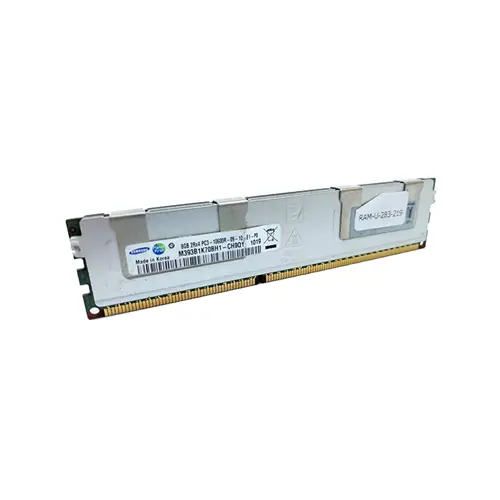
Designed specifically for server platforms, this Samsung M393B1K70BH1-CH9Q1 8GB DDR3-1333 RDIMM features ECC and registered signal technology to ensure data integrity and system stability under heavy multi-DIMM configurations. Its dual-rank x4 organization optimizes memory bandwidth and capacity balance, making it ideally suited for virtualization, in-memory databases, and other enterprise workloads where reliability and sustained throughput are critical.
1. Error Correction Code detects and corrects single-bit errors in real time, preventing silent data corruption that could crash virtualized workloads or financial transactions.
2. Registered buffering stabilizes command and address signals across heavily loaded channels, allowing hyperscale servers to populate dozens of modules without sacrificing signal integrity.
3. Dual Rank x4 organization keeps memory interleaving active and channels saturated, delivering predictable latency under multi-tenant database consolidation.
4. DDR3 technology maintains seamless drop-in compatibility with existing server fleets, controlling migration costs while preserving operational continuity.
5. 1333 MT/s throughput provides a steady bandwidth baseline for concurrent network storage requests, ensuring uninterrupted data streaming in scale-out file servers.
The Samsung M393B1K70BH1-CH9Q1 is a server-class DDR3 RDIMM designed to solve the critical memory challenges in modern datacenters. Its ECC technology silently corrects single-bit errors in real time, shielding virtualized clusters from crashes and safeguarding in-memory databases like SAP HANA against data corruption. The registered buffer preserves signal integrity across fully-populated memory channels, allowing you to deploy hundreds of gigabytes for dense virtual desktop infrastructure without risking system hangs. With a dual-rank x4 configuration, the module interleaves accesses to double bandwidth and reduce latency under heavy concurrent loads—essential for high-frequency trading platforms or multi-tenant databases that demand instant data retrieval. Operating at 1333MHz with CL9 timing, it provides the predictable, low-latency response that transactional applications require. Ultimately, this RDIMM elevates your infrastructure’s reliability and throughput, transforming memory from a single point of failure into a foundation for always-on, data-consistent services.
This server DDR3 Registered ECC RDIMM (8GB, 1333MHz) requires careful capacity planning.
General Virtualization: Balance capacity and memory interleaving. In a dual-socket server with three memory channels per CPU, start with six identical 8GB RDIMMs (48GB) to fully utilize available bandwidth and avoid bottlenecks. Scale to twelve modules (96GB) for larger VM farms while keeping ranks balanced. ECC and registered buffering guarantee data integrity.
In-Memory Database: Maximize capacity by filling every DIMM slot with these 8GB modules, reaching platform maximums (e.g., 768GB). Use uniform dual-rank x4 RDIMMs to ensure lowest latency and avoid rank contention—vital for real-time analytics. ECC protection is mandatory for transactional data.
High-Performance Computing: Install one DIMM per channel (six modules in a common dual-socket, three-channel configuration) to sustain 1333 MHz bandwidth for parallel workloads. If larger memory is required, add a second DIMM per channel (12 modules, 96GB), but be prepared for a potential downclock to 1066 MHz; validate with application benchmarks.
Rigorously tested server memory, compatible with Dell R720, HP DL380p Gen8, IBM x3650 M4.
Q: Can I mix this M393B1K70BH1-CH9Q1 with other memory modules of different brands or speeds?
A: Mixing brands or speeds is strongly discouraged. Registered ECC server memory demands identical modules for stable signal integrity. Mismatched DIMMs risk system faults and data errors in mission-critical environments.
Q: Is this memory compatible with my system?
A: It is compatible with servers using DDR3-1333 Registered ECC RDIMMs, like Intel Xeon E5-2400/2600 v1/v2 or AMD Opteron 6300 platforms. Always confirm via your system's qualified memory list.
Q: What is the recommended DIMM population order for optimal performance?
A: Populate identical DIMMs per channel, following the motherboard manual. Typically, start with the slot farthest from the CPU, then balance across all memory channels to achieve maximum bandwidth and interleaving.
Q: Does this module support overclocking or XMP profiles?
A: No. This is enterprise-grade Registered ECC memory, engineered for stability under 24/7 loads. It runs strictly at JEDEC DDR3-1333 specifications with no overclocking or XMP profile support.
Q: What warranty and typical failure rate can I expect?
A: It comes with a one-year warranty. Enterprise server memory typically exhibits an annual failure rate well below 0.5%, providing exceptional reliability for continuous data center operations.