











 Secure payments
Standard refund policy
Trade Assurance
Secure payments
Standard refund policy
Trade Assurance
| Model | M393B1K70CH0-CH904 |
|---|---|
| Product Type | Memory Module |
| Compliance Standards | EU RoHS,FCC |
| Memory Capacity | 8 GB |
| Memory Technology | DDR3 |
| Product Voltage | 1.5V |
| RAM Speed | 1333MHz |
| RAM Standard | DDR3-1333/PC3-10600 |
| Error Identifying | ECC |
| Signal Type | Registered |
| Column Access Strobe (CAS) | CL9 |
| Rank | Dual Rank x4 |
| Quantity of Pins | 240-pin |
| RAM Genre | RDIMM |
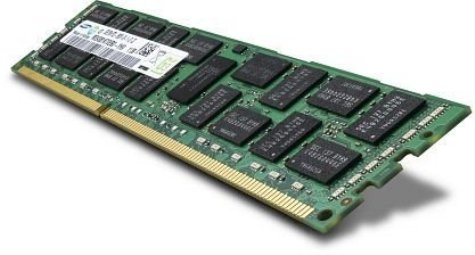
This Samsung M393B1K70CH0-CH904 is an 8GB DDR3-1333 registered ECC RDIMM, purpose-built for server platforms where data integrity is paramount, making it ideal for virtualization and in-memory database workloads. Its dual-rank x4 organization with CL9 latency and registered buffering ensures stable operation in high-density memory configurations by reducing electrical load on the memory controller while delivering reliable error correction.
1. ECC protection detects and corrects single-bit errors automatically, preserving data accuracy for 24/7 uptime in enterprise storage and computing.
2. Registered buffering stabilizes signal integrity across multiple DIMMs, allowing high-capacity memory configurations essential for large-scale virtualization.
3. Ample capacity per stick enables dense memory configurations for virtualized environments, maximizing VM density per server node.
4. High clock speed delivers substantial memory bandwidth, accelerating database queries and real-time analytics without bottlenecks.
5. Dual Rank x4 organization keeps memory channels fully utilized, ensuring consistent throughput under heavy multi-threaded server workloads.
The Samsung M393B1K70CH0-CH904 is a server-class DDR3 Registered DIMM engineered for enterprise environments where reliability and uptime are non-negotiable. Its ECC technology actively detects and corrects single-bit errors, shielding your virtualized infrastructure from silent data corruption that can crash hypervisors or corrupt in-memory database transactions. In a dense virtualization cluster running dozens of VMs, the registered buffer reduces electrical loading on the memory controller, allowing you to populate all DIMM slots without signal degradation—ensuring stable operation even when scaling to maximum capacity. The dual-rank x4 organization further boosts throughput by interleaving memory accesses across two internal ranks, a vital advantage for memory-intensive applications like real-time analytics on Redis or SAP HANA, where every nanosecond of latency directly impacts query performance. With a standard 1.5V voltage and 1333MHz speed at CL9 latency, this module strikes an optimal balance between consistent bandwidth and power efficiency, keeping 24/7 data center operating costs in check. For server administrators, this translates to fewer outages, higher consolidation ratios, and predictable performance under heavy concurrent loads.
General Virtualization
For a typical hypervisor hosting multiple VMs, populate at least six to eight modules per server to reach 48–64 GB of total RAM, leveraging dual- or quad-channel memory interleaving where the platform supports it. Spread identical 8 GB RDIMMs evenly across all memory channels and leave room for future expansion, as virtualization environments tend to grow quickly.
In-Memory Database
In-memory databases demand both capacity and low latency, so aim to fill all available DIMM slots with these 8 GB DDR3-1333 registered ECC modules, giving maximum capacity per socket while maintaining data integrity. Deploy the largest supported configuration (often 128 GB or more) and pair it with dual-rank DIMMs in a balanced channel layout to improve sustained throughput.
High-Performance Computing
HPC workloads benefit from bandwidth-sensitive parallel access, so install a full set of modules—typically eight or twelve per node—to enable all memory channels and maximize the number of ranks per channel. Use identical dual-rank 8 GB RDIMMs in every slot to sustain peak floating-point operations, and consider dual-socket nodes where total memory can reach 256 GB with this module for large-scale simulations.
Rigorously tested, compatible with Dell PowerEdge R720, HP ProLiant DL380p Gen8, IBM System x3650 M4.
Q: Can I mix this M393B1K70CH0-CH904 with other memory modules of different brands or speeds?
A: Mixing brands or speeds is not recommended for registered ECC server memory. Mismatched modules may cause boot failures, degraded stability, or unbuffered ECC fallback. Use identical part numbers for guaranteed availability.
Q: Is this memory compatible with my system?
A: This DDR3-1333 ECC Registered RDIMM supports Intel Xeon E5-2400/2600 v1/v2 and AMD Opteron 6300 series platforms. Verify your server board requires 1.5V, 240-pin registered DIMMs with dual rank x4 organization.
Q: What is the recommended DIMM population order for optimal performance?
A: Install identical DIMMs in balanced channels, filling slots farthest from the CPU first. For triple-channel platforms, populate three identical modules; for quad-channel, four. Consult your server’s memory population guide for interleaving rules.
Q: Does this module support overclocking or XMP profiles?
A: No. This enterprise server DIMM runs strictly at JEDEC DDR3-1333 CL9. Registered ECC modules are not designed for overclocking, and XMP is not supported. Reliability under continuous workload is prioritized.
Q: What warranty and typical failure rate can I expect?
A: This module includes a one-year warranty. As a server-grade registered ECC component, it exhibits an annualized failure rate below 0.5% under normal operating conditions, ensuring long-term data integrity for critical applications.