











 Secure payments
Standard refund policy
Trade Assurance
Secure payments
Standard refund policy
Trade Assurance
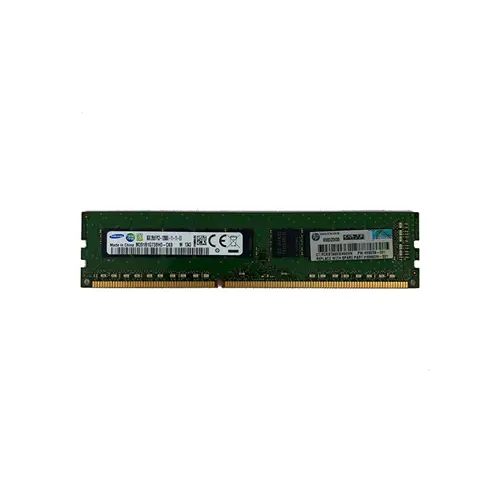
| Product Type | Memory Module |
|---|---|
| Compliance Standards | EU RoHS,FCC |
| Memory Capacity | 8 GB |
| Memory Technology | DDR3 |
| RAM Speed | 1600MHz |
| RAM Standard | DDR3-1600/PC3-12800 |
| Error Identifying | Non-ECC |
| Signal Type | Unbuffered |
| Column Access Strobe (CAS) | CL11 |
| Rank | Dual Rank x8 |
| Quantity of Pins | 240-pin |
| RAM Genre | UDIMM |
This unbuffered, non-ECC DDR3-1600 UDIMM is a reliable solution for mainstream desktop platforms, delivering solid multitasking performance in productivity workloads, content creation, and casual gaming. Its dual-rank x8 configuration improves memory interleaving for better bandwidth efficiency, while the CL11 latency keeps access times predictable under sustained loads.
1. A generous capacity handles simultaneous browser tabs, office suites, and multimedia apps, eliminating frustrating slowdowns during typical desktop multitasking.
2. High-speed operation feeds the processor with fast data streams, enabling fluid gameplay and swift rendering in entry-level to mid-range gaming rigs.
3. Tight CAS latency shaves microseconds off memory response, delivering a perceptibly snappier system feel and better minimum frame rates in demanding titles.
4. Dual Rank interleaving architecture maximizes command efficiency, dynamically accelerating data access and improving overall throughput for content creation and streaming.
5. Unbuffered signal path minimizes electronic delay, granting the CPU immediate access to memory for reduced input lag and greater overclocking headroom.
Built for the desktop, the Samsung M378B1G73BH0-CK0 is an 8GB DDR3-1600 UDIMM that skips ECC and buffering to deliver affordable, high-compatibility performance where consumer systems need it most. Its non-ECC, unbuffered design aligns perfectly with mainstream motherboards, avoiding the incompatibility headaches that server-class memory often creates in home and office rigs.
The 1600MHz clock with CL11 timing directly cuts the waiting in real workloads. In AAA gaming, faster data delivery reduces level-load stutters and keeps frame pacing smoother when the engine streams massive textures, giving you more time immersed in the action instead of staring at a progress bar. For content creators running video editing or 3D rendering software, the dual-rank x8 organization helps maximize bandwidth utilization, making timeline scrubbing and real-time previews feel noticeably snappier. Meanwhile, the 8GB capacity sits in the sweet spot for heavy multitasking—keeping dozens of browser tabs, a productivity suite, and a media player active without forcing your system to resort to sluggish virtual memory. It is a practical lifeline for older desktops, turning a frustratingly slow experience into a responsive daily driver that still handles serious work and play.
Gaming Build
For a smooth gaming experience, deploy two of these 8 GB DDR3‑1600 UDIMMs in a dual‑channel configuration to reach 16 GB total. This setup eliminates the bandwidth bottleneck of a single module and comfortably handles modern titles, background tasks, and streaming. If your budget allows, populating all four slots with identical modules delivers 32 GB, which provides ample headroom for heavily modded games and future releases.
Content Creation
Video editing, 3D rendering, and complex compositing thrive on large memory pools. Install four of these 8 GB modules to build a 32 GB quad‑channel‑capable dual‑channel array (four DIMMs running in two dual‑channel pairs), which significantly accelerates preview renders and multitimeline workflows. For heavier 64 GB workloads, you would need to source 16 GB DDR3 UDIMMs, but starting with four 8 GB sticks remains a cost‑effective step toward a capable creator workstation.
General Productivity
For office suites, web browsing, and light multitasking, a single 8 GB module already provides a snappy, budget‑friendly foundation. Adding a second identical module for 16 GB dual‑channel operation further improves responsiveness when juggling dozens of browser tabs, email clients, and document windows. This well‑balanced 16 GB configuration represents the sweet spot between cost and everyday performance, extending the usable life of an older DDR3 system without overspending.
Rigorously tested desktop memory; compatible with Dell OptiPlex 3020/7020, HP EliteDesk 800 G1, Lenovo ThinkCentre M93p.
Q: Can I mix this M378B1G73BH0-CK0 with other memory modules of different brands or speeds?
A: Mixing is possible but not recommended. The system will default to the slowest module's speed and timings, potentially causing instability. For optimal reliability, use identical modules with matching brand, capacity, and JEDEC profile.
Q: Is this memory compatible with my system?
A: This 240‑pin DDR3 UDIMM is compatible with desktop platforms using Intel 6/7/8‑series or AMD FM1/FM2/AM3+ chipsets. Please verify your motherboard supports 8GB unbuffered non‑ECC DDR3‑1600 modules and has available DIMM slots.
Q: What is the recommended DIMM population order for optimal performance?
A: For dual‑channel operation, install two identical modules in the same‑colored slots (commonly slots 2 and 4 or 1 and 3). Refer to your motherboard manual for the preferred configuration, always matching DIMM rank and capacity per channel.
Q: Does this module support overclocking or XMP profiles?
A: This is a JEDEC‑compliant DDR3‑1600 CL11 module without XMP support. It operates at standard voltage and timings. While minor adjustments may be possible, we recommend using it within JEDEC specifications to ensure stability and warranty coverage.
Q: What warranty and typical failure rate can I expect?
A: This memory module is covered by a 1‑year warranty. The annualized failure rate (AFR) for JEDEC‑standard DDR3 UDIMMs is typically below 0.5% under normal operating conditions, ensuring reliable long‑term performance in desktop environments.