











 Secure payments
Standard refund policy
Trade Assurance
Secure payments
Standard refund policy
Trade Assurance
| Model | M393B1G70QH0-CK009 |
|---|---|
| Product Type | Memory Module |
| Compliance Standards | EU RoHS,FCC |
| Memory Capacity | 8 GB |
| Memory Technology | DDR3 |
| Product Voltage | 1.5V |
| RAM Speed | 1600MHz |
| RAM Standard | DDR3-1600/PC3-12800 |
| Error Identifying | ECC |
| Signal Type | Registered |
| Column Access Strobe (CAS) | CL11 |
| Rank | Single Rank x4 |
| Quantity of Pins | 240-pin |
| RAM Genre | RDIMM |
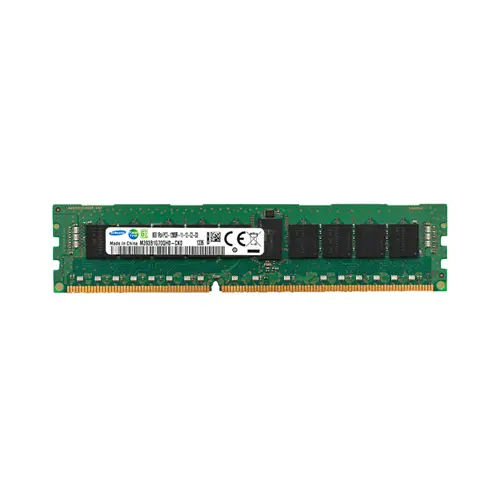
The Samsung M393B1G70QH0-CK009 is a server-grade DDR3-1600 Registered ECC DIMM, purpose-built for virtualization clusters and in-memory databases where data integrity is non-negotiable. Its single-rank x4 organization with CL11 latency ensures stable signal integrity at 1.5V, while Registered ECC corrects single-bit errors in real time to prevent costly system halts under 24/7 workloads.
1. Registered buffering preserves signal clarity across heavily loaded memory channels, enabling stable operation in dense virtualization clusters.
2. ECC protection corrects single-bit errors on the fly, shielding critical enterprise data from silent corruption during continuous operation.
3. Single-rank x4 organization reduces bus load per module, allowing fully populated servers to maintain peak clock rates without compromise.
4. Efficient per-module capacity offers a flexible granularity for scaling total memory, balancing cost and resource allocation across mixed workloads.
5. Elevated data transfer throughput ensures responsive performance under concurrent access, accelerating database transactions and in-memory caching.
Judging by the RDIMM form factor and ECC Registered signal type, the M393B1G70QH0-CK009 is unmistakably a server-grade memory module. This 8GB DDR3-1600 stick is engineered for data centers, where its four core attributes translate directly into business continuity and application performance.
In a dense virtualization cluster running dozens of VMs per host, memory errors are silent killers. The built-in ECC technology actively detects and corrects single-bit flips caused by cosmic radiation, preventing corrupted transactions from creeping into your customer database or financial records. Without ECC, a single uncorrected error could crash a hypervisor and take every tenant offline, turning uptime into a gamble you cannot afford. Meanwhile, the Registered buffer decouples the electrical load from the CPU’s memory controller, allowing you to populate all DIMM slots without signal degradation. This is mission-critical when scaling capacity for in-memory databases like Redis. A single-rank x4 design minimizes bank conflicts during sustained random access, delivering predictable low-latency responses even under massive concurrent connections. Paired with its 1.5V standard voltage, this module balances clock-per-clock efficiency and thermals, so your 24/7 memory-bound workload stays stable and responsive. For virtualized environments or real-time analytics, this isn’t just memory—it’s an insurance policy for data integrity and unwavering platform scalability.
General Virtualization
For general virtualization, density and reliability are key. Equip dual-socket servers with twelve to sixteen modules of this 8 GB DDR3-1600 RDIMM (96–128 GB total) to comfortably support 20–30 moderate VMs. Distribute identical DIMMs evenly across memory channels to maintain balanced interleaving and maximize throughput for mixed workloads.
In-Memory Database
In-memory databases demand low latency and fault tolerance. Populate all available channels with these registered ECC modules, targeting 256 GB or more (32+ DIMMs on suitable platforms). The single-rank x4 configuration reduces electrical loading, enabling higher frequency operation at 1600 MHz while ECC safeguards in-memory data integrity under sustained heavy loads.
High-Performance Computing
HPC clusters benefit from bandwidth-optimised configurations. Install a minimum of one DIMM per memory channel—typically eight modules per node for dual-socket Intel Xeon E5 systems—yielding 64 GB at full channel speed. The registered signal type ensures clean command/address signals across densely populated racks, essential for parallel file I/O and tightly coupled MPI jobs that saturate memory bandwidth.
Stringently tested server memory: compatible with Dell PowerEdge R720, R620, HP DL380p Gen8, IBM x3650 M4, Supermicro X9.
Q: Can I mix this M393B1G70QH0-CK009 with other memory modules of different brands or speeds?
A: Mixing is not recommended. For server reliability, use identical modules with matching brand, speed, rank, and CAS latency. Inconsistent DIMMs often lead to boot failures or silent data corruption.
Q: Is this memory compatible with my system?
A: This DDR3 ECC Registered RDIMM is compatible with Intel Xeon E5-2400/2600 v1/v2 and AMD Opteron 6300 platforms. Please confirm your board’s QVL supports 8GB dual-rank x4 configurations.
Q: What is the recommended DIMM population order for optimal performance?
A: Follow your server board manual, typically filling channels starting from the farthest slot per CPU. Use balanced identical DIMMs across all populated channels to maximize interleaving and throughput.
Q: Does this module support overclocking or XMP profiles?
A: No. This is a JEDEC-compliant server RDIMM without XMP or overclocking capability. It prioritizes data integrity and stable 1.5V operation, essential for mission-critical enterprise environments.
Q: What warranty and typical failure rate can I expect?
A: It includes a 1-year warranty. Enterprise DDR3 ECC RDIMMs demonstrate an annualized failure rate typically below 0.5% under specified environmental and workload conditions.