











 Secure payments
Standard refund policy
Trade Assurance
Secure payments
Standard refund policy
Trade Assurance
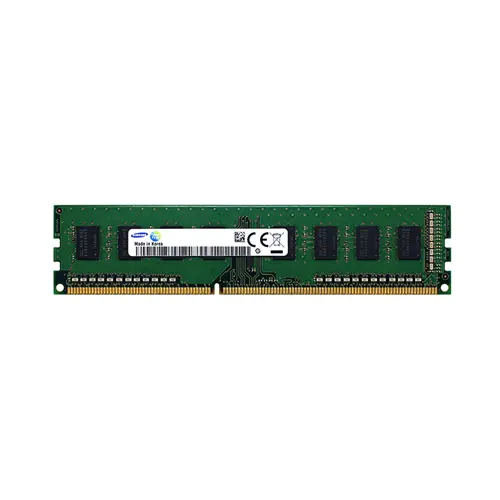
| Model | M393B1G73QH0-CK0 |
|---|---|
| Product Type | Memory Module |
| Memory Capacity | 8 GB |
| Memory Technology | DDR3 |
| Product Voltage | 1.5V |
| RAM Speed | 1600MHz |
| RAM Standard | DDR3-1600/PC3-12800 |
| Error Identifying | ECC |
| Signal Type | Registered |
| Column Access Strobe (CAS) | CL11 |
| Rank | Dual Rank x8 |
| Quantity of Pins | 240-pin |
| RAM Genre | RDIMM |
Designed for legacy server platforms requiring registered memory, this Samsung M393B1G73QH0-CK0 8GB DDR3-1600 RDIMM is optimized for virtualization hosts and in-memory databases where ECC error correction safeguards data integrity under 24/7 operation. Its dual-rank x8 organization and registered signal topology deliver stable electrical loading and improved command/address integrity, enabling consistent performance at CL11 latency across populated memory channels.
1. Registered buffer minimizes the electrical load on the memory controller, allowing stable population of all DIMM slots in dense server nodes and reducing signal integrity risks under sustained heavy workloads.
2. ECC protection actively detects and corrects single-bit errors, preventing silent data corruption that could compromise financial transactions or long-running virtualization hosts.
3. Dual-rank interleaving elevates sustained bandwidth by overlapping access across internal banks, significantly accelerating concurrent database queries and multi-tenant throughput.
4. The capacity tier supplies a balanced memory footprint for lightweight hypervisor deployments and caching layers, keeping cost per virtual machine low without compromising essential reliability.
5. The swift data rate shortens fetch cycles for hot datasets, directly shrinking response latency in frequently accessed application servers and content delivery workloads.
As a server memory module, the Samsung M393B1G73QH0-CK0 is an 8GB DDR3-1600 Registered ECC DIMM engineered to solve the critical challenges of data-center workloads. Its four defining characteristics deliver reliability that directly impacts your operations. ECC correction continuously detects and repairs single-bit errors on the fly—without it, a cosmic-ray-induced bit flip could silently corrupt a virtual machine’s transactional data or crash an entire hypervisor, causing unplanned downtime. The registered buffer stabilizes high-speed command and address signals, so you can fully populate a dual-socket server with dozens of virtual desktops or run a large in-memory database without signal degradation or system instability. A dual-rank x8 organization exploits rank interleaving to boost effective bandwidth; in a multi-instance database environment, the memory controller pipelines accesses across ranks, reducing latency for OLTP queries and real-time analytics. Finally, the 1600 MHz clock and CL11 timing sustain 12.8 GB/s throughput, which keeps an in-memory cache like Redis responsive under peak load. Together, these features mean your virtualization cluster or memory-intensive application gains error-free integrity, high-capacity stability, and the consistent performance essential for business continuity.
General Virtualization
For basic virtualization hosts, install at least two M393B1G73QH0-CK0 modules to enable dual-channel operation and supply 16 GB of ECC RAM. This supports a modest set of light to medium VMs while registered DIMMs maintain signal integrity. Scale to four or six identical 8 GB sticks for higher VM density without swapping, keeping all channels populated evenly.
In-Memory Database
In-memory database servers require maximum capacity and fault tolerance. Populate every available DIMM slot with these 8 GB registered ECC modules to achieve 64–128 GB or more, depending on the platform. Consistent dual-rank x8 modules ensure balanced loading for peak throughput, and ECC protects critical in-memory data structures from bit errors under sustained load.
High-Performance Computing
For HPC nodes, memory bandwidth is critical. Place one module per channel across all memory channels (e.g., one DIMM in each blue slot) to fully utilize the system’s interleaving. A configuration of four or eight of these 8 GB RDIMMs delivers 32–64 GB of capacity while maximizing DDR3-1600 bandwidth, with ECC guarding long-running parallel computations against silent data corruption.
Server memory rigorously tested for Dell R720, HP DL380p Gen8, IBM x3650 M4.
Q: Can I mix this M393B1G73QH0-CK0 with other memory modules of different brands or speeds?
A: Mixing is strongly discouraged for registered ECC memory. Mixed brands, speeds, or ranks can trigger signal integrity issues and system instability. Use identical M393B1G73QH0-CK0 modules to ensure reliable, validated server operation.
Q: Is this memory compatible with my system?
A: This DDR3-1600 Registered ECC module is compatible with server platforms using Intel Xeon E5-2600 v1/v2 or AMD Opteron 6300 series processors. Confirm your motherboard supports 240-pin RDIMM and check its qualified vendor list.
Q: What is the recommended DIMM population order for optimal performance?
A: Follow your motherboard's population guide. Typically, install identical DIMMs per channel, starting with the slot farthest from the CPU. Balanced channel loading and rank interleaving maximize memory bandwidth and ECC performance.
Q: Does this module support overclocking or XMP profiles?
A: No. This server-grade registered DIMM operates at fixed JEDEC DDR3-1600 (CL11) parameters to safeguard data integrity. Overclocking and XMP are not supported, as stability and error correction take priority over marginal speed gains.
Q: What warranty and typical failure rate can I expect?
A: The module includes a 1-year warranty. Enterprise DDR3 RDIMMs exhibit extremely low annualized failure rates, typically under 0.5%, when operated within specified voltage and thermal limits in properly cooled server environments.