











 Secure payments
Standard refund policy
Trade Assurance
Secure payments
Standard refund policy
Trade Assurance
| Model | M393B1K70QB0-YK0K9 |
|---|---|
| Product Type | Memory Module |
| Compliance Standards | EU RoHS,FCC |
| Memory Capacity | 8 GB |
| Memory Technology | DDR3 |
| Product Voltage | 1.35V |
| RAM Speed | 1600MHz |
| RAM Standard | DDR3-1600/PC3-12800 |
| Error Identifying | ECC |
| Signal Type | Registered |
| Column Access Strobe (CAS) | CL11 |
| Rank | Dual Rank x4 |
| Quantity of Pins | 240-pin |
| RAM Genre | RDIMM |
As a DDR3-1600 Registered ECC RDIMM, this module is purpose-built for server platforms where data integrity and reliability are critical, making it ideal for memory-intensive workloads such as virtualization and in-memory databases. Its dual-rank x4 organization with CL11 latency enables balanced bank-level parallelism and stable signal integrity at a low 1.35V operating voltage, reducing thermal overhead while maintaining registered command and ECC correction.
1. 8GB capacity per module allows IT architects to pack more virtual machines per physical host, optimizing consolidation ratios in virtualization-centric data centers.
2. ECC protection corrects single-bit errors silently, preventing data corruption that could crash critical databases or transaction servers.
3. Registered signal buffering stabilizes command and address lines, enabling fully populated high-density memory configurations essential for large-scale enterprise applications.
4. Dual Rank x4 organization leverages rank interleaving to maximize memory channel throughput, reducing latency for concurrent query processing.
5. 1.35V low-voltage operation cuts power draw and cooling overhead in dense server racks, directly lowering total cost of ownership for scale-out deployments.
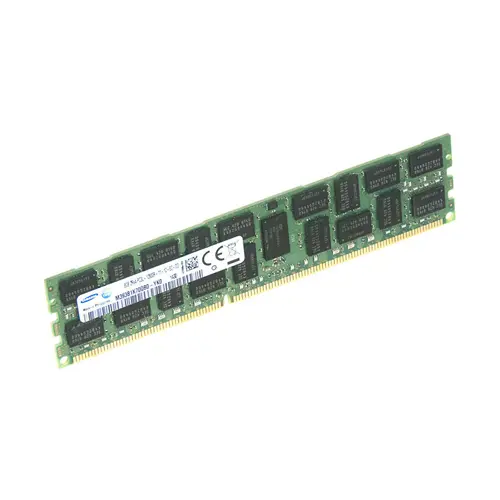
The Samsung M393B1K70QB0-YK0K9 is an 8GB DDR3-1600 RDIMM purpose-built for server workloads, and its four core attributes directly solve the pain points of enterprise data centers. First, the ECC engine constantly scans for and corrects single-bit errors, a non-negotiable safeguard when you run a dense virtualization cluster: a silent bit flip in a hypervisor can corrupt multiple tenant VMs or a live-migration stream, and ECC eliminates that risk. Second, the registered buffer restores clean command and address signals when all DIMM slots are populated, so you can scale to large memory pools without stability degradation—critical for consolidating dozens of virtual machines on one host. Third, the dual-rank x4 configuration delivers twofold protection for in-memory databases like Redis or financial caching tiers. Bank interleaving improves effective bandwidth, while the x4 device width strengthens error containment, making a single DRAM chip failure survivable so transactional integrity never suffers a costly halt. Finally, operation at 1.35V dramatically reduces power dissipation per module; across a fully loaded rack, this prevents thermal throttling, lowers cooling overhead, and extends component lifespan. For your mission-critical infrastructure, these features translate into fewer outages, higher VM density, and verifiable data integrity around the clock.
General Virtualization
For a hypervisor hosting multiple VMs, populate at least one DIMM per memory channel to maximize bandwidth. Using eight identical 8GB RDIMMs across dual-socket servers with four channels each delivers 64GB total and balanced NUMA access, which is a cost-effective start for mixed workloads.
In-Memory Database
Low latency and high reliability are critical. To leverage ECC and registered buffering, fill all channels with multiples of these 8GB RDIMMs; a 128GB configuration (16 modules) is typical for mid-size Redis or Memcached nodes. Keep voltage at 1.35V to reduce heat in dense deployments and maintain memory integrity under sustained load.
High Performance Computing (HPC)
HPC jobs benefit from maximum channel utilization and larger capacity for data staging. Deploy three DIMMs per channel (3DPC) with these dual-rank modules for 24GB per channel, reaching up to 192GB per two-socket node. The registered feature stabilizes heavily loaded ranks, while 1600MT/s keeps bandwidth high for parallel I/O without throttling.
Stringently tested and confirmed compatible with Dell R720, HP DL380p Gen8, Lenovo RD430, and more servers.
Q: Can I mix this M393B1K70QB0-YK0K9 with other memory modules of different brands or speeds?
A: Mixing this registered ECC module with non-identical DIMMs is not recommended. Disparate timings, ranks, or voltages may cause instability, performance loss, or unbootable configurations in mission-critical server environments.
Q: Is this memory compatible with my system?
A: This DDR3-1600 8GB RDIMM targets platforms like Intel Xeon E5-2600 v2 series. Verify your server board supports 1.35V registered ECC 240-pin DIMMs to ensure seamless integration and validated performance.
Q: What is the recommended DIMM population order for optimal performance?
A: Follow your server board’s manual; typically populate identical DIMMs in corresponding slots per memory channel (e.g., A1/B1 first). This ensures balanced interleaving and full ECC protection across dual-rank modules.
Q: Does this module support overclocking or XMP profiles?
A: No. This is a JEDEC-compliant registered server module without XMP. It operates strictly at standard timings (DDR3-1600 CL11) to guarantee data integrity and long-term reliability in 24/7 deployments.
Q: What warranty and typical failure rate can I expect?
A: This module includes a one-year warranty. Engineered to enterprise-grade standards, its annualized failure rate is extremely low under specified thermal and voltage conditions, ensuring stable operation.