











 Secure payments
Standard refund policy
Trade Assurance
Secure payments
Standard refund policy
Trade Assurance
| Model | M393B1K70QB0-YK0Q8 |
|---|---|
| Product Type | Memory Module |
| Compliance Standards | CE,WEEE,RoHS |
| Memory Capacity | 8 GB |
| Memory Technology | DDR3 |
| Product Voltage | 1.35V |
| RAM Speed | 1600MHz |
| RAM Standard | DDR3-1600/PC3-12800 |
| Error Identifying | ECC |
| Signal Type | Registered |
| Column Access Strobe (CAS) | CL11 |
| Rank | Dual Rank x4 |
| Quantity of Pins | 240-pin |
| RAM Genre | RDIMM |
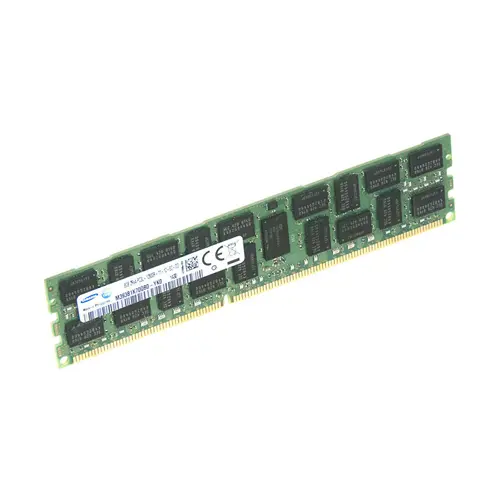
Designed for legacy server platforms, this Samsung M393B1K70QB0-YK0Q8 DDR3-1600 RDIMM with ECC and registered signal integrity is well-suited for memory-intensive virtualization and small-scale in-memory databases where data accuracy is critical. Its dual-rank x4 organization enhances bandwidth utilization and capacity per channel, while the 1.35V low-voltage operation reduces thermal load and power consumption in dense rack deployments.
1. ECC protection continuously detects and corrects single-bit errors in real time, safeguarding transactional integrity in database servers and preventing silent data corruption that could crash critical workloads.
2. Registered signal buffering takes load off the memory controller, enabling fully populated server boards with dozens of DIMMs to run stably at scale in dense virtualization clusters.
3. Dual Rank x4 organization interleaves access across internal banks, keeping the memory channel saturated and delivering consistent throughput for multiple virtual machines competing for shared resources.
4. Low-voltage operation at 1.35V trims power consumption and thermals across racks of always-on nodes, lowering data center cooling overhead without sacrificing the rated transfer speed.
5. The capacity entry point delivers a cost-optimized building block for memory-hungry hypervisors and in-memory caches, allowing infrastructure to scale out economically while maintaining ample headroom per socket.
Designed as a server memory module, the Samsung M393B1K70QB0-YK0Q8 is an 8GB DDR3-1600 RDIMM purpose-built to tackle the reliability and scalability demands of data center workloads. Its four defining features translate directly to real-world operational confidence.
The embedded Error Correcting Code (ECC) proactively detects and corrects single-bit memory errors—a silent threat that can corrupt financial transaction ledgers or crash a critical in-memory database. In a dense virtualization cluster, a flipped bit without ECC could cascade into VM instability or data loss; this module turns that risk into a self-healing event. The Registered (RDIMM) architecture places a buffer between the memory controller and the DRAM chips, stabilizing the electrical load. This means you can populate all 24 DIMM slots per server without signal degradation, allowing a single hypervisor to host dozens of VMs smoothly. Its low 1.35V operation reduces thermal output, cutting cooling costs and extending the lifespan of embedded components in always-on database appliances. Finally, the dual-rank x4 organization interleaves two arrays of memory banks, boosting sustained bandwidth under concurrent access. For an in-memory analytics platform like SAP HANA, this delivers the lower queuing delays necessary to process complex queries faster, directly shrinking batch window times and accelerating insight.
General Virtualization
For a typical hypervisor hosting multiple VMs, populate the server with at least eight of these 8GB DDR3-1600 RDIMMs across balanced memory channels to reach 64GB. The registered ECC design ensures host stability by correcting single-bit errors, which is essential when consolidating workloads. Distribute identical DIMMs symmetrically per CPU socket to maintain uniform memory access and avoid VM performance penalties.
In-Memory Database
Maximize capacity by filling all available DIMM slots with these dual-rank x4 modules, aiming for 128GB or more if the platform supports it. Registered DIMMs permit higher density per channel, reducing latency for large in-memory datasets like Redis or SAP HANA. Ensure all modules are identical Samsung M393B1K70QB0 units to guarantee stable operation under sustained 1.35V low‑voltage stress.
High-Performance Computing
Deploy the maximum supported quantity in a multi-channel configuration—often 12 or 24 DIMMs per node—to provide ample bandwidth for MPI jobs. The low CAS latency (CL11) and dual-rank design help sustain throughput on floating-point heavy simulations. Use homogeneous, validated RDIMM kits and leverage 1.35V operation to reduce cluster power draw without compromising error correction.
Rigorously tested, compatible with servers like Dell PowerEdge R720, HP ProLiant DL380p Gen8, Lenovo ThinkServer RD430.
Q: Can I mix this M393B1K70QB0-YK0Q8 with other memory modules of different brands or speeds?
A: Mixing this RDIMM with different brands or speeds is discouraged and may cause instability. We recommend using identical modules (same part number and rank) for full compatibility.
Q: Is this memory compatible with my system?
A: This module fits server boards supporting DDR3-1600 ECC Registered memory, such as Intel Xeon E5-2600 v1/v2 or AMD Opteron 6300 platforms. Always check your server’s qualified vendor list.
Q: What is the recommended DIMM population order for optimal performance?
A: For optimal performance, populate identical DIMMs in matched banks per your server manual. Typically, fill blue slots first to enable multi-channel mode and balance memory across channels.
Q: Does this module support overclocking or XMP profiles?
A: No, it's an enterprise-grade registered DIMM. It adheres to JEDEC standards with no XMP or overclocking support, prioritizing reliability over speed adjustments.
Q: What warranty and typical failure rate can I expect?
A: One-year warranty. Samsung modules like this typically have an AFR under 0.5%, offering excellent reliability for server environments under continuous operation.