











 Secure payments
Standard refund policy
Trade Assurance
Secure payments
Standard refund policy
Trade Assurance
| Model | M393B1G70EB0-YK0 |
|---|---|
| Product Type | Memory Module |
| Compliance Standards | EU RoHS,FCC |
| Memory Capacity | 8 GB |
| Memory Technology | DDR3 |
| Product Voltage | 1.35V |
| RAM Speed | 1600MHz |
| RAM Standard | DDR3-1600/PC3-12800 |
| Error Identifying | ECC |
| Signal Type | Registered |
| Column Access Strobe (CAS) | CL11 |
| Rank | Single Rank x4 |
| Quantity of Pins | 240-pin |
| RAM Genre | RDIMM |
This DDR3-1600 Registered ECC memory module, with its 1.35V low-voltage operation and single-rank x4 organization, is engineered for virtualization platforms and memory-intensive database servers where data integrity and power efficiency are critical. The registered signal type and ECC error correction ensure stable, reliable operation under sustained heavy loads in multi-DIMM server configurations.
1. Registered DIMM architecture buffers command and address signals to maintain signal integrity, allowing dense server memory populations that maximize virtual machine density without sacrificing uptime.
2. ECC error detection and correction eliminates single-bit memory faults in real time, preserving transactional accuracy for databases and financial systems where silent data corruption is unacceptable.
3. Low-voltage 1.35V operation cuts overall server power consumption and thermal load, directly reducing cooling expenses in large-scale data center environments.
4. DDR3-1600 speed grade supplies substantial per-channel bandwidth, keeping in-memory analytics and consolidated VMs responsive under peak concurrent access.
5. Single-rank design at x4 device width reduces electrical loading on the memory bus while enabling robust chipkill-level error recovery, strengthening data protection for mission-critical enterprise applications.
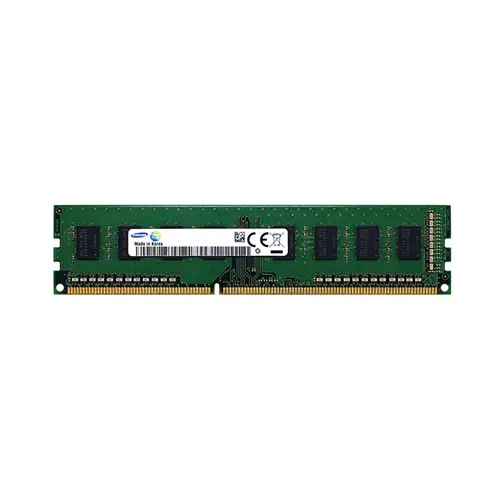
The Samsung M393B1G70EB0-YK0 is a server-class DDR3 Registered ECC RDIMM, and every aspect of its design speaks directly to the demands of mission-critical data centers. Its Error Correcting Code is not just a spec; in a dense virtualization cluster, a single undetected bit flip can corrupt a hypervisor state and cascade failures across dozens of virtual machines. ECC neutralizes this threat silently, protecting transactional integrity in memory databases like SAP HANA or Redis where every calculation must be perfect. The registered buffer is equally decisive: by isolating the memory controller from the electrical load of multiple modules, it lets you fully populate all channels with these 8 GB sticks. This translates into stable, high-capacity configurations essential for hosting heavy virtualized workloads without signal degradation or boot failures. Moreover, the 1.35 V low-voltage operation significantly reduces power draw and cooling expense in a rack full of servers, trimming operational costs around the clock. Finally, the single‑rank x4 organization at 1600 MHz with CL11 timing strikes a deliberate balance between bandwidth and signal cleanliness, keeping real‑time analytics and high‑concurrency queries responsive even under peak load. In short, this memory transforms a standard server into a resilient, efficient platform where uptime and data accuracy are non‑negotiable.
Memory Type Identified: Server Memory (DDR3 Registered ECC RDIMM)
General Virtualization
For a typical hypervisor host running 10–15 light to medium VMs, install a balanced configuration of eight identical 8 GB RDIMMs across all memory channels for 64 GB total. This populates all channels symmetrically, maximising interleaving and memory bandwidth while ECC safeguards VM stability. Avoid mixing ranks or capacities; uniform 8 GB single-rank DIMMs ensure predictable latency under memory overcommit scenarios.
In-Memory Database
An in-memory database like Redis or Memcached demands capacity first. Fully populate all available DIMM slots with these 8 GB RDIMMs to reach the platform’s maximum supported capacity — many dual-socket servers from the DDR3 era top out at 384 GB or 512 GB with 24 or 32 slots. Operating at the module’s 1.35 V low voltage reduces thermal load during sustained high-throughput reads, preserving DIMM longevity in a 24/7 caching layer.
High-Performance Computing (HPC)
HPC cluster nodes require peak bandwidth per core. Configure one 8 GB RDIMM per channel for the channel count of the processor (e.g., four DIMMs for a quad-channel Xeon E5) to balance capacity per core and memory bandwidth. The 1600 MT/s speed and CL11 latency are modest but stable; enabling rank interleaving by using identical single-rank RDIMMs in each channel yields deterministic compute-node performance for MPI workloads.
Validated server RAM, strictly tested, compatible with Dell PowerEdge R720, R620, HP DL380p Gen8, IBM x3650 M4.
Q: Can I mix this M393B1G70EB0-YK0 with other memory modules of different brands or speeds?
A: Mixing is not recommended for server environments. Different timings or ranks can cause instability and ECC errors. Uniform configurations validated by the platform OEM ensure reliable operation.
Q: Is this memory compatible with my system? Which Intel or AMD platforms are supported?
A: It is compatible with server platforms supporting DDR3-1600 ECC Registered DIMMs, such as Intel Xeon E5-2600 v2/v3 series or AMD Opteron 6300 series. Check your motherboard’s memory QVL for full compatibility.
Q: What is the recommended DIMM population order for optimal performance?
A: Follow your server board manual for balanced channel population. Typically, install identical RDIMMs in sets of matching ranks, starting with slot 1 per channel, to maximize interleaving and memory bandwidth.
Q: Does this module support overclocking or XMP profiles?
A: No. This is a JEDEC-compliant registered server memory module. It does not support XMP or overclocking; reliability at standard 1600MHz CL11 is prioritized over performance tuning.
Q: What warranty and typical failure rate can I expect?
A: This module comes with a one-year warranty. Server-grade DRAM typically exhibits very low AFR (0.1–0.3%), especially when operated within specified voltage and temperature limits.