











 Secure payments
Standard refund policy
Trade Assurance
Secure payments
Standard refund policy
Trade Assurance
| Model | M393B1G70QH0-CK0 |
|---|---|
| Product Type | Memory Module |
| Compliance Standards | EU RoHS,FCC |
| Memory Capacity | 8 GB |
| Memory Technology | DDR3 |
| Product Voltage | 1.5V |
| RAM Speed | 1600MHz |
| RAM Standard | DDR3-1600/PC3-12800 |
| Error Identifying | ECC |
| Signal Type | Registered |
| Column Access Strobe (CAS) | CL11 |
| Rank | Single Rank x4 |
| Quantity of Pins | 240-pin |
| RAM Genre | RDIMM |
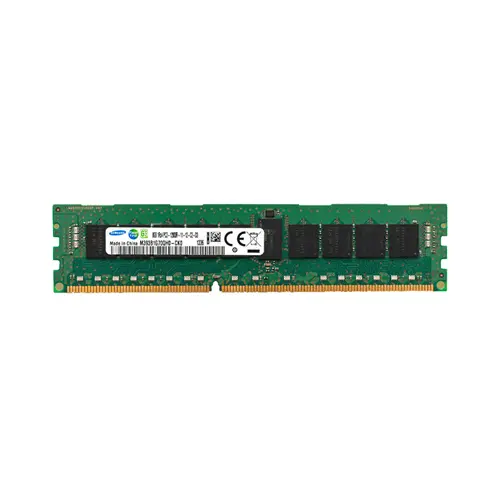
This Samsung 8GB DDR3-1600 Registered ECC RDIMM (Single Rank x4, CL11) is engineered for legacy server platforms where data integrity and uptime are critical, making it ideal for virtualization hosts, in-memory databases, and other enterprise workloads. Its registered signal type and ECC error correction ensure stable operation under heavy load and prevent silent data corruption, preserving transaction accuracy in mission-critical environments.
1. ECC memory detects and corrects single-bit errors automatically, preventing silent data corruption in financial databases and critical enterprise workloads running non-stop.
2. Registered buffering isolates the memory controller from excessive electrical loading, allowing fully populated server boards to scale virtualization density without sacrificing signal integrity.
3. Sixteen hundred megatransfers per second supplies sufficient throughput to handle concurrent requests across dozens of virtual machines, reducing I/O wait under consolidation pressure.
4. The industry-standard operating voltage ensures stable power distribution and predictable thermals in densely packed rack enclosures, contributing to long-term deployment reliability.
5. Single-rank organization with x4-wide DRAMs minimizes per-channel contention, delivering consistent access latency for latency-sensitive caching and in-memory computing tasks.
In server-class infrastructure, the M393B1G70QH0-CK0 RDIMM is engineered to solve the real pains of data center operators, and its four defining characteristics directly translate into reliability and performance where it counts most. Its ECC error correction silently intercepts and remedies single-bit memory faults before they can flip a financial calculation or corrupt a virtual machine state—critical when a single undetected error in an in-memory database like Redis could cascade into application failure or lost transactional integrity. The registered signal architecture buffers command and address lines, which means you can fully populate every DIMM slot across a multi-socket virtualization cluster without the signal distortion that causes random crashes under heavy consolidation. The module’s single-rank x4 organization strikes a deliberate balance: it delivers clean, predictable bandwidth for sequential access patterns, such as the sustained read/write streams of a heavily paged database, while keeping power and thermal load in check for dense 1U deployments. Running at a true DDR3-1600 speed, it sustains 12.8 GB/s per channel, giving your hypervisor the headroom to juggle concurrent workloads without I/O stalling. Together, these four pillars—error immunity, scalable signal integrity, workload-tuned rank topology, and consistent throughput—mean you can consolidate more tenants onto fewer servers and trust that your data stays precisely as you wrote it, clock cycle after clock cycle.
Based on the module specifications — DDR3-1600, ECC Registered, 8GB RDIMM — this is server-class memory designed for stability and data integrity in multi-socket platforms. Below are capacity planning guidelines for typical server workloads.
General Virtualization
Begin with a balanced memory-to-core ratio of 4–8 GB per vCPU. Populate six or twelve identical 8GB RDIMMs across memory channels to maximize interleaving and sustain predictable VM density. Configure in multiples of three or four DIMMs per CPU to maintain balanced NUMA access and allow future scaling without replacing existing modules.
In-Memory Database
Aim for a dataset-fit approach where the entire working set resides in RAM. Deploy the maximum supported DIMMs per server — often 24 modules in dual-socket systems — to reach 192GB or higher, using quad-rank interleaving when latency is critical. Populate all memory channels symmetrically with identical 8GB RDIMMs, ensuring the memory speed does not downshift under heavy load.
High-Performance Computing (HPC)
Optimize for memory bandwidth by fully populating every available channel with a single DIMM per channel (1DPC). For dual-socket nodes, install 16 to 24 modules (128–192GB) to supply large page tables and fast scratch space. Select the lowest CAS latency option and avoid mixing ranks within a channel to preserve consistent latency across parallel job execution.
Rigorously tested server DDR3 RDIMM — compatible with Dell PowerEdge R720, HP ProLiant DL380p Gen8, Lenovo ThinkServer RD430, and more.
Q: Can I mix this M393B1G70QH0-CK0 with other memory modules of different brands or speeds?
A: Mixing different brands or speeds is not recommended for registered server memory. Mismatched RDIMMs can cause system instability, degraded performance, or boot failures. Always use identical modules for guaranteed compatibility and reliability.
Q: Is this memory compatible with my system?
A: This DDR3 ECC registered RDIMM is designed for server platforms like Intel Xeon E5-2600 v1/v2 or AMD Opteron 6300 series. Verify your system supports 240-pin, 1.5V DDR3-1600 with ECC and registered signal type.
Q: What is the recommended DIMM population order for optimal performance?
A: Populate identical RDIMMs per channel starting with the slot farthest from the CPU, typically in matching white slots first. Follow your server motherboard’s population guide for balanced memory channels and maximum bandwidth.
Q: Does this module support overclocking or XMP profiles?
A: No. This is a server-grade ECC registered DIMM adhering to JEDEC DDR3-1600 standards. Overclocking and XMP profiles are not supported, as they compromise the data integrity and reliability required in server environments.
Q: What warranty and typical failure rate can I expect?
A: This module includes a one-year warranty. Typical annualized failure rate (AFR) for server memory is under 0.5%. Our modules undergo rigorous full-load testing to ensure ultra-low defect rates in demanding workloads.