











 Secure payments
Standard refund policy
Trade Assurance
Secure payments
Standard refund policy
Trade Assurance
| Model | M393B1G70QH0-YK0Q8 |
|---|---|
| Product Type | Memory Module |
| Compliance Standards | EU RoHS,FCC |
| Memory Capacity | 8 GB |
| Memory Technology | DDR3 |
| Product Voltage | 1.35V |
| RAM Speed | 1600MHz |
| RAM Standard | DDR3-1600/PC3-12800 |
| Error Identifying | ECC |
| Signal Type | Registered |
| Column Access Strobe (CAS) | CL11 |
| Rank | Single Rank x4 |
| Quantity of Pins | 240-pin |
| RAM Genre | RDIMM |
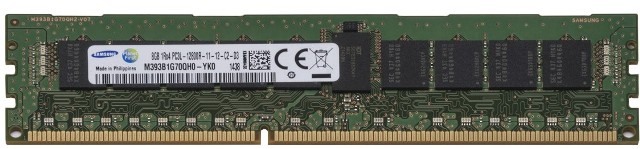
The M393B1G70QH0-YK0Q8 is an 8 GB DDR3-1600 registered ECC RDIMM designed specifically for server platforms, making it ideal for virtualization, in-memory databases, and mission-critical workloads that demand end-to-end data integrity. Its single-rank x4 configuration paired with a CL11 latency and 1.35 V low-voltage operation delivers stable, power-efficient signaling and reliable error correction under sustained heavy loads.
1. ECC error correction silently detects and fixes single-bit memory faults, preserving data integrity during uninterrupted server operation and preventing costly silent data corruption.
2. Registered signaling buffers command and address lines, enabling stable operation with high-capacity memory configurations essential for hosting numerous virtual machines.
3. 1.35V low-voltage operation lowers energy consumption and thermal output across server racks, directly reducing data center cooling overhead while sustaining reliable uptime.
4. 1600MHz clock speed supplies 12.8 GB/s of peak bandwidth per channel, keeping data flowing smoothly to CPUs under sustained multi-tenant workloads.
5. Single Rank x4 organization employs narrow DRAM devices to heighten per-chip fault isolation, reinforcing advanced RAS capabilities like Chipkill for mission-critical enterprise applications.
The M393B1G70QH0-YK0Q8 is a server-grade DDR3L RDIMM engineered for environments where data integrity and nonstop operation are non-negotiable. Its four defining characteristics directly resolve critical pain points in enterprise data centers. First, ECC error correction eliminates silent data corruption, protecting in-memory databases like SAP HANA from bit flips that could poison transactional records or crash a live instance. Second, the Registered buffer stabilizes command and address signals across fully loaded memory channels; in dense virtualization clusters running dozens of VMs per host, this prevents signal degradation and random server hangs as you scale memory capacity. Third, operation at just 1.35V drastically cuts power draw and cooling overhead, which directly shrinks total cost of ownership when hundreds of modules are deployed across racks. Finally, the single-rank x4 organization paired with DDR3-1600 delivers predictable, low-latency bandwidth. In virtualized environments where simultaneous small-block requests from multiple VMs can cause bus contention, this consistent access pattern preserves application responsiveness under mixed workloads, keeping your services fast and your data safe.
General Virtualization
For a typical hypervisor hosting multiple VMs, populate at least six to eight identical 8 GB RDIMMs across three or four memory channels per socket. This balanced configuration maximizes bandwidth while leaving headroom for moderate overcommitment, aiming for 48–64 GB per host to comfortably run a dozen mixed-workload guests.
In-Memory Database
In-Memory databases demand both capacity and low latency, so install a full set of 8 GB modules across all available channels—often 12 or 16 DIMMs per dual-socket server. This builds a 96–128 GB pool that keeps entire datasets in RAM, and the registered ECC buffers maintain signal integrity under heavy sustained load.
High-Performance Computing
HPC workloads benefit from uniform channel population to saturate memory bandwidth. Use one 8 GB RDIMM per channel (e.g., eight modules per CPU) to match the core count and achieve peak throughput without wasting cycles on rank interleaving mismatches. Single-rank x4 modules like the M393B1G70QH0 strike a good balance between capacity and raw transfer speed for parallel simulations.
Stringently validated server RAM, compatible with Dell PowerEdge R720/R620, HP DL380p Gen8, and IBM x3650 M4.
Q: Can I mix this M393B1G70QH0-YK0Q8 with other memory modules of different brands or speeds?
A: Mixing is not recommended for server RDIMMs. Even identical specs from different vendors may cause signal integrity issues. To ensure ECC and stability, always populate with identical Samsung modules.
Q: Is this memory compatible with my system?
A: This DDR3-1600 Registered ECC module works with servers using Intel Xeon E5-2600 v1/v2 or AMD Opteron 6300 series platforms. Please verify your board's qualified vendor list for full support.
Q: What is the recommended DIMM population order for optimal performance?
A: For dual-processor servers, balance channels per CPU. Typically populate blue slots first, starting farthest from the CPU. Always consult your server's manual for specific channel interleaving rules.
Q: Does this module support overclocking or XMP profiles?
A: No. This is an enterprise-grade Registered ECC module, operating strictly at JEDEC standard DDR3-1600 CL11. It does not support XMP or overclocking, prioritizing data integrity over speed.
Q: What warranty and typical failure rate can I expect?
A: It carries a 1-year warranty. As a Samsung enterprise RDIMM, the annualized failure rate is extremely low under normal server conditions, typically below 0.5%, ensuring high reliability.