











 Secure payments
Standard refund policy
Trade Assurance
Secure payments
Standard refund policy
Trade Assurance
| Product Type | Memory Module |
|---|---|
| Memory Capacity | 8 GB |
| Memory Technology | DDR3 |
| Product Voltage | 1.35V |
| RAM Speed | 1600MHz |
| RAM Standard | DDR3-1600/PC3-12800 |
| Error Identifying | ECC |
| Signal Type | Registered |
| Column Access Strobe (CAS) | CL11 |
| Rank | Single Rank x4 |
| Quantity of Pins | 240-pin |
| RAM Genre | RDIMM |
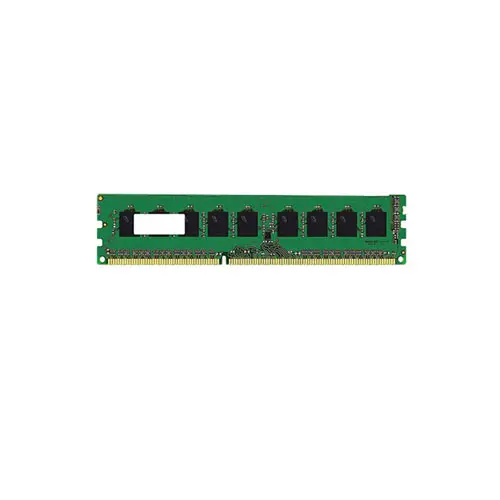
Designed for server platforms, this 8GB DDR3L-1600 RDIMM leverages ECC and registered signal technology to guarantee end-to-end data integrity and signal stability, making it ideal for virtualization and memory-intensive enterprise workloads. The single-rank x4 configuration with 1.35V low-voltage operation reduces power consumption and thermal stress in dense rack deployments, while the 240-pin DIMM form factor ensures broad compatibility with legacy and current-generation DDR3 server boards.
1. ECC protection silently corrects single-bit errors, preserving data integrity in long-running enterprise databases and transactional workloads where even a silent corruption is unacceptable.
2. Registered signal buffering stabilizes command and address lines, enabling servers to populate all DIMM slots without signal degradation and scale memory capacity for dense virtualization hosts.
3. The 1.35V low-voltage design lowers per-DIMM power draw, which compounds into significant energy savings and reduced cooling overhead in multi-node rack deployments.
4. 1600MHz operation provides 12.8GB/s peak bandwidth per channel, keeping latency-sensitive analytics and in-memory caches fed under sustained load.
5. Single Rank x4 organization uses x4-wide DRAM devices that strengthen advanced server RAS features like chipkill, allowing the system to survive a full DRAM chip failure and maintain uptime.
Designed for server environments, the Samsung M393B1G70QH9-YK0 RDIMM directly addresses the toughest challenges in data center operations. Its ECC technology is not just a spec—it actively detects and corrects single-bit memory errors, which means your virtualization cluster avoids silent data corruption that could crash multiple guest systems overnight. Coupled with the registered buffer, this module stabilizes signal integrity when populating all 24 DIMM slots per server, enabling you to confidently scale up to 768 GB of RAM for a dense VMware farm without unexpected reboots.
The 1.35V low-voltage operation significantly cuts power consumption across a full rack, reducing both electricity costs and thermal stress in colocation facilities. Meanwhile, DDR3-1600 speed with Single Rank x4 organization delivers the balanced bandwidth essential for in-memory databases like Redis or SAP HANA: consistent CL11 latency ensures predictable response times under heavy concurrent queries, preventing transaction bottlenecks during peak trading hours. Every design choice here translates directly into uptime, efficiency, and workload performance you can build a business on.
General Virtualization
For a dual-socket server using this 8GB DDR3L-1600 RDIMM, populate at least one DIMM per memory channel to balance capacity and bandwidth. A common configuration is six identical modules (48GB total) across three channels per CPU, leaving room for scaling. The ECC and registered design ensures stability for multiple VMs, while the low 1.35V operation reduces thermal load in dense deployments.
In-Memory Database
Maximize total capacity by completely filling all available DIMM slots with these 8GB modules—for instance, 16 or 24 modules yielding 128GB to 192GB. The registered ECC memory protects against soft errors during intense data processing. Single-rank x4 organization helps maintain lower latency under heavy random access, which is critical for Redis or Memcached workloads running entirely in RAM.
High-Performance Computing
Configure a balanced population per socket to fully utilize the memory controller’s aggregate bandwidth. For example, install 8 modules (64GB) in a quad-channel arrangement, placing an identical DIMM in each channel. The DDR3-1600 speed and single‑rank design deliver predictable access times for MPI jobs. Sticking to the low‑voltage RDIMM also improves power efficiency across compute nodes during sustained parallel runs.
Rigorously tested server RDIMM, compatible with Dell PowerEdge R720, HP ProLiant DL380p Gen8, Lenovo ThinkServer RD430.
Q: Can I mix this M393B1G70QH9-YK0 with other memory modules of different brands or speeds?
A: Mixing is not recommended. Registered ECC modules require identical specifications for stable operation. Combining different brands, speeds, or ranks may cause POST failures or memory errors in server environments.
Q: Is this memory compatible with my system?
A: This DDR3-1600 ECC RDIMM is designed for Intel Xeon E5/E5-v2 and select AMD Opteron platforms. Verify your server board supports 1.35V low-voltage, 240-pin registered DIMMs with Single Rank x4 organization and CL11 timing.
Q: What is the recommended DIMM population order for optimal performance?
A: Follow your server board's memory configuration guide. Typically, populate identical DIMMs per memory channel in the white or blue slots first, balancing between CPU sockets to maximize interleaving and throughput.
Q: Does this module support overclocking or XMP profiles?
A: No. This server-grade RDIMM adheres to JEDEC DDR3-1600 specifications for 24/7 operational stability. Overclocking and XMP are disabled, as data integrity under ECC takes precedence over performance margins.
Q: What warranty and typical failure rate can I expect?
A: This Samsung module is backed by a one-year warranty. Enterprise memory undergoes rigorous testing and demonstrates an extremely low annualized failure rate under recommended thermal and voltage conditions.