











 Secure payments
Standard refund policy
Trade Assurance
Secure payments
Standard refund policy
Trade Assurance
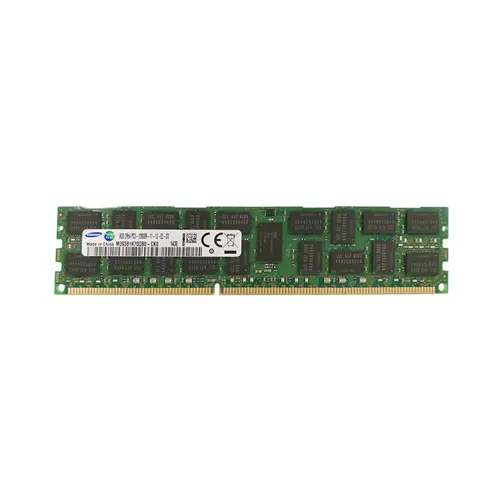
| Model | M393B1K70QB0-CK0 |
|---|---|
| Product Type | Memory Module |
| Compliance Standards | EU RoHS,FCC |
| Memory Capacity | 8 GB |
| Memory Technology | DDR3 |
| Product Voltage | 1.5V |
| RAM Speed | 1600MHz |
| RAM Standard | DDR3-1600/PC3-12800 |
| Error Identifying | ECC |
| Signal Type | Registered |
| Column Access Strobe (CAS) | CL11 |
| Rank | Dual Rank x4 |
| Quantity of Pins | 240-pin |
| RAM Genre | RDIMM |
This DDR3-1600 registered ECC RDIMM (M393B1K70QB0-CK0) is purpose-built for legacy server platforms running virtualization, in-memory databases, and mission-critical workloads that demand uncompromising data integrity. Its dual-rank x4 organization maximizes memory bandwidth utilization in multi-DIMM configurations, while the registered signal type stabilizes command and address signals under heavy channel loads to maintain reliable operation across dense memory populations.
1. Hardware error correction safeguards transactional integrity, preventing silent data corruption in virtualized databases and ensuring consistent uptime for enterprise workloads.
2. Registered buffering stabilizes command and address signals across multiple ranks, allowing dense memory configurations that maximize virtualization density and in-memory computing capacity.
3. Dual Rank organization increases bank-level parallelism, keeping data pipelines saturated under heavy multi-threaded access and improving effective bandwidth for analytics platforms.
4. The memory’s speed grade delivers responsive throughput per channel, reducing fetch latency during simultaneous VM operations without pushing power envelopes beyond typical data-center profiles.
5. This capacity point provides a versatile building block for moderate consolidation ratios, populating server channels with an optimal balance of footprint and cost per gigabyte.
The Samsung M393B1K70QB0-CK0 is an 8GB DDR3-1600 Registered DIMM purpose-built for server environments that demand absolute data reliability and non-stop operation. Its ECC engine actively corrects single-bit errors in real time, directly preventing silent data corruption that could destabilize an entire virtualized cluster or corrupt financial transaction records. The Registered buffer maintains clean command and address signaling, allowing a 2U server to fully populate all 24 DIMM slots without signal degradation—a decisive advantage when scaling an in-memory database like Redis to hundreds of gigabytes. The dual-rank x4 organization interleaves memory accesses across two internal ranks, translating to faster effective bandwidth and lower latency for multi-threaded processing; this means complex OLAP queries return results noticeably sooner under heavy concurrency. With a 1.5V operating voltage, CAS 11 latency, and 1600MHz speed, the module delivers predictable throughput that keeps your database cluster within SLA targets during peak loads. For an IT architect, this memory is not a generic component but the critical foundation of resilient, high-throughput infrastructure that protects business continuity around the clock.
General Virtualization
Balance capacity and speed by installing two DIMMs per channel (2DPC) in dual-socket servers. With this 8GB RDIMM, a typical dual-CPU platform populating eight channels with sixteen modules delivers 128 GB at the full 1600 MHz frequency. Avoid three DIMMs per channel unless you require extreme overcommit, as the system may throttle to 1333 MHz.
In-Memory Database
Maximize total memory to keep entire datasets resident in RAM. Fill all available slots with these 8GB modules, even if 3DPC forces a minor speed reduction to 1066 MHz or 1333 MHz. A fully populated 24-slot server yields 192 GB, ensuring the low-latency access that in-memory databases and caching layers demand.
High-Performance Computing (HPC)
Prioritize bandwidth and latency above raw capacity. Use a single 8GB RDIMM per channel (1DPC) to sustain the maximum 1600 MHz speed and minimal CAS latency. For a dual-socket compute node with four channels per CPU, eight modules provide 64 GB of high-throughput memory ideal for memory-sensitive simulations and parallel processing.
Rigorously tested server memory, compatible with Dell R720, HP DL380p Gen8, Lenovo x3650 M4.
Q: Can I mix this M393B1K70QB0-CK0 with other memory modules of different brands or speeds?
A: Mixing is not recommended for server environments. Different brands, speeds, or ranks can cause instability. For reliable ECC operation, use identical modules with the same part number across all channels.
Q: Is this memory compatible with my system?
A: This is a DDR3 Registered ECC RDIMM. It requires a server platform supporting Intel Xeon E5-2600 v1/v2 series or equivalent AMD Opteron processors with C600-series chipsets. Verify your board supports 1.5V 8GB dual-rank x4 modules.
Q: What is the recommended DIMM population order for optimal performance?
A: Populate identical DIMMs per channel, starting with slots farthest from the CPU. For dual-socket servers, balance memory equally across both processors and populate all channels symmetrically to enable interleaving.
Q: Does this module support overclocking or XMP profiles?
A: No. As a server-grade Registered ECC DIMM, it strictly adheres to JEDEC DDR3-1600 standards at fixed timings. Overclocking and XMP are unsupported because reliability and data integrity are paramount.
Q: What warranty and typical failure rate can I expect?
A: This module carries a one-year warranty. Enterprise DDR3 RDIMMs typically exhibit a very low annualized failure rate (AFR) under 0.5%, provided they operate within specified thermal and voltage limits.