











 Secure payments
Standard refund policy
Trade Assurance
Secure payments
Standard refund policy
Trade Assurance
| Model | M939B1G73QH0-YK0 |
|---|---|
| Product Type | Memory Module |
| Compliance Standards | EU RoHS,FCC |
| Memory Capacity | 8 GB |
| Product Voltage | 1.35V |
| RAM Standard | DDR3-1600/PC3-12800 |
| Error Identifying | ECC |
| Signal Type | Registered |
| Column Access Strobe (CAS) | CL11 |
| Quantity of Pins | 240-pin |
| RAM Genre | DIMM |
This DDR3L-1600 registered ECC DIMM is engineered for server platforms handling memory-intensive workloads such as virtualization, in-memory databases, and mission-critical applications where data integrity is paramount. Its registered signal architecture ensures stable multi-rank configurations under heavy load, while ECC and a low 1.35V operating voltage deliver robust error correction and improved energy efficiency in 24/7 data center environments.
1. 8 GB capacity per module enables dense memory configurations in a 2U server, allowing more virtual machines to reside on fewer physical hosts without exhausting DIMM slots.
2. DDR3-1600 data rate sustains 12.8 GB/s of peak bandwidth per channel, keeping latency-sensitive enterprise workloads like OLTP databases and real-time analytics fluid under load.
3. Registered buffering isolates the memory controller from excessive electrical loading, guaranteeing stable signal integrity when all channels are populated for maximum virtualization density.
4. ECC error correction transparently detects and repairs single-bit faults, preventing silent data corruption in financial transactions and long-running scientific computations.
5. 1.35 V low-voltage operation significantly reduces power draw and cooling demands across server clusters, lowering total cost of ownership while maintaining full 1600 MT/s throughput.
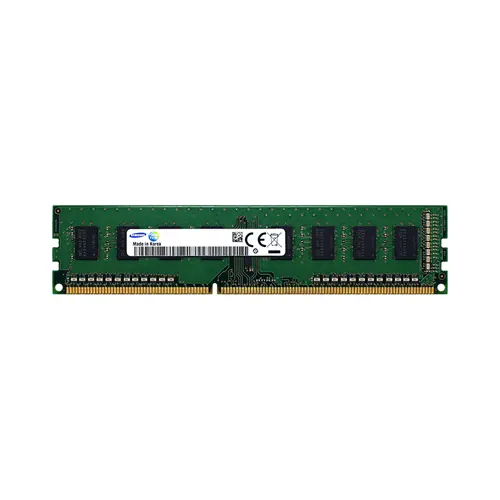
The M939B1G73QH0-YK0 is an 8GB DDR3-1600 registered DIMM with ECC, purpose-built for servers where undetected errors cascade into real financial loss. Operating at 1.35V, it draws less power per module, directly reducing the thermal load in a densely packed 1U rack — a difference you feel in lower cooling costs and prolonged hardware lifespan. The registered architecture buffers command and address signals, stabilizing signal integrity when every slot on a virtualization host is populated. For a Hyper-V or VMware cluster hosting a dozen VMs, this means you can scale memory capacity without the intermittent crashes that plague unbuffered modules under heavy load. The ECC engine goes further, correcting single-bit upsets. In an in-memory database like Redis, a flipped bit in a cached financial transaction or session table can corrupt data silently; ECC detects and fixes these cosmic-ray-induced errors before they poison a query result. That translates directly to trustworthy uptime and data consistency under continuous 24/7 operation.
General Virtualization
For hypervisor hosts running multiple VMs, density and reliability are critical. Populate all memory channels symmetrically with these 8 GB Registered ECC DIMMs to maximize interleaving. A common starting point is six modules (48 GB total) per dual-socket server, providing balanced capacity for moderate consolidation ratios while leveraging ECC for data integrity.
In-Memory Database
In-memory databases demand both capacity and fault tolerance. Deploy a fully populated configuration—often 12 to 16 modules (96–128 GB) per node—to hold entire datasets in RAM and sustain heavy write traffic. Registered DIMMs enable such high-density setups, and the 1.35 V operation reduces thermal load in densely packed chassis.
High-Performance Computing (HPC)
HPC clusters require maximum memory bandwidth per core. Use one DIMM per channel initially, scaling to two or three modules per channel to balance latency and capacity for large simulation workloads. With dual-socket systems, combine 8 or 16 of these 8 GB RDIMMs to achieve 64 or 128 GB per node, ensuring consistent CL11 timing across identical part numbers for stability under sustained floating-point operations.
Stringently tested server memory, compatible with Dell R620/R720, HP DL380p Gen8, and similar systems.
Q: Can I mix this M939B1G73QH0-YK0 with other memory modules of different brands or speeds?
A: Mixing is strongly discouraged for server environments. Different brands, speeds, or timings often cause instability, signal integrity issues, and may lead to unbootable systems. Use identical modules for guaranteed reliability.
Q: Is this memory compatible with my system?
A: This module is designed for servers supporting DDR3 Registered ECC memory. It is compatible with Intel Xeon E5-1600/2600 v1/v2 and AMD Opteron 6300 series platforms. Please verify your motherboard supports 240-pin Registered DIMMs.
Q: What is the recommended DIMM population order for optimal performance?
A: Refer to your server motherboard manual. Typically, populate identical modules per channel starting with the slots farthest from the CPU. Following the recommended order ensures proper multi-channel interleaving and maximized memory bandwidth.
Q: Does this module support overclocking or XMP profiles?
A: No. This is a server-grade Registered ECC DIMM operating strictly at JEDEC-defined DDR3-1600 CL11. Overclocking and XMP profiles are not supported to ensure maximum data integrity and 24/7 operational stability.
Q: What warranty and typical failure rate can I expect?
A: This module is backed by a one-year warranty. It is built with rigorous testing standards; typical annualized failure rates are below 0.5%, with mean time between failures exceeding 1 million hours under normal operating conditions.