











 Secure payments
Standard refund policy
Trade Assurance
Secure payments
Standard refund policy
Trade Assurance
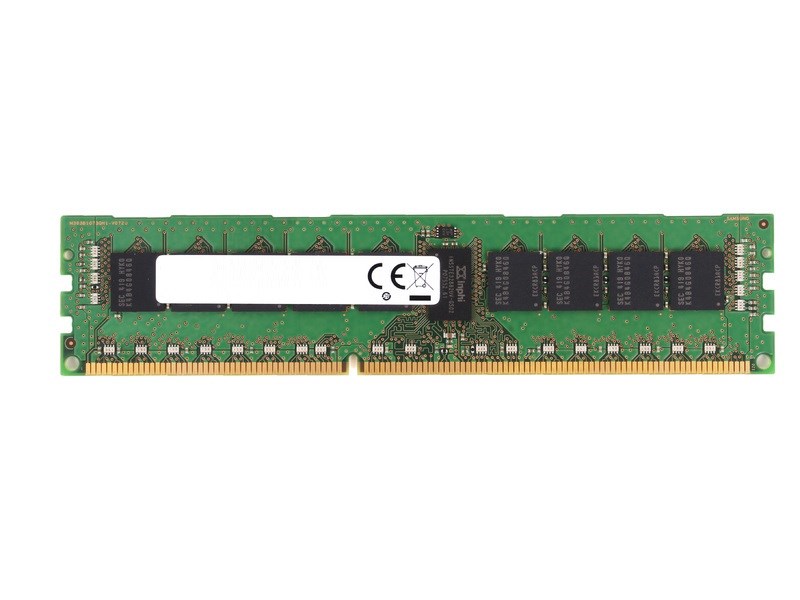
| Model | M393B1G73QH0-YK008 |
|---|---|
| Product Type | Memory Module |
| Compliance Standards | EU RoHS,FCC |
| Memory Capacity | 8 GB |
| Memory Technology | DDR3 |
| Product Voltage | 1.35V |
| RAM Speed | 1600MHz |
| RAM Standard | DDR3-1600/PC3-12800 |
| Error Identifying | ECC |
| Signal Type | Registered |
| Column Access Strobe (CAS) | CL11 |
| Rank | Dual Rank x8 |
| Quantity of Pins | 240-pin |
| RAM Genre | RDIMM |
The M393B1G73QH0-YK008 is a server-class DDR3L registered ECC memory module engineered for virtualization, in-memory databases, and other mission‑critical workloads where data integrity and signal stability are paramount. Its dual‑rank x8 configuration at 1600 MHz with CL11 latencies balances capacity and throughput, while the 1.35 V low‑voltage operation minimizes thermal stress to support dense, always‑on rack deployments.
1. Error-correcting code continuously detects and repairs bit flips, safeguarding transactional integrity for databases and preventing costly downtime in virtualized server farms.
2. The registered buffer stabilizes signal integrity when populating numerous DIMMs per channel, empowering dense server configurations to support sprawling in-memory workloads without compromise.
3. Low-voltage operation curtails energy draw and thermal output per DIMM, meaning a fully loaded rack cuts cooling overhead and extends power supply longevity in always-on data centers.
4. Dual-rank interleaving keeps the memory bus efficiently utilized by overlapping accesses across internal banks, which boosts throughput for multiple concurrent virtual machines under heavy consolidation.
5. High clock frequency provides the necessary bandwidth headroom for real-time caching layers and high-frequency trading systems where every nanosecond of retrieval latency translates directly to business impact.
In server environments where data integrity and uninterrupted operation are non-negotiable, the M393B1G73QH0-YK008 RDIMM delivers critical reliability through four essential design features. Its ECC technology actively detects and corrects single-bit memory errors—a silent yet real threat in dense virtualization clusters, where a flipped bit in a hypervisor’s memory space can crash dozens of virtual machines. Combined with registered signal buffering, this module stabilizes the command and address buses, enabling a server to scale to full capacity without the electrical loading problems that plague unbuffered memory; for an in-memory database like Redis or Memcached, that translates directly to consistent sub-millisecond response times under heavy concurrent access. The dual-rank x8 organization further maximizes bandwidth utilization by interleaving access across ranks, effectively reducing idle cycles and boosting throughput during large-scale online transaction processing. At the same time, the module’s 1.35V low-operating voltage cuts overall thermal load in a densely packed rack, lowering cooling costs and extending component life without sacrificing the 1600MHz speed—a balance that matters deeply when every watt in a data center impacts the bottom line.
General Virtualization
For general virtualization hosts, populate at least six to eight identical M393B1G73QH0-YK008 modules across memory channels to balance capacity and bandwidth. A common configuration is 8 × 8 GB (64 GB total) per socket, using one RDIMM per channel to maintain reliable 1600 MT/s speed and leave room for future expansion. This setup comfortably supports dozens of lightweight virtual machines while keeping power draw low with 1.35 V operation.
In-Memory Database
In-memory databases demand both large capacity and data integrity, making ECC registered memory essential. Install the maximum number of supported modules per channel, typically three RDIMMs per channel on dual-socket servers, to reach 192 GB or higher while accepting a slight speed reduction. The dual-rank x8 design of this DIMM helps maintain acceptable latency under heavy transactional loads.
High-Performance Computing (HPC)
HPC workloads benefit from fully populating all memory channels with one RDIMM per channel to maximize bandwidth without dropping to lower clock speeds. A homogeneous set of 8 modules per CPU socket delivers a balanced 128 GB capacity and consistent cache-line transfers for simulation or modeling codes. The low-voltage 1.35 V specification also reduces thermal load, which is critical in dense compute clusters.
Rigorously tested server DDR3L RDIMM: compatible with Dell R720, R620, HPE DL380p Gen8, Lenovo x3650 M4.
Q: Can I mix this M393B1G73QH0-YK008 with other memory modules of different brands or speeds?
A: Mixing is not recommended. For server DDR3 Registered ECC RDIMMs, mismatched brands, speeds, or ranks often cause signal integrity issues and system instability. Use identical modules.
Q: Is this memory compatible with my server system?
A: It is compatible with platforms supporting DDR3-1600 Registered ECC RDIMMs, such as Intel Xeon E5-2600 v1/v2 or AMD Opteron 6300 series. Please consult your server board’s QVL.
Q: What is the recommended DIMM population order for optimal performance?
A: Follow your server motherboard manual. Typically, populate identical DIMMs per channel starting with the farthest slot from the CPU. Balance memory across processors in dual-socket systems to maximize bandwidth.
Q: Does this module support overclocking or XMP profiles?
A: No. This is a JEDEC-compliant server RDIMM. It only operates at standard DDR3-1600 (PC3-12800) with CL11 timings and does not support overclocking or XMP profiles.
Q: What warranty and typical failure rate can I expect?
A: This module includes a 1-year warranty. Enterprise-grade DDR3 RDIMMs have a very low annualized failure rate (AFR), typically below 0.5% under normal operating conditions.