











 Secure payments
Standard refund policy
Trade Assurance
Secure payments
Standard refund policy
Trade Assurance
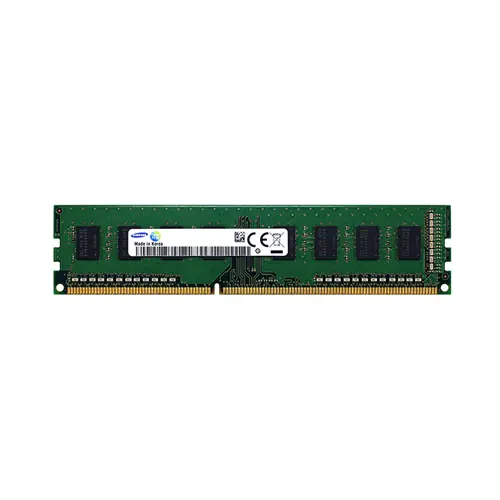
| Model | M392B1K70CM0-YK0 |
|---|---|
| Product Type | Memory Module |
| Compliance Standards | EU RoHS,FCC |
| Memory Capacity | 8 GB |
| Memory Technology | DDR3 |
| Product Voltage | 1.35V |
| RAM Speed | 1600MHz |
| RAM Standard | DDR3-1600/PC3-12800 |
| Error Identifying | ECC |
| Signal Type | Registered |
| Column Access Strobe (CAS) | CL11 |
| Rank | Dual Rank x4 |
| Quantity of Pins | 240-pin |
| RAM Genre | VLP RDIMM |
This 8GB VLP RDIMM is engineered specifically for dense server deployments such as 1U virtualization hosts and in-memory database nodes where physical height clearance is critical. Its dual-rank x4 organization running at 1.35V low-voltage DDR3-1600 with registered ECC ensures superior signal integrity and data reliability under sustained heavy workloads while reducing power consumption.
1. ECC protection silently corrects single-bit memory errors, safeguarding transactional integrity in databases and preventing silent data corruption in long-running server workloads.
2. Registered signal buffering stabilizes high-capacity memory configurations, enabling dense server deployments without compromising signal integrity across numerous DIMMs per channel.
3. Dual-rank x4 organization leverages rank interleaving to boost effective bandwidth, reducing latency under heavily consolidated virtualized environments.
4. Very low profile design maximizes airflow and enables installation in space-constrained server chassis, crucial for high-density rack and blade deployments.
5. Operational at a reduced voltage level, the module cuts power draw and thermal load, directly lowering data center energy costs and improving cooling efficiency.
Engineered specifically for server environments, the M392B1K70CM0-YK0 is an 8GB DDR3-1600 VLP Registered DIMM that brings four critical capabilities to your data center. Its Error Correcting Code (ECC) actively detects and corrects single-bit memory errors caused by background radiation or cosmic rays, which directly prevents silent data corruption in always-on applications like in-memory databases—imagine a financial trading platform where one flipped bit could equate to a substantial monetary discrepancy. The Registered on-chip buffer stabilizes the electrical load when you populate all memory channels in a dense virtualization cluster, allowing you to confidently run dozens of virtual machines on a single node without intermittent crashes from signal degradation. Operating at just 1.35V instead of the standard 1.5V, the module reduces both your power bill and cooling demands across a row of racks; in a 24/7 co-location facility, that cumulative saving significantly lowers operational expenditure. Finally, the Very Low Profile form factor resolves physical clearance issues inside 1U and blade servers, ensuring your airflow remains unobstructed and hot-swap maintenance is straightforward, which means higher rack density and less downtime during hardware refreshes.
General Virtualization
Deploy this 8 GB VLP RDIMM in a multi-module configuration to maximize memory density per server node. For typical hypervisor workloads, populate six to eight modules per CPU socket to achieve 48–64 GB, ensuring enough headroom for dozens of light to medium VMs. Follow a balanced population across memory channels to sustain 1600 MT/s while registered ECC preserves data integrity in multi-tenant environments.
In-Memory Database
In-memory engines demand both capacity and low latency, so install at least 12 identical RDIMMs for 96 GB, filling all channels in a 2-socket server. Dual-rank x4 organization improves bank-level parallelism, reducing transaction latency for key-value stores and caching layers. Spare a module per memory riser to implement hot-spare ranking when the firmware supports SDDC, guarding against uncorrected errors.
High Performance Computing
HPC nodes routinely saturate memory bandwidth, making a fully populated 16-module, 128 GB arrangement ideal for per-node scaling. The 1.35 V low-voltage operation curbs thermal output in dense racks, allowing sustained turbo frequencies. Configure interleaved NUMA domains and disable node interleaving only when the scheduler explicitly pins MPI ranks to local DIMMs for latency-sensitive iterative solvers.
Strictly tested server memory, compatible with Dell PowerEdge R720, HP ProLiant DL380p Gen8, and more.
Q: Can I mix this M392B1K70CM0-YK0 with other memory modules of different brands or speeds?
A: Mixing is not recommended. ECC Registered DIMMs require identical ranks, speed, and timings for stable operation. Using mismatched modules may cause POST failures or memory errors in server environments.
Q: Is this memory compatible with my server? Does it support Intel or AMD platforms?
A: This DDR3-1600 VLP RDIMM is compatible with dual-socket Intel Xeon E5-2400/2600 v1/v2 and AMD Opteron 6300/4300 series platforms that require 1.35V ECC Registered memory. Verify slot clearance for VLP height.
Q: What is the recommended DIMM population order for optimal performance with this module?
A: Populate identical DIMMs in sets of four, starting from the farthest slots per channel. For dual-rank x4 RDIMMs, fill one DIMM per channel first, then balance across memory controllers to maintain lockstep mode and maximize bandwidth.
Q: Does this module support overclocking or XMP profiles?
A: No, server-grade ECC Registered memory does not support overclocking or XMP. It strictly adheres to JEDEC DDR3-1600 (PC3-12800) specifications at CL11 for 24/7 data integrity and stability.
Q: What warranty and typical failure rate can I expect for this M392B1K70CM0-YK0 memory?
A: This module includes a 1-year warranty. Typical annualized failure rate (AFR) for Samsung server DIMMs is below 0.5%, combining rigorous component screening and signal integrity testing.