











 Secure payments
Standard refund policy
Trade Assurance
Secure payments
Standard refund policy
Trade Assurance
| Model | M393B1G70EB0-YK0Q2 |
|---|---|
| Product Type | Memory Module |
| Compliance Standards | RoHS,WEEE |
| Memory Capacity | 8 GB |
| Memory Technology | DDR3 |
| Product Voltage | 1.35V |
| RAM Speed | 1600MHz |
| RAM Standard | DDR3-1600/PC3-12800 |
| Error Identifying | ECC |
| Signal Type | Registered |
| Column Access Strobe (CAS) | CL11 |
| Rank | Single Rank x4 |
| Quantity of Pins | 240-pin |
| RAM Genre | RDIMM |
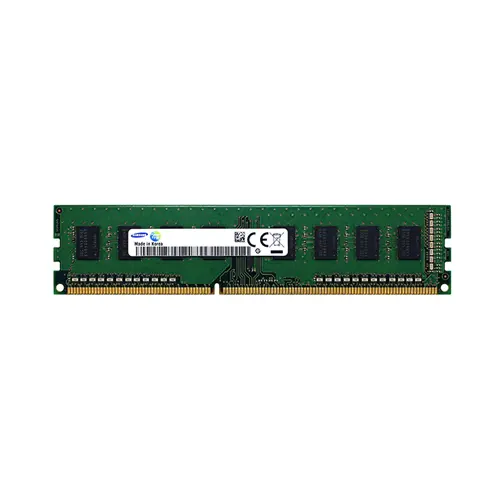
This M393B1G70EB0-YK0Q2 is a Samsung DDR3-1600 registered ECC memory module (RDIMM) explicitly engineered for server platforms, delivering robust data integrity and stability for mission-critical workloads such as virtualization and in-memory databases. Its 1.35V low-voltage operation reduces power consumption across dense server deployments, while the single-rank x4 organization combined with registered signal buffering minimizes electrical loading on the memory bus, enabling reliable operation with large-capacity configurations.
1. Registered signal buffering stabilizes command and address buses across fully loaded server memory channels, preventing signal degradation that could otherwise cause silent data corruption in high-density rack deployments.
2. ECC single-bit error correction and multi-bit detection provide a vital safety net for financial transactions and database operations, turning an entire DIMM’s lifetime into uninterrupted data integrity.
3. The 1.35-volt operating voltage reduces overall server farm power draw and cooling demands, allowing denser blade configurations without exceeding thermal budgets.
4. Eight-gigabyte capacity per module hits a sweet spot for virtualized workloads, enabling dozens of lightweight VMs per dual-socket host while leaving room for memory expansion in future scale-up scenarios.
5. 1600 MT/s throughput delivers balanced bandwidth for concurrent OLTP and web-serving tasks, ensuring that modern multi-core server CPUs receive a steady stream of data without stalling on memory fetches.
The Samsung M393B1G70EB0-YK0Q2 is a server-grade 8GB DDR3 Registered DIMM whose four core engineering traits—ECC correction, registered redrive, 1.35V low-power operation, and single-rank x4 organization—directly resolve real-world data center pain points. For your virtualization clusters, ECC silently scrubs single-bit errors that would otherwise crash a production VM or corrupt a transactional in-memory database like SAP HANA; this translates into uncompromised data integrity and genuine hands-off reliability, not just a specification. The registered clock driver electrically isolates the DRAM loads from the memory bus, so you can fully populate a 24-slot node to reach a confident 192 GB or more without signal degradation—critical when scaling VM density without random reboots freezing your tenants. Operating at just 1.35V, the module cuts thermal dissipation and energy draw compared with legacy 1.5V alternatives, meaning your 24/7 rack shrinks both cooling costs and power bills. Under the hood, the single-rank x4 configuration optimizes bank-level parallelism, reducing queue delays when a Redis cluster or vSAN tier faces a spike in reads; that architectural detail delivers consistently snappy, predictable performance, so no user ever feels the lag behind the silicon.
Capacity Planning for DDR3 ECC Registered Server Memory
The M393B1G70EB0-YK0Q2 is an 8GB DDR3-1600 ECC Registered RDIMM, clearly designed for server platforms. Its error-correcting code and registered architecture ensure data integrity and signal stability in multi-DIMM configurations, making it suitable for mission-critical workloads. Below are capacity guidelines for three typical server scenarios.
General Virtualization
Virtualized hosts running multiple VMs thrive on balanced memory-to-core ratios. Populate all memory channels symmetrically to maximize bandwidth—for a dual-socket system with three channels per CPU, install modules in sets of six (48 GB total) to feed hypervisor-level schedulers without creating starvation. Scale to 96 GB (12 x 8 GB) as guest density grows, allowing approximately 4–6 GB per light to medium VM.
In-Memory Database
In-memory databases like Redis or SAP HANA demand large, contiguous memory pools to hold entire datasets. Maximize capacity by fully populating every DIMM slot with identical 8 GB RDIMMs, aiming for 128 GB or more per node. Prioritize rank balance—single-rank x4 modules help maintain high operating frequency even when all channels are loaded, reducing latency under heavy analytical queries.
High Performance Computing
HPC clusters favor memory bandwidth over raw capacity per node. Install modules evenly across all available memory channels to enable full interleaving. For a dual-socket, three-channel platform, using six 8 GB RDIMMs (48 GB) delivers 38.4 GB/s theoretical peak bandwidth. Keep capacities moderate and rely on distributed processing; this efficiently feeds large MPI workloads without wasting power or budget on idle memory.
Rigorously tested for server platforms: fits Dell PowerEdge R720/R620, HP DL380p Gen8, Lenovo x3650 M4, and more.
Q: Can I mix this M393B1G70EB0-YK0Q2 with other memory modules of different brands or speeds?
A: Mixing registered ECC RDIMMs of different brands or speeds is not recommended for server environments; it may cause instability, degrade ECC protection, and invalidate platform validation. Always use identical modules for reliable operation.
Q: Is this memory compatible with my system?
A: This DDR3-1600 1.35V registered ECC RDIMM targets Intel Xeon E5-2400/2600 and AMD Opteron platforms with appropriate chipsets. Consult your server board's qualified vendor list to ensure support for 8GB single-rank PC3-12800 RDIMMs.
Q: What is the recommended DIMM population order for optimal performance?
A: Please follow your server or motherboard manual. Typically, populate identical RDIMMs in the first white slot per channel, balancing capacity across memory controllers for multi-CPU systems to ensure full memory bandwidth and RAS features.
Q: Does this module support overclocking or XMP profiles?
A: No. This is a JEDEC-compliant server registered ECC module built for mission-critical stability. Overclocking and XMP profiles are not supported, as they can compromise data integrity and are unsuitable for enterprise workloads.
Q: What warranty and typical failure rate can I expect?
A: This Samsung memory module is covered by a 1-year warranty. Its typical annualized failure rate is extremely low, often under 0.1%, backed by rigorous manufacturing testing and high-quality components for sustained 24/7 operation.