











 Secure payments
Standard refund policy
Trade Assurance
Secure payments
Standard refund policy
Trade Assurance
| Model | M392B1G70BH0-YK0 |
|---|---|
| Product Type | Memory Module |
| Compliance Standards | CE,WEEE,RoHS |
| Memory Capacity | 8 GB |
| Memory Technology | DDR3 |
| Product Voltage | 1.35V |
| RAM Speed | 1600MHz |
| RAM Standard | DDR3-1600/PC3-12800 |
| Error Identifying | ECC |
| Signal Type | Registered |
| Column Access Strobe (CAS) | CL11 |
| Rank | Single Rank x4 |
| Quantity of Pins | 240-pin |
| RAM Genre | VLP RDIMM |
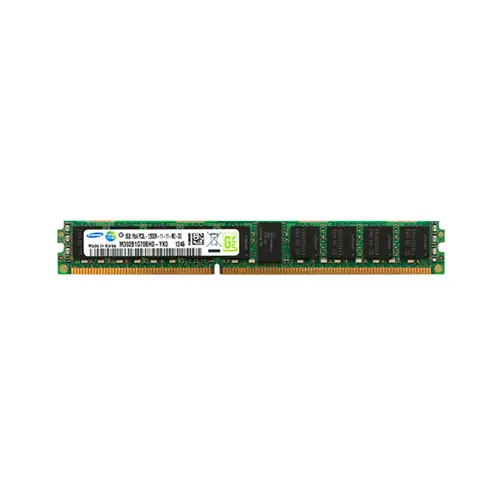
The M392B1G70BH0-YK0 is a server-class DDR3-1600 VLP RDIMM, purpose-built for high-density virtualization and in-memory database workloads where data integrity is non-negotiable. Its Registered signal type and ECC rigorously eliminate single-bit errors, while the single-rank x4 organization and very low-profile form factor optimize thermal airflow and signal integrity in densely packed rack servers.
1. Registered signal type stabilizes command and address lines across fully populated memory channels, preserving data integrity in high-density server nodes running mission-critical database applications.
2. ECC error correction continuously detects and repairs single-bit memory faults, shielding virtualized workloads from silent data corruption that could compromise financial transaction accuracy.
3. VLP RDIMM low-profile design maximizes air circulation inside compact 1U and blade enclosures, directly reducing fan power draw and extending hardware lifespan in large-scale deployments.
4. Eight-gigabyte module capacity offers an optimal building block for virtualized environments, packing sufficient working memory per socket to boost VM density without escalating idle energy consumption.
5. DDR3-1600 transfer rate satisfies the throughput demands of mid-generation server processors, sustaining responsive analytics performance under concurrent query loads.
The Samsung M392B1G70BH0-YK0 is a server-grade DDR3 Registered DIMM, purpose-built for enterprise environments where absolute stability is non-negotiable. Its ECC technology directly prevents single-bit errors from silently corrupting data in memory—a critical safeguard when a flipped bit in a financial transaction database or a virtualization host could cascade into system crashes or financial discrepancies. The Registered buffer, meanwhile, decouples the memory controller from the DRAM chips, enabling platforms to populate all 24 DIMM slots without signal degradation; for a VMware cluster running dozens of virtual machines, this translates to terabyte-scale reliable capacity without sacrificing performance. The module's 1.35V ultra-low voltage significantly reduces thermal load across a fully populated server rack, directly lowering cooling costs in a 24/7 data center while extending component lifespan. Finally, its Very Low Profile form factor ensures physical compatibility in dense 1U or blade chassis where vertical space is a constraint, meaning operators can maximize memory density even in the tightest deployments. Together, these features coalesce into assured uptime and consistent latency for mission-critical workloads like in-memory databases and large-scale virtualization, where hardware failure is simply not an option.
General Virtualization
For virtualized workloads, balance density and cost. Deploy six to twelve 8GB VLP RDIMMs across a dual-socket platform to achieve 48–96 GB of total RAM, enabling 20–30 lightweight VMs. Leverage 1.35V modules to reduce power draw in dense rack deployments, and use an identical single-rank DIMM per channel to maintain consistent latency and avoid rank contention.
In-Memory Database
In-memory databases demand capacity and fault tolerance. Populate all available channels with identical 8GB Registered ECC DIMMs — typically 12–24 modules for 96–192 GB on dual-socket servers. ECC corrects single-bit errors critical for data integrity. The VLP form factor eases airflow in DIMM-heavy configurations, while 1.35V operation helps keep thermals under control during sustained high-memory-pressure loads.
High-Performance Computing
HPC clusters prioritize bandwidth and node density. Install one 8GB RDIMM per channel across all memory channels to maximize peak throughput; a dual-socket node with 16–24 modules provides 128–192 GB while maintaining balanced access. The single-rank x4 design enables higher sustained bandwidth, and the very low profile height simplifies cabling in blade or 1U chassis, improving serviceability at scale.
This registered DDR3 memory is fully tested and compatible with servers like Dell PowerEdge R720, HP DL380p Gen8, Lenovo RD430.
Q: Can I mix this M392B1G70BH0-YK0 with other memory modules of different brands or speeds?
A: Mixing this registered ECC module with different brands or speeds is strongly discouraged in server environments. It may cause signal integrity issues, system instability, and increased uncorrectable errors. Always use identical part numbers.
Q: Is this memory compatible with my system?
A: This DDR3-1600 registered ECC DIMM is compatible with servers using Intel Xeon E5-2600 v1/v2 or AMD Opteron 6300 series platforms. Verify your motherboard’s qualified vendor list for specific 240-pin RDIMM support.
Q: What is the recommended DIMM population order for optimal performance?
A: Follow your server board’s manual. Generally, populate the farthest DIMM slot in each memory channel first, then proceed inward to balance load and maximize interleaving. Symmetric configurations per CPU are critical.
Q: Does this module support overclocking or XMP profiles?
A: No. This module strictly adheres to JEDEC DDR3-1600 specifications at 1.35V. Server RDIMMs do not support overclocking, XMP, or manual timing tuning; they prioritize error-free operation over peak frequency.
Q: What warranty and typical failure rate can I expect?
A: This module carries a 1-year warranty. Engineered with ECC and high-quality components, the annualized failure rate is very low under specified operating conditions, ensuring dependable long-term service in datacenter deployments.