











 Secure payments
Standard refund policy
Trade Assurance
Secure payments
Standard refund policy
Trade Assurance
| Model | M393B1K70EB0-YK0 |
|---|---|
| Product Type | Memory Module |
| Compliance Standards | EU RoHS,FCC |
| Memory Capacity | 8 GB |
| Memory Technology | DDR3 |
| Product Voltage | 1.35V |
| RAM Speed | 1600MHz |
| RAM Standard | DDR3-1600/PC3-12800 |
| Error Identifying | ECC |
| Signal Type | Registered |
| Column Access Strobe (CAS) | CL11 |
| Rank | Dual Rank x4 |
| Quantity of Pins | 240-pin |
| RAM Genre | RDIMM |
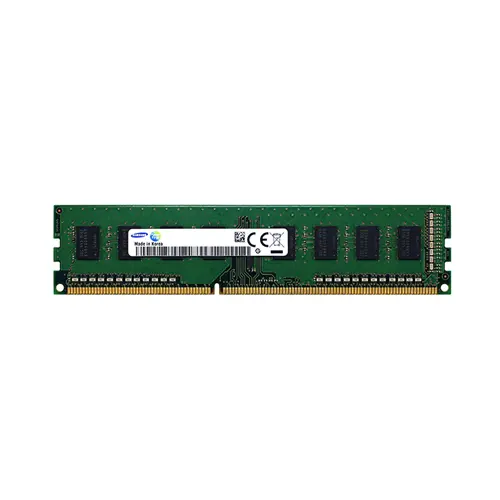
Designed as a registered DDR3L RDIMM with ECC, this 8 GB module operating at 1.35 V and 1600 MHz (PC3-12800) is purpose‑built for server platforms running memory‑intensive workloads such as virtualization and in‑memory databases. Its dual‑rank x4 organization combined with registered signaling ensures robust signal integrity and data reliability across fully populated memory channels, while the ECC engine provides single‑bit error correction critical for maintaining data integrity in 24/7 enterprise environments.
1. ECC protection silently corrects single-bit errors in real time, preserving data integrity for mission-critical workloads and preventing silent data corruption that could crash virtual machines.
2. Registered signal buffering stabilizes command and address lines across high-density memory configurations, enabling reliable operation with fully populated server boards under heavy load.
3. Dual Rank x4 organization interleaves access across multiple internal banks, maximizing channel utilization and delivering consistent bandwidth ideal for high virtualization density.
4. The low 1.35V supply significantly reduces power draw per DIMM, lowering datacenter cooling demands and improving total cost of ownership in large-scale deployments.
5. PC3-12800 bandwidth ensures steady throughput for memory-hungry applications like in-memory databases and consolidated virtual desktop infrastructure, where stalls directly impact user experience.
This Samsung RDIMM is engineered specifically for servers, where unplanned downtime directly translates to revenue loss. Its four defining characteristics resolve critical pain points in data center environments.
First, ECC error correction is your last line of defense against silent data corruption. In a virtualized cluster running multiple financial databases, a single bit-flip caused by background radiation can crash a transaction or poison a storage volume; ECC detects and corrects these errors in real time, preserving end‑to‑end data integrity. Second, the registered buffer architecture stabilizes high‑density memory configurations. When you populate a rack server with dozens of DIMMs to support memory‑hungry analytic engines, the register re‑drives address and command signals, eliminating electrical loading and enabling reliable operation even at full capacity. Third, the dual‑rank x4 organization maximizes interleaving and command efficiency, boosting sustained bandwidth for Redis or SAP HANA workloads where nanosecond memory latency dictates query throughput. Finally, the 1.35V operating voltage slashes power consumption per DIMM, which scales into substantial thermal and energy savings across a hyperscale deployment—lowering cooling overhead while maintaining 1600MHz speed. Together, these features mean fewer crashes, predictable performance under heavy load, and a more efficient infrastructure stack where business continuity is never negotiable.
General Virtualization
For general virtualization hosts running multiple VMs, populate at least six to eight identical M393B1K70EB0-YK0 modules across all memory channels to maximize bandwidth. A balanced configuration of 48 GB (6 x 8 GB) or 64 GB (8 x 8 GB) per server provides ample capacity for moderate consolidation ratios while maintaining low latency with registered ECC. Always install modules in matched sets of three or four per CPU to enable triple-channel or quad-channel interleaving and avoid performance penalties.
In-Memory Database
In-memory databases such as Redis or SAP HANA demand large, contiguous memory pools and absolute data integrity. Deploy a fully populated configuration with the maximum number of these 8 GB RDIMMs supported by the platform—typically 12 or 16 modules per socket for 96 GB or 128 GB total. The dual-rank x4 organization and ECC are critical to sustain high throughput and correct single-bit errors in real time without service interruption.
High-Performance Computing (HPC)
HPC clusters benefit from balanced memory bandwidth per core, so install one 8 GB DIMM per memory channel across all available channels—usually 8 or 12 modules per node. This yields sufficient capacity for large datasets while ensuring a symmetric NUMA topology. The 1600 MT/s speed and 1.35 V low-voltage operation help reduce overall power draw in dense compute racks, which is essential when scaling out hundreds of nodes.
Verified rigorously tested server memory, compatible with Dell PowerEdge R720/R620, HP DL380p Gen8, IBM x3650 M4.
Q: Can I mix this M393B1K70EB0-YK0 with other memory modules of different brands or speeds?
A: Mixing is strongly discouraged in server environments. For reliable operation, all DIMMs must match in brand, speed, rank, and timings. Mismatched modules can cause POST failures, instability, or silent data corruption in mission-critical systems.
Q: Is this memory compatible with my system?
A: This 8GB DDR3L-1600 Registered ECC DIMM is compatible with Intel Xeon E5-2400/2600 v2 and select AMD Opteron 6300 platforms. Please verify your motherboard’s qualified vendor list (QVL) and support for 1.35V dual-rank RDIMMs to guarantee seamless integration.
Q: What is the recommended DIMM population order for optimal performance?
A: Follow your server manual’s population sequence strictly. Typically, populate identical DIMMs starting with the first slot of each memory channel. Balanced interleaving across channels maximizes throughput and reduces latency in multi-socket configurations.
Q: Does this module support overclocking or XMP profiles?
A: No. As an enterprise Registered ECC DIMM, it adheres to JEDEC DDR3L-1600 (PC3L-12800) at 1.35V. Overclocking and XMP are disabled to ensure 24/7 data integrity, stability, and compliance with server validation standards.
Q: What warranty and typical failure rate can I expect?
A: This Samsung module is backed by a 1-year warranty. It exhibits a typical annualized failure rate (AFR) below 0.5% under specified operating conditions, thanks to stringent chip selection and enterprise-grade burn-in testing against early life defects.