











 Secure payments
Standard refund policy
Trade Assurance
Secure payments
Standard refund policy
Trade Assurance
| Model | M391B1G73BH0-YK0 |
|---|---|
| Product Type | Memory Module |
| Compliance Standards | EU RoHS,FCC |
| Memory Capacity | 8 GB |
| Memory Technology | DDR3 |
| Product Voltage | 1.35V |
| RAM Speed | 1600MHz |
| RAM Standard | DDR3-1600/PC3-12800 |
| Error Identifying | ECC |
| Signal Type | Unbuffered |
| Column Access Strobe (CAS) | CL11 |
| Rank | Dual Rank x8 |
| Quantity of Pins | 240-pin |
| RAM Genre | UDIMM |
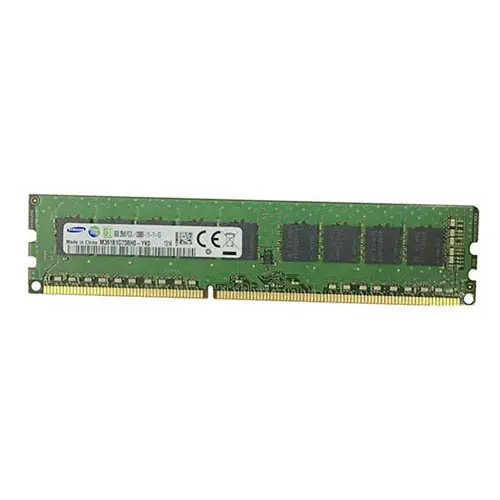
The M391B1G73BH0-YK0 is an 8GB DDR3-1600 ECC Unbuffered DIMM designed for entry-level servers and workstations, where it ensures data integrity for applications like virtualization, memory-resident databases, or archival storage. Operating at a low 1.35V with a dual-rank x8 organization and CL11 latency, this module balances energy efficiency with reliable error correction, making it ideal for 24/7 operation in platforms such as NAS appliances or small business servers that require stability without the cost of registered memory.
1. ECC protection silently corrects single-bit errors in real time, preventing silent data corruption in transactional databases and ensuring regulatory compliance for archival integrity.
2. Dual rank x8 organization interleaves memory banks to sustain peak channel utilization, keeping latency low when multiple VMs contend for shared resources.
3. A 1.35V operating voltage significantly cuts power draw per DIMM, directly shrinking the facility power and cooling burden in densely packed rack deployments.
4. Eight gigabytes of capacity per stick provide a sweet spot for entry-level virtualization hosts, allowing sufficient guest memory hosting without exhausting slot real estate.
5. The 1600 MT/s data rate delivers ample bandwidth for concurrent request processing in web and caching servers, avoiding I/O bottlenecks before NVMe storage tiers take over.
The Samsung M391B1G73BH0-YK0 is an 8GB DDR3 UDIMM built for entry-level servers and workstations. Four features define its real-world value. ECC error correction prevents single-bit memory faults from silently corrupting data—a must when a small business runs its accounting system and virtualized domain controller on one box, where one undetected error leads to catastrophic downtime. Its 1.35V low-voltage design cuts energy draw and heat, slashing cooling costs in always-on deployments like an NVR surveillance server. The dual-rank x8 organization interleaves banks for higher effective bandwidth, keeping performance smooth when a Redis cache handles rapid queries or a light hypervisor runs two VMs. As an unbuffered UDIMM, it avoids the latency of registered modules, delivering quicker command response for single-CPU platforms. This translates into lower energy bills and more predictable performance. For users demanding server-grade integrity with low power and low latency, this module keeps small-scale operations running reliably.
Based on the 8GB DDR3L-1600 ECC Unbuffered DIMM specifications, this module is server memory. The following capacity planning advice applies to platforms that support ECC UDIMMs.
General Virtualization
Start with 32 GB using four identical M391B1G73BH0-YK0 modules evenly distributed across memory channels. This balanced configuration enables dual-channel interleaving and ECC protection for multiple light to medium virtual machines. When host RAM demand grows, populate the remaining slots with the same part to scale to 64 GB or the board maximum while retaining reliability.
In-Memory Database
Maximize capacity with fully populated DIMM slots. Most single-socket servers accept up to four of these dual-rank 8 GB UDIMMs, giving 32 GB; if the board offers eight slots, aim for 64 GB. Use only identical modules—mixing leads to ECC mismatches. For pure in-memory workloads, prioritize capacity over frequency and validate the configuration with database vendor certification tools.
High Performance Computing
Install one module per channel (typical 1DPC setup) to keep the 1600 MT/s speed stable and latency low. For dual-channel boards, deploy two 8 GB modules for 16 GB; for quad-channel, use four for 32 GB. These dual-rank DIMMs offer sufficient bandwidth per slot. Avoid 2DPC unless peak capacity is mandatory, because speed may drop, impacting tight HPC inter-process communication.
Rigorously tested for server compatibility: Dell PowerEdge T110 II, R220, Lenovo TS140, HP ML10 Gen8.
Q: Can I mix this M391B1G73BH0-YK0 with other memory modules of different brands or speeds?
A: Mixing is not recommended for server environments. Even slight differences in rank, voltage, or timings can compromise ECC integrity and system stability. Use identical modules for reliable 24/7 operation.
Q: Is this memory compatible with my Intel Xeon E3 or AMD Ryzen server platform?
A: It is designed for platforms supporting DDR3 ECC UDIMM, such as Intel Xeon E3 v2/v3 with C200/C220 chipsets, or select AMD AM3+ servers. Verify your motherboard's QVL for 8GB 2Rx8 PC3-12800E compatibility.
Q: What is the recommended DIMM population order for optimal performance on a dual-channel server board?
A: Populate identical modules starting with channel A (slots furthest from CPU). For dual rank x8 modules, fill primary blue slots first to enable dual-channel symmetric mode and maximize memory bandwidth.
Q: Does this module support overclocking or XMP profiles?
A: No. As an ECC UDIMM engineered for mission-critical stability, it runs strictly at JEDEC DDR3-1600 (CL11, 1.35V). Overclocking and XMP are not supported, preserving data integrity in server workloads.
Q: What warranty and typical failure rate can I expect with this server memory?
A: It includes a 1-year limited warranty. Annualized failure rate (AFR) is typically below 0.3% under specified conditions, reflecting high-grade Samsung DRAM and rigorous ECC testing for long-term deployment.