











 Secure payments
Standard refund policy
Trade Assurance
Secure payments
Standard refund policy
Trade Assurance
| Model | M391B1G73QH0-YK0Q0 |
|---|---|
| Product Type | Memory Module |
| Compliance Standards | EU RoHS,FCC |
| Memory Capacity | 8 GB |
| Memory Technology | DDR3 |
| Product Voltage | 1.35V |
| RAM Speed | 1600MHz |
| RAM Standard | DDR3-1600/PC3-12800 |
| Error Identifying | ECC |
| Signal Type | Unbuffered |
| Column Access Strobe (CAS) | CL11 |
| Rank | Dual Rank x8 |
| Quantity of Pins | 240-pin |
| RAM Genre | UDIMM |
This DDR3-1600 ECC Unbuffered DIMM with a dual-rank x8 organization and low 1.35V operating voltage is tailored for entry-level servers and single-socket workstations where data integrity and energy efficiency are paramount. Its ECC engine provides single-bit error correction to prevent data corruption in virtualization and light database workloads, while the unbuffered architecture and dual-rank interleaving deliver lower latency and sustained bandwidth compared to registered alternatives.
1. ECC error correction actively guards against single-bit memory faults, preserving data integrity in always-on entry server workloads where silent corruption is unacceptable.
2. Unbuffered UDIMM topology reduces command-to-data latency, a practical fit for single-socket server boards that prioritize cost-effective responsiveness over maximum DIMM-per-channel scaling.
3. Dual Rank x8 organization boosts bank-level parallelism, sustaining higher effective bandwidth under mixed virtualization loads so multiple light VMs run without memory controller stalls.
4. 1600MHz clock speed supplies up to 12.8 GB/s peak throughput per channel, comfortably handling concurrent file serving and database lookups in small business servers.
5. 1.35V low-voltage operation cuts DRAM power draw and thermal output, easing cooling demands in dense microserver enclosures while lowering the total energy bill for 24/7 operation.
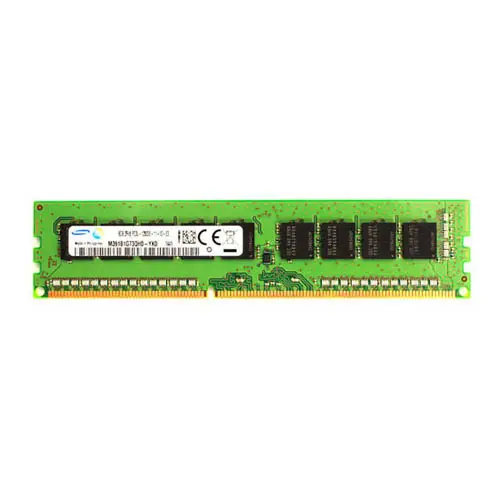
The Samsung M391B1G73QH0-YK0Q0 is an 8GB DDR3 UDIMM with ECC, running at 1600MHz with a low 1.35V profile. Built for entry-level servers and network-attached storage, this module directly addresses the relentless demand for data integrity and energy efficiency in always-on environments. In a virtualization cluster hosting multiple VMs, an uncorrected memory bit-flip can silently corrupt a virtual disk or abruptly crash an entire host, leading to costly service interruptions. The onboard ECC engine continuously corrects single-bit errors and detects multi-bit faults, transforming invisible radiation events into non-events and preserving the uptime of your critical workloads. In an in-memory database such as Redis, the module’s Dual Rank x8 organization leverages rank interleaving to boost effective bandwidth, meaning faster query responses and snappier real-time analytics without requiring additional DIMM slots. Simultaneously, the 1.35V DDR3L operation slashes thermal dissipation and power draw by roughly 20 percent compared to standard 1.5V modules, which yields substantial cumulative energy savings in dense rack deployments. For your business, this combination of error-resilient computing, lower latency under contention, and reduced operating expenses translates to a hardened, cost-effective foundation where data accuracy and platform stability are never compromised.
General Virtualization
For a hypervisor hosting multiple VMs, populate six identical M391B1G73QH0 modules (48 GB total) across a triple-channel platform, or four modules (32 GB) in dual‑channel mode. This unbuffered ECC design guards against single‑bit errors without the cost of registered DIMMs, balancing reliability and density for moderate consolidation ratios.
In‑Memory Database
Maximize capacity by installing one 8 GB UDIMM per channel—up to four or six modules depending on the board—to keep the entire dataset in DRAM. The 1.35 V low‑voltage operation reduces thermal load inside 1U chassis, while ECC and dual‑rank x8 organization strengthen data integrity under sustained write pressure.
High‑Performance Computing (HPC)
Populate all memory channels symmetrically with eight identical sticks (64 GB) to feed bandwidth‑sensitive workloads like CFD or molecular dynamics. Unbuffered 1600 MHz CAS 11 timing minimizes latency per access, and the dual‑rank structure improves interleaving, sustaining high throughput during MPI‑parallel runs without breaking the power budget.
Rigorously tested ECC UDIMM, compatible with Dell PowerEdge T110 II, R210 II, HP ProLiant ML110 Gen7, and more.
Q: Can I mix this M391B1G73QH0-YK0Q0 with other memory modules of different brands or speeds?
A: Mixing is not recommended, especially in servers. ECC UDIMMs require identical specs for stability. Different brands or speeds may cause POST issues or silent data corruption.
Q: Is this memory compatible with my Intel Xeon E3 or AMD Ryzen Pro server platform?
A: It is compatible with platforms supporting DDR3-1600 ECC unbuffered DIMMs. Verify your board's qualified vendor list and ensure it accepts 1.35V dual-rank x8 UDIMMs.
Q: What is the recommended DIMM population order for optimal performance?
A: Populate identical DIMMs per channel, starting with the slots furthest from the CPU. For dual-channel servers, install matched pairs in the same-colored slots to enable interleaving.
Q: Does this module support overclocking or XMP profiles?
A: No. As an enterprise, JEDEC-compliant ECC module, it runs strictly at DDR3-1600 CL11. It does not support XMP or overclocking; stability and data integrity are prioritized.
Q: What warranty and typical failure rate can I expect?
A: This module carries a one-year warranty. Built with Samsung’s stringent screening, the annualized failure rate is well below 0.2% under specified conditions, ensuring high reliability.