











 Secure payments
Standard refund policy
Trade Assurance
Secure payments
Standard refund policy
Trade Assurance
| Model | M390B1G73BH0-YK0 |
|---|---|
| Product Type | Memory Module |
| Compliance Standards | EU RoHS,FCC |
| Memory Capacity | 8 GB |
| Memory Technology | DDR3 |
| Product Voltage | 1.35V |
| RAM Speed | 1600MHz |
| RAM Standard | DDR3-1600/PC3-12800 |
| Error Identifying | ECC |
| Signal Type | Unbuffered |
| Column Access Strobe (CAS) | CL11 |
| Rank | Dual Rank x8 |
| Quantity of Pins | 240-pin |
| RAM Genre | UDIMM |
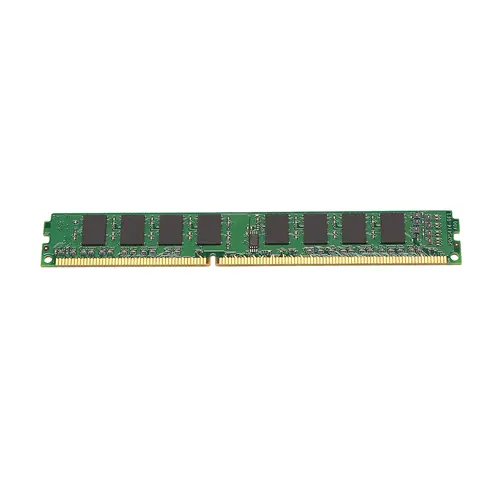
This low-voltage DDR3L-1600 ECC UDIMM is engineered for entry-level servers and small workstations where data integrity is critical but registered memory is not supported. Its dual-rank x8 organization balances density and signal reliability, while 1.35V operation and ECC error correction enhance power efficiency and safeguard in-memory data for virtualization or light database workloads.
1. The 8 GB capacity supplies ample workspace for lightweight virtualized tasks and containerized applications, preventing sluggish swap usage under moderate multi‑tenant loads.
2. ECC single‑bit correction silently eliminates soft errors, preserving cryptographic and transactional data integrity in a small business server that runs around the clock.
3. A 1.35V power envelope slashes thermal output and energy draw in dense rack or edge deployments, directly trimming ongoing operational costs.
4. The 1600 MHz clock drives 12.8 GB/s of peak bandwidth, keeping file serving and backup streams smooth even when multiple clients compete for I/O.
5. Dual Rank x8 organization enables rank interleaving, raising effective throughput under the jumbled access patterns generated by busy hypervisors and database caches.
When you depend on a system to run critical services around the clock, silent data corruption is an invisible threat. The M390B1G73BH0-YK0 8GB DDR3-1600 UDIMM eliminates that risk with hardware ECC. In a small-business virtualization host juggling multiple light-weight VMs or a memory-resident database like Redis, a single bit-flip can crash an application or quietly poison a financial record. The integrated error correction instantly catches and fixes these errors, turning a potential outage into a non-event. Its 1.35V low-voltage operation further shrinks thermal stress and energy cost inside compact server chassis, directly extending component lifespan during dense 24/7 workloads. The unbuffered architecture preserves lower latency, ensuring seamless compatibility and snappier response on single-socket Intel Xeon E3 or AMD Ryzen PRO platforms that do not accept registered DIMMs. Meanwhile, the dual-rank x8 organization enables bank interleaving to lift effective bandwidth, a tangible boost for multi-threaded database queries and backup NAS scrubs under ZFS. This means your virtualized testing environment sustains higher VM density without lag, and your archived data remains mathematically provable—cooler, safer, and deliberately built for mission dependability.
General Virtualization
Deploy at least four M390B1G73BH0-YK0 modules (32 GB total) across all available memory channels to maximize bandwidth and redundancy for hypervisor and guest workloads. ECC unbuffered DIMMs protect virtual machines from in-memory errors, which is critical when hosting multiple services. Start with two 8 GB DIMMs per populated channel to maintain balanced throughput, and scale to 64 GB as virtual machine density increases.
In-Memory Database
Maximize capacity by fully populating every DIMM slot, targeting 64 GB or higher with eight identical 8 GB dual-rank modules. Dual-rank x8 organization and CL11 latency offer a strong balance of access speed and density for real-time analytics. Avoid mixing capacities or speeds to keep memory interleaving optimal, and leverage the 1.35 V low-power design to reduce thermal load in 24/7 database hosts.
High-Performance Computing (HPC)
Install matched sets of four or six modules to enable multi-channel interleaving, delivering the aggregate bandwidth demanded by simulation and modeling software. The ECC feature prevents silent data corruption during long-running parallel jobs, while dual-rank ranks boost command rate efficiency. For memory-bound workloads, populate one DIMM per channel first; then add a second kit only if capacity needs exceed raw bandwidth requirements, keeping all modules identical for stable synchronization.
Rigorously tested ECC UDIMM for servers. Verified compatible: Dell PowerEdge T20, HP ProLiant MicroServer Gen8, Lenovo ThinkServer TS140.
Q: Can I mix this M390B1G73BH0-YK0 with other memory modules of different brands or speeds?
A: We strongly advise against mixing. Combining ECC modules with non-ECC or different speeds may cause system instability, uncorrected errors, and is not validated for server environments.
Q: Is this memory compatible with my system?
A: It fits servers/workstations supporting DDR3 ECC Unbuffered DIMMs, such as Intel Xeon E3/E5 platforms or select AMD Opteron boards. Verify if your motherboard requires 240-pin UDIMM ECC.
Q: What is the recommended DIMM population order for optimal performance?
A: Populate identical modules in matching channels (e.g., blue slots first) per your motherboard manual. For dual-channel, use one DIMM per channel to enable ECC and balanced interleaving.
Q: Does this module support overclocking or XMP profiles?
A: No. As an industry-standard ECC server DIMM, it runs strictly at JEDEC DDR3-1600 CL11 specifications. Overclocking and XMP are not supported to ensure data integrity.
Q: What warranty and typical failure rate can I expect?
A: This module carries a one-year warranty. Its AFR (Annualized Failure Rate) is well below 0.5% under normal operating conditions, backed by rigorous manufacturing testing.