











 Secure payments
Standard refund policy
Trade Assurance
Secure payments
Standard refund policy
Trade Assurance
| Model | M391B1G73QH0-CK0Q |
|---|---|
| Product Type | Memory Module |
| Compliance Standards | EU RoHS,FCC |
| Memory Capacity | 8 GB |
| Memory Technology | DDR3 |
| Product Voltage | 1.5V |
| RAM Speed | 1600MHz |
| RAM Standard | DDR3-1600/PC3-12800 |
| Error Identifying | ECC |
| Signal Type | Unbuffered |
| Column Access Strobe (CAS) | CL11 |
| Rank | Dual Rank x8 |
| Quantity of Pins | 240-pin |
| RAM Genre | UDIMM |
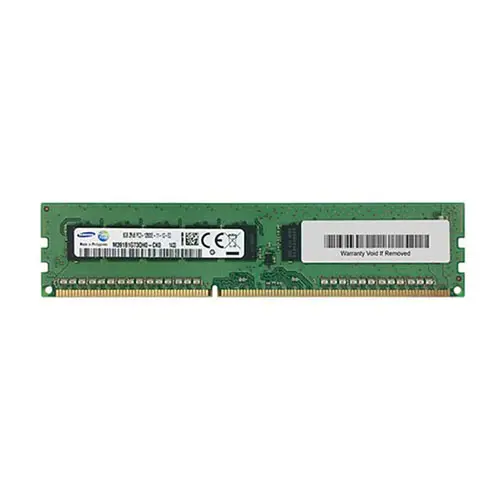
This Samsung M391B1G73QH0-CK0Q is an unbuffered ECC DDR3-1600 module, ideally suited for single-socket servers and entry-level workstations where data integrity is critical but registered memory is not required. Its ECC protection prevents single-bit errors in memory-sensitive workloads, while the dual-rank x8 organization improves bank-level parallelism for stable throughput under sustained access.
1. ECC protection actively corrects single-bit errors, preserving data integrity for financial transactions and database operations that cannot tolerate silent corruption.
2. Dual Rank x8 organization enables effective rank interleaving, keeping memory channels saturated to sustain throughput when hosting multiple virtual machines.
3. 8GB capacity offers a practical building block for lightweight virtualization, allowing dense container or microservice consolidation without overprovisioning.
4. 1600MHz clock speed supplies 12.8 GB/s of peak bandwidth, reliably feeding entry-level server processors during concurrent request handling.
5. Unbuffered UDIMM design eliminates register latency, delivering the responsive memory access needed for single-socket servers running latency-sensitive workloads.
The M391B1G73QH0-CK0Q is an 8GB DDR3-1600 Unbuffered ECC UDIMM, purpose-built for entry-level servers and workstations where data integrity and responsive performance directly impact business continuity, not just benchmark scores. In these environments, four characteristics transform real-world outcomes. First, ECC actively corrects single-bit memory errors caused by background radiation or electrical noise. For a VMware ESXi cluster hosting multiple virtual machines, an uncorrected bit flip can silently corrupt a database record or crash an entire VM; ECC eliminates that risk, keeping your services running cleanly. Second, the unbuffered architecture removes the register delay, delivering lower latency that is critical for in-memory databases like Redis, where every microsecond of response time matters during peak transaction loads. Third, the dual-rank design interleaves two internal ranks of DRAM banks, allowing the memory controller to pipeline commands and boost bandwidth utilization. This translates to smoother performance when virtualized workloads compete for shared memory resources. Fourth, the 1600MHz speed and CL11 timing strike a proven balance between stability and throughput on older platforms, ensuring reliable 24/7 operation without compromising the responsiveness needed for file serving, web hosting, or light database applications. Choosing this module means choosing operational peace of mind rather than unexplained downtime.
Based on the provided specifications—8GB DDR3-1600 ECC Unbuffered UDIMM (M391B1G73QH0-CK0Q)—this is server memory, typically used in entry-level servers, small business servers, and workstations requiring data integrity. Below is the capacity planning guidance for typical server workloads.
General Virtualization
For a small virtualization host running 5–10 light VMs, populate at least four of these 8GB modules for a total of 32GB. Leverage dual-channel or triple-channel configurations (depending on the platform) to maximize memory bandwidth, and leave 1–2 slots free for future scaling. ECC is critical here to prevent data corruption in multi-tenant environments.
In-Memory Database
In-memory databases like Redis or Memcached demand capacity headroom; aim for the maximum supported UDIMM slots (often 64GB using eight 8GB sticks). Configure all channels symmetrically to sustain low latency under heavy read/write loads, and never mix non-ECC DIMMs as a single bit error can crash the dataset. Consider a 64GB floor for moderate datasets.
High-Performance Computing (HPC)
HPC memory configuration is sensitive to per-core ratios. Install six or eight identical 8GB ECC UDIMMs for 48–64GB total, populating one DIMM per channel to avoid rank contention and maintain peak throughput. For memory-bandwidth-bound simulations, fill every available channel even if total capacity exceeds immediate need, as balanced DIMM population prevents NUMA penalties.
Rigorously tested to ensure seamless compatibility with servers like Dell PowerEdge R210 II, HP ProLiant ML310e Gen8.
Q: Can I mix this M391B1G73QH0-CK0Q with other memory modules of different brands or speeds?
A: Mixing is not recommended for server environments. Combining ECC and non-ECC modules or mismatched speeds forces the system to the lowest common specification, potentially disabling ECC protection and causing instability.
Q: Is this memory compatible with my Intel Xeon E3-1200 v2 series server platform?
A: Yes, this DDR3L-1600 ECC UDIMM is compatible with platforms using C202/C204/C206 chipsets that support unbuffered ECC memory. It will also work in many single-socket AMD Opteron systems. Verify your board supports 1.5V ECC UDIMMs.
Q: What is the recommended DIMM population order for optimal performance?
A: Install identical modules in sets of two for dual-channel performance. Populate the blue slots first in most Supermicro and Intel server boards, following the memory interleaving chart in your specific motherboard manual for balanced channel loading.
Q: Does this module support overclocking or XMP profiles?
A: No. As a server ECC UDIMM, it adheres strictly to JEDEC DDR3-1600 CL11 standards at 1.5V. It does not feature XMP profiles and overclocking is unsupported to ensure mission-critical data integrity and system stability.
Q: What warranty and typical failure rate can I expect?
A: It includes a one-year warranty. Enterprise-class Samsung modules using RoHS-compliant components target an annualized failure rate well below 0.05% under standard operating conditions, ensuring reliable long-term deployment in server environments.