











 Secure payments
Standard refund policy
Trade Assurance
Secure payments
Standard refund policy
Trade Assurance
| Product Type | Memory Module |
|---|---|
| Compliance Standards | EU RoHS,FCC |
| Memory Capacity | 8 GB |
| Memory Technology | DDR3 |
| Product Voltage | 1.35 V |
| RAM Speed | 1600 MHz |
| RAM Standard | DDR3-1600/PC3-12800 |
| Error Identifying | ECC |
| Signal Type | Registered |
| Column Access Strobe (CAS) | CL11 |
| Rank | Dual Rank x8 |
| Quantity of Pins | 240-pin |
| RAM Genre | RDIMM |
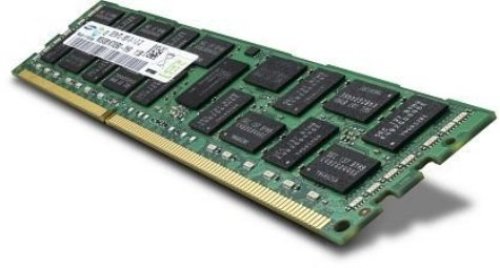
This 8 GB DDR3-1600 Registered ECC module (RDIMM) running at 1.35 V delivers the data integrity and signal stability essential for server-class platforms, making it ideally suited for virtualization clusters and in-memory database workloads that cannot tolerate memory errors. Its dual-rank x8 organization with registered buffering reduces bus loading and enables rank interleaving, while ECC and CL11 latency provide a reliable, low-overhead foundation for sustained 24/7 enterprise operation.
1. Operating at just 1.35V, this module lowers energy draw per DIMM substantially, directly reducing power bills and cooling demands in dense, always-on data center deployments.
2. Integrated ECC silently detects and corrects single-bit errors, ensuring transactional integrity and preventing undetected data corruption in critical database operations.
3. Registered buffering stabilizes command and address signals, allowing high-capacity memory configurations essential for running dozens of virtual machines on a single host.
4. Dual Rank x8 architecture leverages rank interleaving to maintain peak bandwidth utilization, delivering smooth throughput during heavy multi-tenant cloud processing.
5. A 1600 MT/s transfer rate supplies consistent memory bandwidth, keeping latency-sensitive enterprise applications responsive under full server consolidation loads.
When deploying virtualization clusters, every memory error threatens workload stability—a single uncorrected bit-flip can crash multiple virtual machines. The Samsung M393B1G73BH0-YK0 is a Registered DDR3 RDIMM engineered to eliminate that risk. Its ECC technology actively detects and corrects single-bit errors in real time, preserving data integrity for mission-critical hypervisors and in-memory databases like SAP HANA or Redis, where even silent data corruption translates directly into financial loss or transaction rollbacks.
The Registered signal buffer decouples the memory bus from the DRAM chips, enabling you to populate all available DIMM slots without compromising signal integrity. In dense 2U servers running dozens of VMs, this means you can confidently scale to 192GB or more while maintaining rock‑solid stability—without random reboots under heavy I/O. The 1.35V low‑voltage operation cuts power consumption by up to 20% compared to standard 1.5V modules, significantly reducing cooling costs in packed data center racks over a 24/7 lifecycle. Meanwhile, the Dual Rank x8 organization interleaves two internal ranks of memory banks, allowing the memory controller to hide precharge delays and sustain higher bandwidth under concurrent access patterns. For an in-memory database serving thousands of queries per second, this translates into lower latency and higher transactions per minute, directly boosting your service throughput without CPU wait states. Beyond raw specs, these four characteristics converge to keep your virtualized infrastructure both resilient and cost‑effective around the clock.
General Virtualization
For a balanced virtual machine host, populate at least six to eight of these 8GB DDR3L RDIMMs across triple-channel or quad-channel memory banks to achieve 48–64 GB total capacity. The low 1.35V operating voltage reduces power and cooling costs in dense virtualization clusters, while ECC and registered signaling maintain stability under mixed workloads. Distribute modules evenly across all memory channels to maximize throughput for concurrent VMs.
In-Memory Database
Clocking at 1600 MT/s with CL11 latency and dual-rank x8 organization, these modules deliver predictable low-latency access for in-memory datasets. Deploy twelve to sixteen modules per server to reach 96–128 GB, ensuring the entire working set fits in RAM to avoid disk I/O penalties. Populate all channels symmetrically with identical 8GB RDIMMs to sustain high transaction rates and maintain data integrity through ECC scrubbing.
High-Performance Computing
For memory-bandwidth‑sensitive HPC jobs, fill every DIMM slot with these registered 8GB DDR3L sticks, aiming for 128–256 GB per node depending on slot count. The dual-rank configuration improves bank-level parallelism, while 1.35V operation allows denser packing without thermal throttling. Match modules in identical ranks and speed across nodes to ensure predictable runtimes, and rely on ECC to guard against silent data corruption during long compute cycles.
Rigorously tested and verified compatible with servers like Dell PowerEdge R720, HP ProLiant DL380p Gen8, and Lenovo ThinkServer RD530.
Q: Can I mix this M393B1G73BH0-YK0 with other memory modules of different brands or speeds?
A: Mixing RDIMMs should be approached with caution. It is strongly recommended to populate identical Samsung modules with matching speed, rank, and timings to ensure registered ECC stability and avoid system POST issues.
Q: Is this memory compatible with my system?
A: This module is compatible with servers using Intel or AMD platforms that support registered DDR3-1600 memory. Please verify your board’s qualified vendor list for the M393B1G73BH0-YK0 to confirm dual-rank x8 ECC RDIMM support.
Q: What is the recommended DIMM population order for optimal performance?
A: Populate identical DIMMs per channel, starting with the slot farthest from the CPU. For dual-rank RDIMMs like this, fill blue or primary slots first to maintain balanced memory interleaving and maximize bandwidth.
Q: Does this module support overclocking or XMP profiles?
A: No, this is an industry-standard server RDIMM running at JEDEC DDR3-1600 CL11. It does not support XMP or overclocking; such features would undermine the data integrity guarantees required for ECC registered memory.
Q: What warranty and typical failure rate can I expect?
A: This module carries a one-year warranty against defects. As a server-grade component, the typical annualized failure rate is extremely low, well within the expected reliability for enterprise-class registered ECC memory.