











 Secure payments
Standard refund policy
Trade Assurance
Secure payments
Standard refund policy
Trade Assurance
| Product Type | Memory Module |
|---|---|
| Compliance Standards | CE,WEEE,RoHS |
| Memory Capacity | 8 GB |
| Memory Technology | DDR3 |
| RAM Speed | 1600 |
| RAM Standard | DDR3-1600/PC3-12800 |
| Error Identifying | Non-ECC |
| Signal Type | Unbuffered |
| Column Access Strobe (CAS) | CL11 |
| Rank | Dual Rank x8 |
| Quantity of Pins | 204-pin |
| RAM Genre | SoDIMM |
Identified as a notebook memory module by its 204-pin SO-DIMM form factor, unbuffered signal type, and non-ECC error detection, this 8GB DDR3-1600 stick is best suited for upgrading mainstream laptops and small-form-factor mobile workstations handling everyday productivity, light content creation, and extended multitasking. The dual-rank x8 organization improves overall memory bandwidth efficiency and broad chipset compatibility, while the unbuffered, non-ECC design delivers a low-latency, plug-and-play upgrade with minimal power overhead for portable systems.
1. A generous memory capacity allows your laptop to comfortably handle numerous open applications and browser tabs simultaneously, eliminating the frustrating slowdowns that hamper on-the-go productivity.
2. High-speed operation ensures swift application launches and responsive file handling, transforming daily mobile computing into a seamless, lag-free experience.
3. Optimized latency timing accelerates system command execution while drawing minimal extra power, striking an ideal balance between sprightly responsiveness and extended battery life away from an outlet.
4. The dual-rank chip arrangement interleaves memory accesses to boost multitasking fluidity, letting you switch between spreadsheets, video calls, and media playback without the system stuttering.
5. A notebook-specific compact module design guarantees effortless, tool-free installation into compatible laptop slots, making an instant performance upgrade accessible to anyone in just minutes.
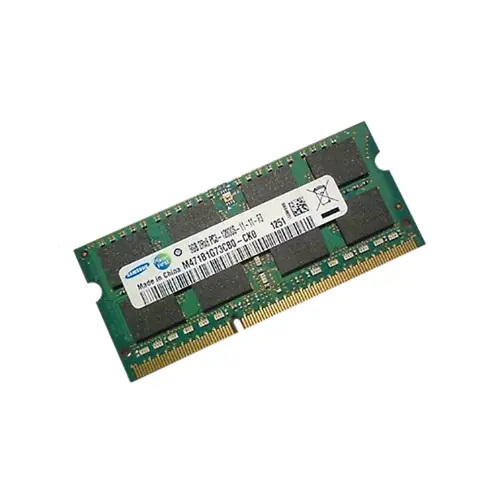
The Samsung M471B1G73CB0-CK0 is a DDR3-1600 SoDIMM engineered specifically for modern notebooks and compact workstations. Its four core attributes directly address the genuine frustrations of mobile computing. First, the Non-ECC, unbuffered design eliminates the signal-register latency found in server memory, giving your processor a direct, zero-delay path to RAM. For a mobile workstation running engineering simulations or financial models, this means complex datasets load without the micro-stutter that disrupts analytical flow. Second, the 204-pin SoDIMM form factor ensures flawless drop-in compatibility across a vast ecosystem of thin-and-light laptops, turning a performance overhaul into a five-minute DIY upgrade. Third, the dual-rank x8 architecture with CL11 timing balances bandwidth and responsiveness brilliantly. When you upgrade a struggling ultrabook to this 8GB module, the interleaved rank access effectively prevents the memory bottleneck that causes freezing during heavy multitasking—imagine a research workflow with multiple virtual desktops, video conferencing, and data dashboards all running concurrently. Finally, because it forgoes the power-hungry parity circuits of ECC memory, it contributes to longer battery life during on-the-go work sessions, which for a road-warrior professional means reaching the deadline without desperately hunting for an outlet.
Laptop Upgrade
This 8GB DDR3-1600 SO-DIMM is ideal for breathing new life into older laptops. If your system currently has a single 4GB or 8GB module, adding a second identical stick enables dual-channel mode, boosting integrated graphics and multitasking. For a straightforward capacity doubling, replace an existing 4GB with two 8GB modules for a total of 16GB – enough for smooth Windows 10/11 operation with dozens of browser tabs and Office apps.
Mobile Workstation
When running demanding applications like CAD, 3D rendering, or large data analysis, maximize capacity within your laptop’s limits. Most DDR3-era mobile workstations accept up to 32GB via two 16GB modules, but if your device supports two 8GB sticks, a 16GB kit will still noticeably improve responsiveness. Always install matched pairs to maintain dual-rank interleaving and avoid performance bottlenecks during memory-intensive tasks.
Ultrabook Power Saving
Standard-voltage DDR3-1600 provides a good balance, but if your ultrabook supports low-voltage DDR3L (1.35V) and you prioritize battery life, consider mixing identical modules with lower voltage support – however, this specific module operates at 1.5V. To reduce power draw, populate only the slots you need; a single 8GB stick consumes less energy than two 4GB sticks, extending runtime on lightweight productivity workloads.
Rigorously tested 8GB DDR3 1600MHz SODIMM, compatible with Dell Latitude E6430, HP EliteBook 8470p, Lenovo ThinkPad T430.
Q: Can I mix this M471B1G73CB0-CK0 with other memory modules of different brands or speeds?
A: Mixing modules of different brands or speeds is not recommended. It may cause instability or force all modules to run at the slowest common speed and relaxed timings, compromising dual‑channel performance.
Q: Is this memory compatible with my system?
A: This DDR3 204‑pin SoDIMM is designed for notebooks. It generally fits Intel 2nd/3rd Gen Core or AMD A‑series platforms. Always verify your laptop’s QVL or manufacturer specifications for definitive compatibility.
Q: What is the recommended DIMM population order for optimal performance?
A: For optimal dual‑channel performance, populate both SoDIMM slots with identical modules. If only one module is installed, place it in the primary slot as indicated in your notebook’s service manual.
Q: Does this module support overclocking or XMP profiles?
A: No. As a JEDEC‑compliant unbuffered SoDIMM, this DDR3 module does not support XMP profiles or overclocking. It operates exclusively at standard DDR3‑1600 speeds with CL11 latency.
Q: What warranty and typical failure rate can I expect?
A: This module includes a 1‑year warranty. Typical annualized failure rate (AFR) is below 0.5%, meeting strict industry standards. Defective units are promptly replaced per our warranty terms.