











 Secure payments
Standard refund policy
Trade Assurance
Secure payments
Standard refund policy
Trade Assurance
| Product Type | Memory Module |
|---|---|
| Compliance Standards | CE,WEEE,RoHS |
| Memory Capacity | 8 GB |
| Memory Technology | DDR3 |
| RAM Speed | 1600 |
| RAM Standard | DDR3-1600/PC3-12800 |
| Signal Type | Unbuffered |
| Column Access Strobe (CAS) | CL11 |
| Rank | Dual Rank x8 |
| Quantity of Pins | 204-pin |
| RAM Genre | SoDIMM |
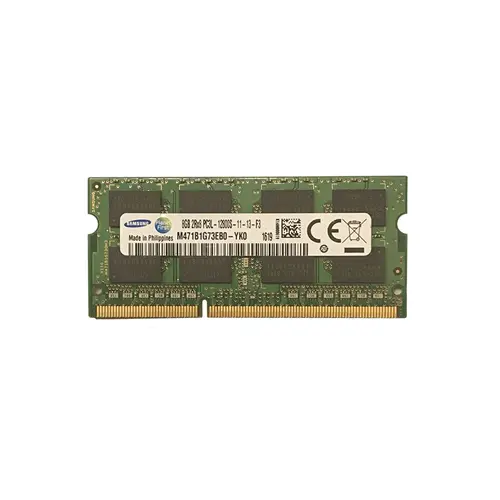
This 8 GB DDR3-1600 SoDIMM with dual-rank x8 organization and a CL11 latency is tailored for notebook and mobile workstation platforms, delivering a plug-and-play upgrade that balances energy efficiency with robust multitasking capability. Its unbuffered design and 204-pin form factor guarantee broad compatibility, while the dual-rank architecture leverages interleaving to maximize bandwidth utilization and reduce access latency in memory-intensive productivity workloads.
1. The SoDIMM form factor plugs directly into compact notebook slots, making memory upgrades tool-free and instantly compatible with ultraportable laptop designs.
2. An 8GB capacity module comfortably handles everyday multitasking, keeping multiple browser tabs, office apps, and video calls running smoothly without swapping to sluggish storage.
3. DDR3 technology ensures drop-in compatibility with a vast installed base of older notebooks, extending system usability without a full platform rebuild.
4. The 1600 MT/s transfer rate provides ample bandwidth for responsive application loading and fluid HD media playback in mainstream mobile environments.
5. CL11 column access latency delivers quick data retrieval that reduces micro-stutter during typical on-the-go productivity, helping the system feel snappy without taxing battery-draining overhead.
As a notebook memory module, the M474B1G73EB0-YK0 brings immediate and tangible benefits to professionals and everyday users alike. Its unbuffered, dual‑rank x8 design means the memory controller can interleave access across two internal ranks, directly boosting multitasking responsiveness when you are running a virtual machine on a mobile workstation while keeping multiple browser tabs, spreadsheets, and communication apps active. Instead of stalling under concurrent loads, your system maintains smooth, predictable performance—critical when every second of productivity counts away from a desk.
The 204‑pin SO‑DIMM form factor and strict JEDEC DDR3‑1600 compliance ensure drop‑in compatibility with an enormous installed base of notebooks, from aging ThinkPads to compact all‑in‑one systems. For a thin‑and‑light upgrade scenario, this removes the guesswork: the module’s CL11 latency hits the sweet spot between speed and power draw, helping preserve battery runtime that road warriors depend on. Meanwhile, international CE, WEEE, and RoHS accreditation provides procurement‑grade peace of mind, guaranteeing that the component meets safety, environmental, and reliability standards in corporate fleets where consistency and warranty validation are non‑negotiable. With 8 GB of capacity, it transforms a sluggish, disk‑thrashing laptop into a genuinely capable companion for field engineering, on‑site data analysis, and daily enterprise tasks.
Based on the specs — DDR3-1600, Unbuffered, 204-pin SoDIMM — this is laptop memory. Here is the capacity planning guide for typical mobile scenarios.
Laptop Upgrade
Replace a single 4 GB module with this 8 GB module for an instant capacity doubling, or pair two identical sticks to achieve 16 GB dual‑channel. Verify that the system supports 8 GB per slot and DDR3-1600; dual‑rank x8 modules like this improve signal integrity on older chipsets and noticeably boost integrated graphics and multitasking.
Mobile Workstation
Maximize professional application performance by installing two of these 8 GB modules as a matched 16 GB dual‑channel kit. This configuration provides enough headroom for CAD, 3D rendering, and large virtual machines, minimizing swapping to slow storage. Confirm the notebook’s maximum supported capacity — many DDR3‑era mobile workstations top out at 16 GB, making this a logical ceiling configuration.
Ultrabook Power Saving
Take advantage of the low‑voltage DDR3L variant (1.35 V) of this module to extend battery runtime. A single 8 GB stick keeps power consumption low while comfortably handling office suites, video streaming, and dozens of browser tabs. If you add a second module for dual‑channel, stick to a matched low‑voltage pair and consider disabling unused hardware to preserve every minute of run time.
Rigorously tested DDR3 8GB SoDIMM, compatible with Dell Latitude E6430, ThinkPad T430, HP EliteBook 8470p.
Q: Can I mix this M474B1G73EB0-YK0 with other memory modules of different brands or speeds?
A: Mixing different brands or speeds may cause instability. For optimal reliability, we recommend installing identical modules. If mixed, the system will default to the slowest speed and least aggressive timings.
Q: Is this memory compatible with my notebook?
A: This 204-pin DDR3-1600 SoDIMM fits notebooks with Intel Core 3rd/4th Gen or AMD A-series platforms. Verify your system supports 1.5V DDR3 SoDIMM and a maximum module capacity of 8 GB.
Q: What is the recommended DIMM population order for optimal performance?
A: In a dual-slot notebook, insert the module into the primary slot (often labeled ‘DIMM0’ or ‘Slot 1’). If installing two modules, any identical pair will deliver dual-channel performance regardless of order.
Q: Does this module support overclocking or XMP profiles?
A: No, this module follows JEDEC standard DDR3-1600 CL11 timings only. It does not support Intel XMP or manual overclocking, ensuring consistent operation within official voltage and speed specifications.
Q: What warranty and typical failure rate can I expect?
A: This product includes a 1-year warranty. The typical annualized failure rate (AFR) for such enterprise-grade Samsung modules is below 0.5% under normal operating conditions, in line with industry reliability standards.