











 Secure payments
Standard refund policy
Trade Assurance
Secure payments
Standard refund policy
Trade Assurance
| Product Type | Memory Module |
|---|---|
| Compliance Standards | EU RoHS,FCC |
| Memory Capacity | 8 GB |
| Memory Technology | DDR3 |
| RAM Speed | 1600MHz |
| RAM Standard | DDR3-1600/PC3-12800 |
| Error Identifying | Non-ECC |
| Signal Type | Unbuffered |
| Column Access Strobe (CAS) | CL11 |
| Rank | Dual Rank x8 |
| Quantity of Pins | 240-pin |
| RAM Genre | UDIMM |
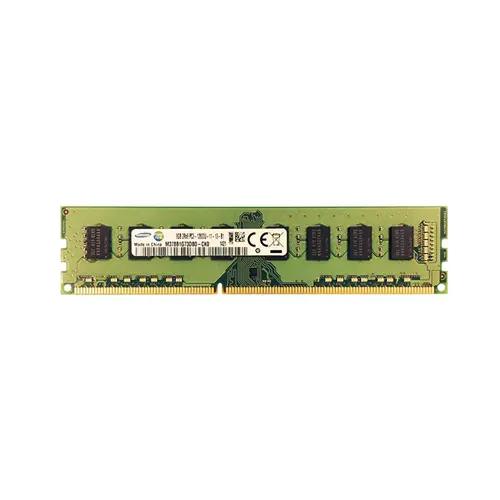
This 8GB DDR3-1600 UDIMM targets mainstream desktop platforms, ideally suited for multitasking productivity, legacy gaming rigs, and content creation where reliable non-ECC throughput is essential. Its dual-rank x8 organization boosts command/address bus utilization through interleaved bank access, while the unbuffered signal type and CL11 timing keep latency low for responsive everyday performance.
1. An eight-gigabyte capacity provides enough headroom for modern gaming and content creation suites, preventing stutters when multitasking between browser tabs, media players, and demanding applications.
2. A sixteen-hundred-megahertz transfer rate delivers the memory bandwidth needed for smooth texture streaming and faster video rendering, keeping frame delivery consistent in detailed scenes.
3. An eleven-cycle CAS latency sharpens input-to-display reaction speed, giving competitive gamers finer control and reducing micro-lag during fast-paced firefights.
4. Dual-rank by-eight organization interleaves memory accesses for higher effective throughput, sustaining peak performance when background processes compete for system resources.
5. The unbuffered signal path shaves away controller latency, enabling snappier command execution that benefits overclocking headroom and real-time editing responsiveness.
The Samsung M378B1G73DB0-CK0 is a desktop UDIMM, and its design directly addresses the pain points of enthusiasts and professionals who demand snappy, reliable performance without the overhead of server-grade features.
First, its unbuffered, non-ECC architecture eliminates the additional latency that registered memory introduces. In a 3A gaming scenario, every nanosecond counts when the CPU is hammering the memory controller with draw calls and physics calculations. This direct communication path means cleaner frame pacing and reduced micro-stutter. Second, the DDR3-1600 speed with a CL11 CAS latency hits a practical sweet spot for older platforms, breathing new life into systems that cannot leverage newer standards. When rendering a complex 4K timeline in Adobe Premiere, that 12.8GB/s bandwidth keeps massive sequential read and write operations flowing smoothly, preventing dropped frames during preview. Third, the dual-rank x8 organization interleaves memory banks, allowing the memory controller to hide refresh cycles and access data more efficiently under heavy multitasking. This translates to a perceptibly smoother desktop experience when you have a game, streaming software, and dozens of browser tabs combating for resources. Finally, strict EU RoHS and FCC compliance guarantees long-term stability and signal integrity, crucial for the 24/7 reliability required during overnight rendering jobs where a single bit error from inferior modules could corrupt hours of work. This module is a genuine upgrade that treats your desktop’s responsiveness like the priority it should be.
Gaming Build
For a responsive gaming rig, install two 8GB modules in dual-channel mode to achieve 16GB total, which eliminates memory bottlenecks for modern titles and streaming. The DDR3-1600 speed and CL11 timings provide smooth frame pacing, though dual-rank x8 chips slightly trade latency for density. A 32GB kit (4x8GB) offers future-proofing but is only beneficial if you run heavily modded games or background virtual machines.
Content Creation
Video editing and 3D rendering demand high capacity; populate all four DIMM slots with 8GB modules to reach 32GB or extend to a 64GB configuration using 8GB sticks where the motherboard supports it. The dual-rank UDIMMs improve rank interleaving under sustained write loads, and 1600MHz bandwidth handles 4K proxy workflows without choking. For dedicated rendering workstations, prioritize capacity over extreme frequency.
General Productivity
A cost-effective office setup runs a single 8GB stick, leaving an open slot for future expansion to 16GB. This entry-level configuration comfortably handles spreadsheet multitasking, web browsing with dozens of tabs, and light photo editing. Add a matching second module later when budget permits, gaining dual-channel bandwidth that accelerates integrated graphics performance in typical office apps.
Validated strictly for desktop compatibility: fits Dell OptiPlex 9020, HP EliteDesk 800 G1, Lenovo ThinkCentre M93p.
Q: Can I mix this M378B1G73DB0-CK0 with other memory modules of different brands or speeds?
A: Mixing is possible but not recommended. The system will downclock all modules to the slowest speed and may experience stability issues due to unmatched timings, voltage, or memory IC characteristics.
Q: Is this memory compatible with my system?
A: It is compatible with desktop motherboards supporting DDR3 UDIMMs with 240-pin slots. Confirm your motherboard chipset supports DDR3-1600/PC3-12800 and unbuffered, non-ECC memory, such as Intel 6/7/8/9 Series or AMD FM1/FM2/AM3+ platforms.
Q: What is the recommended DIMM population order for optimal performance?
A: Install in identical pairs using the same-color slots to enable dual-channel mode. For a single dual-rank x8 module on this desktop platform, any available slot works, but populate the primary channel (usually slot A1) first.
Q: Does this module support overclocking or XMP profiles?
A: This module complies with JEDEC DDR3-1600 (PC3-12800) standard and does not include XMP profiles. Manual overclocking via BIOS is possible but not covered under warranty as it exceeds JEDEC specifications.
Q: What warranty and typical failure rate can I expect?
A: This product includes a one-year warranty. It meets high reliability standards, with typical annualized failure rates below 0.5% under normal operating conditions for desktop DDR3 UDIMM modules.