











 Secure payments
Standard refund policy
Trade Assurance
Secure payments
Standard refund policy
Trade Assurance
| Model | M393B1K70DH0-CK0QB |
|---|---|
| Product Type | Memory Module |
| Compliance Standards | EU RoHS,FCC |
| Memory Capacity | 8 GB |
| Memory Technology | DDR3 |
| Product Voltage | 1.5V |
| RAM Speed | 1600MHz |
| RAM Standard | DDR3-1600/PC3-12800 |
| Error Identifying | ECC |
| Signal Type | Registered |
| Column Access Strobe (CAS) | CL11 |
| Rank | Dual Rank x4 |
| Quantity of Pins | 240-pin |
| RAM Genre | RDIMM |
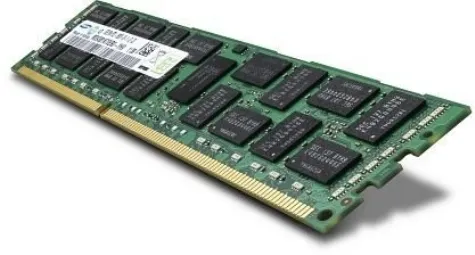
This Samsung M393B1K70DH0-CK0QB is a DDR3-1600 registered ECC RDIMM engineered for server platforms requiring uncompromised data integrity, making it ideally suited for virtualization farms and in‑memory databases where silent data corruption is impermissible. Its dual‑rank x4 organization and registered signaling ensure stable signal integrity across fully populated memory channels, allowing consistent 1600 MT/s operation even under heavy sustained load.
1. ECC error correction detects and fixes single-bit data errors in real time, protecting transactional databases from silent corruption that could otherwise crash entire services.
2. Registered signal buffering stabilizes command and address lines under fully populated configurations, letting virtualization platforms scale up memory capacity without sacrificing signal integrity.
3. Dual Rank x4 organization keeps multiple memory banks active simultaneously through rank interleaving, sustaining consistent bandwidth for heavily consolidated virtual machines.
4. Delivering PC3-12800 peak throughput, this module supplies ample memory bandwidth for mid-range enterprise workloads such as web serving, collaboration, and lightweight analytics.
5. An 8 GB capacity per stick enables granular memory provisioning, allowing infrastructure teams to right-size cloud nodes economically while maintaining headroom for containerized microservices.
The Samsung M393B1K70DH0-CK0QB is a server-grade DDR3 RDIMM, and its four defining characteristics directly answer the critical demands of data center workloads. The registered buffer re-drives address and command signals, enabling a single server board to support large memory populations without electrical degradation—essential when you are scaling to hundreds of gigabytes for dense virtualization clusters, where every VM needs guaranteed memory isolation. The integrated ECC engine continuously detects and corrects single-bit errors, preventing silent data corruption in write-intensive memory databases like Redis or in-memory OLTP; one uncorrected bit flip can crash a financial transaction or corrupt a long-running analytics job. Its dual-rank x4 organization interleaves accesses across two internal ranks, significantly improving bandwidth under heavy concurrent loads by overlapping row activation cycles—this translates directly into higher VM density and faster query response times during peak hours. Running at 1600MHz with a CL11 latency, the module balances throughput and access time, ensuring that even bursty, latency-sensitive applications, such as virtualized middleware handling millions of API calls, never stall waiting for data. Together, these features turn raw capacity into dependable, high-performance enterprise memory.
This 8GB DDR3-1600 Registered ECC RDIMM (M393B1K70DH0-CK0QB) is strictly a server-grade module, built for multi-socket systems requiring 24/7 data integrity. The following capacity plans apply its 1.5V, dual-rank x4 organization and ECC to typical enterprise workloads.
General Virtualization
Populate all memory channels identically to maximize bandwidth and VM density. For a dual-socket server with eight channels per CPU, install two 8GB DIMMs per channel (16 modules per socket, 256GB total) to balance cost and performance. The registered ECC eliminates single-bit errors that could corrupt guest states, while dual-rank interleaving boosts throughput for mixed workloads.
In-Memory Database
Minimize swap latency by maximizing capacity with speed-matched 8GB sticks. Fully load every channel—e.g., 24 x 8GB (192GB) across three channels per CPU—keeping the entire dataset resident. The CL11 CAS latency and x4 organization ensure fast, parallel access. ECC correction is vital here: memory bit-flips can silently corrupt indexed tables, so registered RDIMMs guarantee the data durability real-time analytics demand.
High-Performance Computing (HPC)
Bandwidth dictates performance. Install one DIMM per channel (1DPC) to run at the full 1600MT/s without downclocking. A dual-socket node with four channels per CPU should use eight identical 8GB modules (64GB total), leaving slots free for future scaling. Consistently matching the dual-rank x4 configuration across CPUs maintains symmetric memory access, avoiding NUMA imbalance that would stall scientific simulations.
Validated server memory, compatible with Dell PowerEdge R720, HP ProLiant DL380p Gen8, and Lenovo ThinkServer RD430.
Q: Can I mix this M393B1K70DH0-CK0QB with other memory modules of different brands or speeds?
A: Mixing is not recommended for server environments. Different brands or speeds can cause instability. Always use identical modules with the same speed, rank, and ECC registered configuration to ensure reliable operation.
Q: Is this memory compatible with my system?
A: This DDR3-1600 ECC Registered RDIMM is designed for select Intel Xeon E5-2400/2600 and AMD Opteron 6300 series platforms. Please verify your server motherboard's qualified vendor list for 8GB 1.5V dual-rank x4 modules.
Q: What is the recommended DIMM population order for optimal performance?
A: Follow your server board manual's population guidelines. Typically, populate identical DIMMs per channel starting with the farthest slot from the CPU. Balance memory across all memory channels for optimal bandwidth.
Q: Does this module support overclocking or XMP profiles?
A: No. This is an enterprise-grade ECC Registered module operating at JEDEC standard DDR3-1600 with CL11 latency. Overclocking and XMP are not supported to guarantee data integrity and stability.
Q: What warranty and typical failure rate can I expect?
A: This module is covered by a one-year warranty. The estimated annualized failure rate (AFR) is low, typically between 0.2% and 0.5% under normal server operating conditions, ensuring high reliability.