











 Secure payments
Standard refund policy
Trade Assurance
Secure payments
Standard refund policy
Trade Assurance
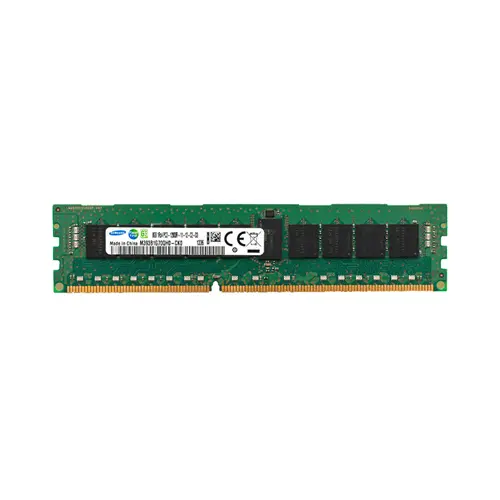
| Model | M393B1G70QH0-CK0Q9 |
|---|---|
| Product Type | Memory Module |
| Compliance Standards | EU RoHS,FCC |
| Memory Capacity | 8 GB |
| Memory Technology | DDR3 |
| Product Voltage | 1.5V |
| RAM Speed | 1600MHz |
| RAM Standard | DDR3-1600/PC3-12800 |
| Error Identifying | ECC |
| Signal Type | Registered |
| Column Access Strobe (CAS) | CL11 |
| Rank | Single Rank x4 |
| Quantity of Pins | 240-pin |
| RAM Genre | RDIMM |
Evaluating the M393B1G70QH0-CK0Q9, this DDR3-1600 Registered ECC module is unequivocally server-class memory, purpose-built for virtualization clusters, in-memory databases, and other mission-critical enterprise workloads where data integrity is non-negotiable. Its registered signal architecture stabilizes high-density deployments by buffering command/address lines, while the integrated ECC engine provides single-bit error correction, and the single-rank x4 organization optimizes bank-level parallelism for consistent low-latency access under heavy, concurrent loads.
1. ECC protection quietly corrects single-bit errors in real time, safeguarding transactional integrity and eliminating silent data corruption in always-on cloud and database servers.
2. Registered DIMM architecture buffers command and address signals to preserve electrical stability, enabling fully-loaded server boards to operate reliably under sustained heavy workloads.
3. Generous module capacity allows hosting more virtual machines per node, directly improving consolidation ratios and lowering total cost of ownership in dense data centers.
4. DDR3-1600 bandwidth accelerates large in-memory caches and frequent page swaps, cutting response time for virtual desktops and high-concurrency web applications.
5. Single-rank design reduces bus loading, maintaining peak signal headroom and consistent latency when all memory channels are populated across multi-socket server platforms.
Built for the data center, the M393B1G70QH0-CK0Q9 is an 8GB DDR3-1600 Registered ECC DIMM, meticulously engineered to meet the unforgiving demands of server environments. Its four defining characteristics translate directly into mission-critical reliability where failure is not an option. In a dense virtualization cluster hosting dozens of VMs, ECC memory correction silently intercepts and repairs single-bit errors caused by background radiation before they can corrupt hypervisor data or destabilize guest operating systems—preventing random crashes that would cascade across your infrastructure. Simultaneously, the Registered signal buffer stabilizes the electrical load on the memory bus, enabling the server to reliably support higher-density memory configurations without signal degradation, so you can confidently maximize your VM density. For in-memory databases like SAP HANA or high-transaction Redis clusters, the DDR3-1600 speed and Single Rank x4 organization deliver a balanced blend of high bandwidth and low-latency access, shrinking query response times and accelerating real-time analytics under heavy concurrent loads. That means consistent performance during peak trading hours or instantaneous fraud detection without data integrity compromises. Every byte is protected, every transaction is accurate, and your uptime is secured—this module turns raw memory specifications into a foundation for business continuity.
General Virtualization
For a typical hypervisor hosting multiple VMs, populate at least six identical 8 GB RDIMMs across three memory channels per CPU to balance capacity and bandwidth. This permits 48 GB to 96 GB per socket, comfortably supporting dozens of light to medium workloads. Use identical Samsung M393B1G70QH0 modules to maintain uniform rank and timing, avoiding performance penalties from mixed-configuration non-uniform memory access.
In-Memory Database
In-memory databases demand large, low-latency heaps, so maximize capacity per channel with two dual-rank or four single-rank modules. Aim for a minimum of 128 GB (16 × 8 GB) per node, fully populating all DIMM slots if possible. The registered ECC design of this Samsung RDIMM ensures data integrity under sustained high throughput, while 1600 MHz CL11 provides the low latency required for real-time transactions.
High-Performance Computing
HPC workloads leverage memory bandwidth aggressively; configure one RDIMM per channel to achieve the highest possible clock speed without dropping to slower ranks. For a dual-socket system, install 12 identical 8 GB modules (six per CPU) to deliver 96 GB of balanced, high-bandwidth capacity. The single-rank x4 organization helps maintain 1600 MHz operation, crucial for memory-bound simulation and modeling codes.
Rigorously tested server memory. Compatible with Dell PowerEdge R720, HP ProLiant DL380p Gen8, IBM System x3650 M4.
Q: Can I mix this M393B1G70QH0-CK0Q9 with other memory modules of different brands or speeds?
A: Mixing is not recommended. Registered DDR3 modules should be identical in speed, rank, and timings to avoid signal integrity issues and ensure stable server operation.
Q: Is this memory compatible with my system? Which Intel or AMD platforms are supported?
A: It is compatible with servers supporting DDR3 Registered ECC memory, such as Intel Xeon E5-2600 v1/v2 series or select AMD Opteron 6300 platforms. Verify motherboard qualification.
Q: What is the recommended DIMM population order for optimal performance?
A: Follow the server motherboard's population guide. Typically, populate identical DIMMs in matched slots per memory channel, starting with slot 1 in each channel for balanced interleaving.
Q: Does this module support overclocking or XMP profiles?
A: No. As a server-grade Registered ECC DIMM, it operates strictly at JEDEC-standard DDR3-1600 with fixed timings and does not support overclocking or XMP profiles.
Q: What warranty and typical failure rate can I expect?
A: This module includes a one-year warranty. Typical failure rates are very low, reflecting rigorous manufacturing standards, with expected AFR well below industry averages.