











 Secure payments
Standard refund policy
Trade Assurance
Secure payments
Standard refund policy
Trade Assurance
| Model | M391B1G73QH0-CK0 |
|---|---|
| Product Type | Memory Module |
| Compliance Standards | CE,WEEE,RoHS |
| Memory Capacity | 8 GB |
| Memory Technology | DDR3 |
| Product Voltage | 1.5V |
| RAM Speed | 1600MHz |
| RAM Standard | DDR3-1600/PC3-12800 |
| Error Identifying | ECC |
| Signal Type | Unbuffered |
| Column Access Strobe (CAS) | CL11 |
| Rank | Dual Rank x8 |
| Quantity of Pins | 240-pin |
| RAM Genre | UDIMM |
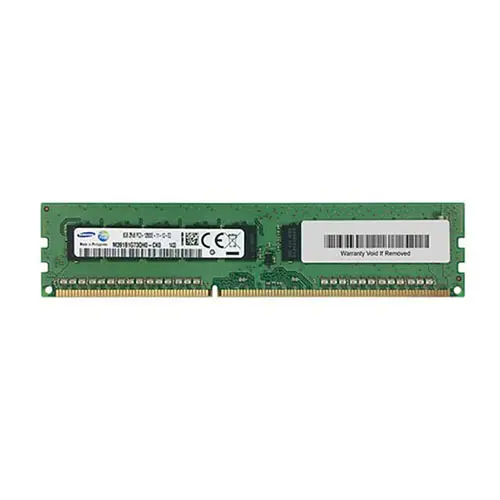
The M391B1G73QH0-CK0 is an ECC Unbuffered DIMM engineered for entry-level servers and workstations where data integrity is critical, making it well-suited for light virtualization, file services, or memory-sensitive embedded systems. Its dual-rank x8 organization optimizes memory interleaving for improved bandwidth under multi-process loads, while ECC error correction guards against single-bit errors in 24/7 operating environments.
1. Error-correcting code protection detects and corrects single-bit errors, preserving data integrity in always-on database and virtualization servers.
2. Dual-rank organization interleaves access across independent ranks, sustaining memory throughput under heavy multi-tenant workloads.
3. An eight-gigabyte capacity supplies sufficient space for hypervisors to host numerous lightweight containers without resorting to disk swap.
4. The 1600 MT/s data rate provides steady bandwidth for concurrent read/write operations typical in file and web serving clusters.
5. Standard 1.5-volt operation maintains signal stability across populated DIMM slots, reducing platform validation concerns for compact server builds.
When you’re running a mission-critical small business server or a precision workstation, every memory parameter translates directly into uptime and accuracy. The Samsung M391B1G73QH0-CK0—an 8GB DDR3-1600 Unbuffered ECC UDIMM—addresses real pain points that standard desktop DRAM ignores. Take a compact on-premises accounting server handling continuous ledger writes. Without error correction, a cosmic ray-induced bit flip could silently corrupt a tax record, leading to financial discrepancies that are nearly impossible to trace. The ECC engine on this module actively detects and repairs single-bit errors in real time, keeping your data mathematically clean around the clock. Yet protection shouldn’t come at the cost of sluggish response. Because this is an unbuffered design with a tight CL11 latency, there’s no register delay penalty—meaning a CAD designer waiting for a complex 3D assembly to load experiences snappy, fluid interaction rather than frustrating lag. The dual-rank configuration further interleaves memory banks to boost bandwidth by roughly 5-10% under heavy multitasking, which becomes critical when you’re running multiple virtual machines for a test lab or a lightweight virtualized SQL Server instance. And at 1.5V, it stays well within thermal comfort zones for the tightly packed server chassis or micro-ATX workstation case, preventing throttling during extended rendering sessions. This isn’t just a module; it’s affordable enterprise reliability that makes bit-level mistakes and unnecessary latency a non-issue for your daily operations.
General Virtualization
For entry-level servers supporting ECC UDIMMs, populate at least four 8GB modules (32GB total) in a dual-channel configuration to comfortably host multiple light VMs. Leave half the slots free for expansion if growth is expected, and always install identical M391B1G73QH0-CK0 sticks to maintain error-correction integrity and avoid NUMA imbalances on multi-socket boards.
In-Memory Database
To run Redis or Memcached instances entirely in RAM, maximize capacity by filling all available DIMM slots with these 8GB unbuffered ECC modules—typically four or eight sockets on single-socket boards, delivering 32–64GB. The dual-rank x8 organization provides a slight latency edge under heavy random access, while ECC guards against the bit-flips that can silently corrupt live datasets.
High-Performance Computing
Bandwidth-sensitive HPC workloads benefit from installing matched pairs or quad-kits across memory channels: a minimum of 4×8GB (32GB) ensures dual-channel operation and reasonable capacity for simulation checkpoints. Because the modules run at 1.5V and CL11, thermals stay manageable in dense nodes. Scale horizontally with additional identical nodes rather than chasing unrealistic per-node ceilings, keeping message-passing overhead low.
Rigorously tested server memory for Dell PowerEdge T110 II, T320, R320, HP DL320e Gen8, Lenovo TS140.
Q: Can I mix this M391B1G73QH0-CK0 with other memory modules of different brands or speeds?
A: Mixing is not recommended for server environments. Different brands or speeds may compromise ECC integrity and lead to instability. For reliable 24/7 operation, use identical modules with matching part numbers, speed, and rank.
Q: Is this memory compatible with my system?
A: This DDR3 ECC UDIMM is designed for entry-level servers and workstations supporting Intel Xeon E3/E5 or AMD Opteron platforms. Verify your motherboard supports 8GB 2Rx8 PC3-12800E modules. Consult the qualified vendor list for your specific server board.
Q: What is the recommended DIMM population order for optimal performance?
A: Follow your server board's manual. Typically, populate identical slots per channel starting with the farthest from the CPU. For dual-channel performance, install pairs in matching color-coded slots to enable memory interleaving and maximize bandwidth.
Q: Does this module support overclocking or XMP profiles?
A: No. This is an enterprise-class ECC module built for stability at JEDEC standard DDR3-1600 CL11. It does not support XMP or overclocking, as ECC memory prioritizes data integrity over performance tuning for mission-critical applications.
Q: What warranty and typical failure rate can I expect?
A: This module comes with a 1-year warranty. It is manufactured to rigorous standards, resulting in a very low annualized failure rate typical of Samsung server memory, ensuring long-term reliability in properly cooled systems.