











 Secure payments
Standard refund policy
Trade Assurance
Secure payments
Standard refund policy
Trade Assurance
| Model | M393B1G70BH0-CMA |
|---|---|
| Product Type | Memory Module |
| Compliance Standards | EU RoHS,FCC |
| Memory Capacity | 8 GB |
| Memory Technology | DDR3 |
| Product Voltage | 1.5V |
| RAM Speed | 1866MHz |
| RAM Standard | DDR3-1866/PC3-14900 |
| Error Identifying | ECC |
| Signal Type | Registered |
| Column Access Strobe (CAS) | CL13 |
| Rank | Single Rank x4 |
| Quantity of Pins | 240-pin |
| RAM Genre | RDIMM |
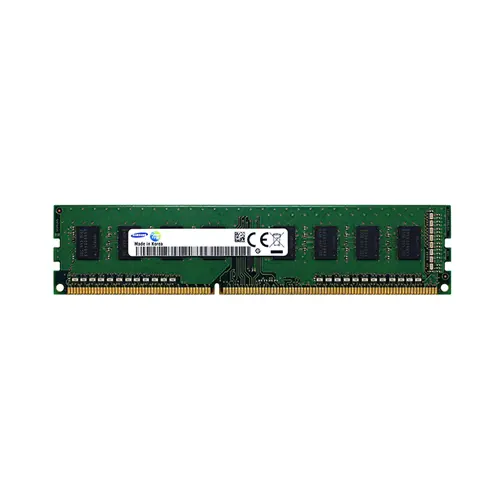
This Samsung 8GB DDR3-1866 Registered ECC RDIMM is purpose-built for server and enterprise platforms running virtualization, in-memory databases, and data-critical applications that demand uncompromising data integrity. Its single-rank x4 configuration paired with registered signal buffering and ECC error correction delivers stable, low-latency CL13 performance at 1866MT/s, effectively preventing single-bit errors and ensuring reliable operation under sustained heavy loads.
1. ECC protection silently detects and corrects single-bit errors in real time, preserving transactional accuracy and preventing costly downtime for virtualized databases.
2. Registered buffering reinforces signal integrity across heavily populated memory channels, enabling stable scaling of virtual machines without compromising system reliability.
3. The 1866 MT/s data rate supplies consistent bandwidth to handle concurrent user requests in multi-tenant hosting and private cloud platforms.
4. Single Rank x4 organization minimizes electrical loading and thermal output, sustaining low-latency responsiveness under 24/7 enterprise workloads.
5. An 8GB module provides a right-sized capacity building block for entry-level virtualization nodes, balancing memory-per-core ratios while optimizing infrastructure cost.
The M393B1G70BH0-CMA is a server-grade DDR3 RDIMM, purpose-built for environments where data integrity and unwavering stability are non-negotiable. Its four defining characteristics directly answer the real pain points of IT infrastructure. The Registered signal type buffers command and address signals, dramatically reducing the electrical load on the memory controller. For a virtualization cluster hosting dozens of VMs on a single node, this means you can populate all memory channels without risking signal degradation or sudden host crashes—your multi-tenant workloads remain isolated and reliably online around the clock. Meanwhile, the integrated ECC engine actively corrects single-bit errors caused by background radiation. In an in-memory database like Redis or SAP HANA, this prevents silent data corruption that could cascade into flawed financial transactions or corrupted user sessions. The 1866MHz speed with CL13 latency and Single Rank x4 organization strikes a critical balance: the single-rank architecture accelerates burst access to frequently requested data, lowering query latency in high-concurrency OLTP scenarios where every microsecond of response time impacts customer experience. Together, these features transform an 8GB module into a safeguard for business continuity—reducing emergency maintenance, protecting data fidelity, and ensuring that your databases and virtualized services deliver consistent performance under continuous pressure.
Capacity Planning Guidance for DDR3-1866 ECC RDIMM (8GB Module)
The M393B1G70BH0-CMA is a server-grade DDR3 Registered DIMM with ECC, optimized for stability in multi-socket platforms. When planning capacity with these 8GB modules, align channel population and total memory to workload demands.
General Virtualization
Populate all memory channels symmetrically—typically three or four modules per CPU—to maximize interleaving and bandwidth for dense VM hosting. For moderate consolidation, 12 modules (96GB) per dual-socket server provide headroom, while high-density hosts benefit from 16 or more modules (128GB+), respecting the platform’s 1.5V power budget.
In-Memory Database
Prioritize large capacity footprints by fully populating all DIMM slots using 8GB RDIMMs, often reaching 256GB or 512GB. Configure memory in a balanced rank-per-channel arrangement to sustain low-latency access under heavy write traffic, and ensure ECC protection guards against data corruption in persistent caching layers.
High-Performance Computing (HPC)
Focus on per-core capacity balance and bandwidth. A typical dual-socket node with eight channels demands eight or sixteen 8GB modules (64–128GB) for memory-bound simulations. Use identical modules across all channels to maintain uniform latency and avoid NUMA performance penalties, critical at 1866 MT/s CL13 timing.
Rigorously tested for compatibility with Dell PowerEdge R720, HP ProLiant DL380p Gen8, IBM System x3650 M4, and more.
Q: Can I mix this M393B1G70BH0-CMA with other memory modules of different brands or speeds?
A: Mixing is strongly discouraged in server environments. This registered ECC RDIMM should operate with identical modules to guarantee signal integrity and prevent stability issues. Even slight variations may cause unbootable systems or memory errors.
Q: Is this memory compatible with my system?
A: Compatibility depends on your server platform (Intel Xeon or AMD Opteron). Verify that the motherboard supports DDR3-1866 registered ECC RDIMMs. We recommend checking the memory QVL list for your specific server model to ensure compatibility.
Q: What is the recommended DIMM population order for optimal performance?
A: Populate channels symmetrically, typically starting with the first white slot per channel. Refer to your server's manual for the exact population order to enable interleaving and maximize memory bandwidth. All channels should be balanced for optimal performance.
Q: Does this module support overclocking or XMP profiles?
A: No, server memory operates at standard JEDEC profiles only. This DDR3-1866 RDIMM runs at its rated speed and timings without overclocking support. Overclocking is not applicable to registered ECC memory designed for stable 24/7 operation.
Q: What warranty and typical failure rate can I expect?
A: This module carries a 1-year warranty. Typical early-life failure rate is very low, in line with enterprise-class components. Proper handling and compatible systems minimize failures; our experienced failure rate remains under 0.5 percent annually.