











 Secure payments
Standard refund policy
Trade Assurance
Secure payments
Standard refund policy
Trade Assurance
| Model | M393B1G70EB0-CMA |
|---|---|
| Product Type | Memory Module |
| Compliance Standards | EU RoHS,FCC |
| Memory Capacity | 8 GB |
| Memory Technology | DDR3 |
| Product Voltage | 1.5V |
| RAM Speed | 1866MHz |
| RAM Standard | DDR3-1866/PC3-14900 |
| Error Identifying | ECC |
| Signal Type | Registered |
| Column Access Strobe (CAS) | CL13 |
| Rank | Single Rank x4 |
| Quantity of Pins | 240-pin |
| RAM Genre | RDIMM |
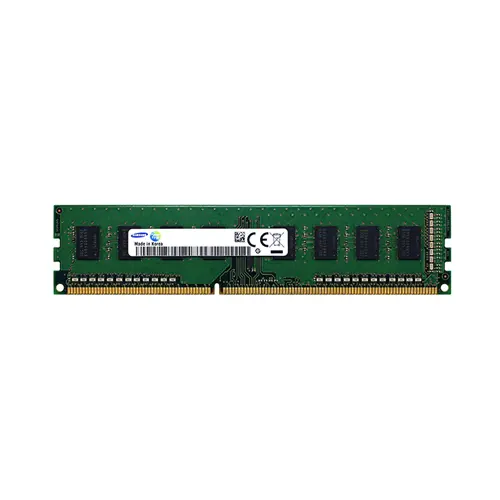
Designed as a DDR3-1866 Registered ECC RDIMM, this module is optimized for legacy server platforms running memory-intensive workloads such as virtualization and in-memory databases. Its x4 Single-Rank configuration minimizes electrical loading on the memory bus, while Registered signaling and ECC ensure signal integrity and data reliability in multi-DIMM configurations.
1. ECC continuously catches and corrects single-bit errors, preserving data integrity for financial transactions and virtualized database workloads where even minor corruption is unacceptable.
2. Registered DIMM buffers the command and address buses, enabling fully populated server boards to scale memory capacity for high VM density without sacrificing signal stability.
3. Single Rank x4 organization isolates failures at the DRAM chip level, strengthening advanced ECC modes like Chipkill to keep mission-critical services online during hardware faults.
4. 1866 MT/s throughput delivers up to 14.9 GB/s per channel, reducing latency in memory-resident analytics and improving responsiveness under heavy multi-tenant hosting.
5. The 8 GB module acts as a balanced capacity building block, allowing granular memory provisioning for lightweight virtualized nodes while maintaining low power and cost profiles.
When you operate a virtualized cluster or an in‑memory database like Redis, you are not merely adding hardware—you are underwriting business continuity. The M393B1G70EB0-CMA, a DDR3-1866 Registered ECC DIMM, tackles exactly the pains that keep IT managers awake. Its error‑correcting code (ECC) is your silent guardian against single‑bit flips caused by background radiation; in a 24/7 trading database, one uncorrected error can cascade into transaction corruption that no backup will easily unwind. The registered signal buffer makes the real difference once you populate multiple DIMMs per channel. Without it, the memory controller struggles with electrical loading, leading to intermittent boot failures or mysterious crashes under the heavy context‑switching of dozens of virtual machines. What that means for you is a VMWare host that stays up predictably even with all slots filled. The single‑rank x4 organization helps here by keeping the chip count low while tightening latencies—your memcached instance responds faster because fewer ranks mean shorter turnaround time for random accesses. Finally, 1866 MT/s bandwidth feeds the pipeline of real‑time analytics, ensuring that large in‑memory datasets flow smoothly into the processor and reducing the latency spikes that erode end‑user patience. This memory does not simply meet a spec sheet; it translates into fewer outages, sharper database responses, and a virtual infrastructure you can truly trust.
General Virtualization
Populate all memory channels evenly with identical M393B1G70EB0-CMA RDIMMs to maximize throughput and avoid NUMA penalties. Start with one 8 GB DIMM per channel (e.g., 6 × 8 GB for a dual-socket hexa-channel platform) to balance density and cost for moderate VM densities, then scale to two DIMMs per channel only when consolidation ratios demand more capacity without sacrificing the 1866 MT/s frequency.
In-Memory Database
Favor maximum capacity over speed, as these workloads live entirely in RAM. Use the largest supported number of these 8 GB single-rank x4 RDIMMs per server—typically 24 or more—to build a low-latency, error-correcting memory pool that can hold multi-terabyte datasets in a single node. Keep memory ranks per channel at 8 (e.g., two quad-rank-equivalent arrangements) to stay within the platform’s rated speed, even though occasional BIOS tuning may be needed.
High-Performance Computing
Configure one 8 GB DIMM per populated channel to keep the memory bus at the full 1866 MHz and lowest CAS 13 latency. This matches the single-rank x4 design’s strength for bandwidth-sensitive simulations and modeling. For dual-socket nodes, a balanced 12 × 8 GB or 16 × 8 GB setup delivers optimum GB/s per core while ECC and registered signaling ensure data integrity across long cluster runs.
Strictly tested server memory, compatible with Dell PowerEdge R720, HP DL380p Gen8, IBM x3650 M4.
Q: Can I mix this M393B1G70EB0-CMA with other memory modules of different brands or speeds?
A: Mixing brands or speeds is not recommended for this registered ECC server module. Consistency ensures signal integrity and system stability. Always populate with identical part numbers across all channels for validated performance.
Q: Is this memory compatible with my system?
A: This is a DDR3 Registered DIMM for Intel Xeon E5/E7 and AMD Opteron platforms. Verify your server board requires 240-pin RDIMMs, supports 1866 MT/s, and has compatible rank/RAS features. Check the manufacturer’s QVL list.
Q: What is the recommended DIMM population order for optimal performance?
A: Populate DIMMs in matched sets by channel, starting with blue slots typically. Refer to your server’s population guide to balance memory across memory controllers, utilizing symmetric ranks and capacities for maximum bandwidth and reliability.
Q: Does this module support overclocking or XMP profiles?
A: No. This enterprise-grade ECC module is built to JEDEC standards for compliance and stability. It does not support overclocking or XMP profiles, prioritizing error correction and 24/7 operational certainty over performance tuning.
Q: What warranty and typical failure rate can I expect?
A: This module is backed by a 1-year warranty covering manufacturing defects. Owing to rigorous binning and ECC resilience, typical failure rates remain extremely low in properly cooled, rated enterprise environments.