











 Secure payments
Standard refund policy
Trade Assurance
Secure payments
Standard refund policy
Trade Assurance
| Model | M393B1G70QH0-CMAQ8 |
|---|---|
| Product Type | Memory Module |
| Compliance Standards | EU RoHS,FCC |
| Memory Capacity | 8 GB |
| Memory Technology | DDR3 |
| Product Voltage | 1.5V |
| RAM Speed | 1866MHz |
| RAM Standard | DDR3-1866/PC3-14900 |
| Error Identifying | ECC |
| Signal Type | Registered |
| Column Access Strobe (CAS) | CL13 |
| Rank | Single Rank x4 |
| Quantity of Pins | 240-pin |
| RAM Genre | RDIMM |
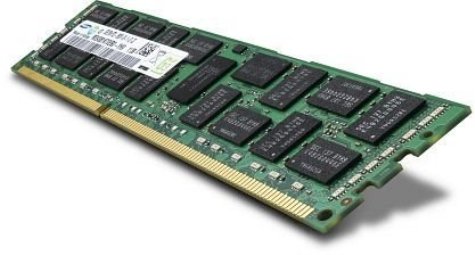
The M393B1G70QH0-CMAQ8 is a server-class DDR3-1866 Registered ECC RDIMM, purpose-built for legacy enterprise platforms running virtualization, in-memory databases, or any mission-critical workload where data integrity and signal stability are non-negotiable. Its Single Rank x4 organization, combined with a tight CL13 latency and a registered buffer, minimizes electrical loading and bank conflicts, delivering consistent low-latency access alongside hardware-level single-bit error correction for maximum uptime.
1. ECC protection silently corrects single-bit memory errors, preserving data integrity for virtualized workloads and preventing silent corruption in critical database transactions.
2. Registered signal buffering stabilizes electrical loads across fully populated server channels, enabling higher memory densities without compromising uptime in large-scale virtualization clusters.
3. 1866MHz frequency boosts per-channel bandwidth, accelerating in-memory analytics and cache-heavy application throughput under concurrent user loads.
4. Single Rank x4 organization balances loading on the memory bus, ensuring consistent command/address timing for predictable performance in dense rack deployments.
5. CL13 latency tightens access timing, reducing request-to-response delays for latency-sensitive services like real-time financial processing and online transaction systems.
Designed for the rigorous demands of enterprise computing, the Samsung M393B1G70QH0-CMAQ8 RDIMM is engineered with features that directly translate to fewer outages and faster insights. In a dense virtualization cluster hosting dozens of VMs, the Registered signal buffer stabilizes the memory bus by reducing electrical load on the CPU’s memory controller. This means you can populate all 24 DIMM slots without sacrificing signal integrity, confidently scaling memory capacity to support more tenants per host. Simultaneously, the integrated ECC systematically detects and corrects single-bit errors caused by background radiation, effectively preventing silent data corruption that could crash a critical virtual machine or corrupt financial transactions.
For in-memory databases like Redis or SAP HANA, the module’s DDR3-1866 speed and CL13 latency deliver rapid data access, but the often-overlooked Single Rank x4 organization is equally vital. The x4 architecture provides an additional level of fault isolation: even if a DRAM chip fails, only a fraction of the data word is impacted, allowing advanced ECC to recover seamlessly. This significantly reduces the risk of an entire dataset becoming inaccessible due to a single die failure, ensuring your real-time analytics dashboard remains responsive and accurate under sustained workload pressure.
Capacity Planning Guide for Samsung M393B1G70QH0-CMAQ8 (8GB DDR3-1866 RDIMM)
The M393B1G70QH0-CMAQ8 is a registered DDR3 ECC memory module designed for server platforms. Its error correction and buffering make it suitable for enterprise workloads demanding data integrity and stability. When planning capacity, always install modules in identical configurations to populate the correct memory channels for the target processor.
General Virtualization
Virtualization thrives on ample memory headroom. Start with six to eight of these 8GB modules (48–64GB) per host to comfortably run a dozen light-to-medium VMs. Balance cost and density by populating all memory channels evenly to maintain interleaving, which maximizes throughput for simultaneous VM operations.
In-Memory Database
In-memory databases like Redis or SAP HANA require capacity over raw frequency. Deploying twelve or more modules (96GB+) is typical for mid-sized datasets. Prioritize fully populating the CPU’s memory channels with single-rank x4 DIMMs to leverage the low latency of CL13 and keep the entire working set in RAM.
High-Performance Computing (HPC)
HPC clusters optimize for bandwidth per core. A common configuration is one 8GB DIMM per channel across all sockets (e.g., 8 modules for a dual-socket system) to deliver peak memory bandwidth. This sizing provides a lean 64GB per node for tightly-coupled parallel tasks while minimizing power draw and cost per floating-point operation.
Rigorously tested, compatible with Dell PowerEdge R720/R620, HP DL380p Gen8, Lenovo x3650 M4, Cisco UCS C220 M3.
Q: Can I mix this M393B1G70QH0-CMAQ8 with other memory modules of different brands or speeds?
A: Mixing is not recommended. In a registered server environment, all modules must share identical rank, timing, and component characteristics to maintain signal integrity and avoid system instability.
Q: Is this memory compatible with my system?
A: This DDR3-1866 registered ECC RDIMM targets dual-socket Intel Xeon E5-2600 v2 platforms. Verify your server board’s QVL and chipset support for 1.5V, 8GB single-rank x4 modules.
Q: What is the recommended DIMM population order for optimal performance?
A: Always follow the server motherboard manual. Typically, populate identical modules per channel, starting with the first slot (DIMM_A1). Balance memory across CPU sockets to maximize interleaved bandwidth.
Q: Does this module support overclocking or XMP profiles?
A: No. This is an enterprise registered DIMM adhering strictly to JEDEC DDR3-1866 standards. Overclocking or XMP is not supported, as absolute data integrity and 24/7 stability are prioritized.
Q: What warranty and typical failure rate can I expect?
A: A 1-year warranty is provided. As a rigorously screened enterprise module, it demonstrates a very low annualized failure rate (AFR), typically under 0.5%, ensuring exceptional mission-critical reliability.