











 Secure payments
Standard refund policy
Trade Assurance
Secure payments
Standard refund policy
Trade Assurance
| Model | M393B1G73QH0-CMA |
|---|---|
| Product Type | Memory Module |
| Compliance Standards | EU RoHS,FCC |
| Memory Capacity | 8 GB |
| Memory Technology | DDR3 |
| Product Voltage | 1.5V |
| RAM Speed | 1866MHz |
| RAM Standard | DDR3-1866/PC3-14900 |
| Error Identifying | ECC |
| Signal Type | Registered |
| Column Access Strobe (CAS) | CL13 |
| Rank | Dual Rank x8 |
| Quantity of Pins | 240-pin |
| RAM Genre | RDIMM |
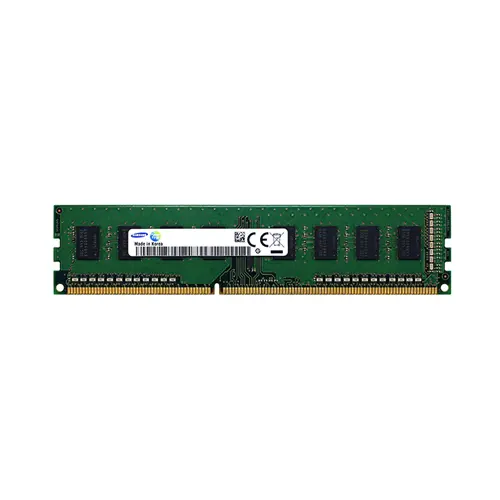
Designed for server platforms demanding high data integrity, the M393B1G73QH0-CMA is an 8GB DDR3-1866 registered ECC RDIMM ideally suited for virtualization clusters and in-memory database workloads. Its dual-rank x8 organization and CL13 latency optimize bandwidth delivery under heavy concurrent access, while the hardware error correction and registered signal buffering ensure rock-solid stability in multi-DIMM configurations.
1. Registered signal buffering reduces electrical loading on the memory bus, allowing server boards to support large DIMM counts for dense virtualization and scale-out workloads without compromising signal integrity.
2. ECC error detection and correction automatically resolves single-bit faults, preserving in-memory data accuracy for financial transactions and long-running scientific computations where even silent corruption is unacceptable.
3. Dual Rank interleaving ensures heavily consolidated virtual machines see consistently high memory throughput by overlapping accesses across internal ranks, reducing idle cycles under mixed-load contention.
4. The high-speed data rate effectively feeds modern multi-core server processors, preventing memory bandwidth from becoming the bottleneck during real-time big-data analytics and in-memory database operations.
5. A modest per-module capacity combined with registered buffering enables cost-effective, granular memory expansion across dual-socket servers, maximizing total addressable RAM without sacrificing stability.
The Samsung M393B1G73QH0-CMA is an 8GB DDR3-1866 RDIMM engineered for server environments where uptime and data integrity are non-negotiable. Its most critical feature is ECC error correction. In a virtualization cluster hosting multiple virtual machines, a single undetected bit flip in hypervisor memory can silently corrupt a database transaction or crash a node. ECC instantly catches and corrects these single-bit errors, directly preventing costly service interruptions.
Equally vital is the registered signal buffer. Unlike unbuffered DIMMs, the on-board register re-drives address and command signals, stabilizing the electrical load as you populate all memory channels. This means you can scale a database server to 96 GB or beyond across three channels without signal degradation, ensuring predictable performance for an in-memory analytics platform where query latency must remain flat even at peak concurrency.
The dual-rank x8 organization and 1866 MHz speed further address a real bottleneck. Dual rank enables rank interleaving—while one rank completes a burst, the other can begin a new access, overlaying latency and boosting effective bandwidth. For a Redis or memcached instance serving millions of key lookups per second, that sustained throughput and the CL13 latency directly translate into higher cache hit rates and snappier application response. This module is not just a component; it is a stability and performance guarantee for business-critical workloads.
This module is a server-grade DDR3-1866 Registered ECC DIMM (RDIMM), designed for platforms where data integrity and memory density are critical.
General Virtualization
For hypervisor hosts, balance capacity and memory bandwidth by populating all memory channels identically. Install one 8GB RDIMM per channel in a typical dual-socket server (e.g., eight modules for 64GB across four channels per CPU). This configuration provides reliable VM density and preserves 1866 MT/s speed. Scale seamlessly to 128GB or 192GB by doubling DIMMs per channel while maintaining matched dual-rank x8 populations.
In-Memory Database
In-memory databases demand maximum capacity with strict error protection. Fully populate every available DIMM slot with these 8GB RDIMMs to achieve the highest possible RAM footprint (e.g., 24 slots for 192GB on a two-processor system). The ECC and registered buffering prevent data corruption under extreme loads, and identical dual-rank modules ensure consistent latency and reliability. Never mix with unbuffered or non-ECC memory.
High-Performance Computing
HPC environments prioritize bandwidth over raw capacity. Install one 8GB RDIMM per memory channel for each CPU socket — typically eight modules in a dual-socket node (64GB) — to sustain the full 1866 MHz clock. This single-DIMM-per-channel layout avoids speed downgrades and delivers the lowest latency for data-intensive simulation or modeling. Adding more modules per channel reduces frequency, so scale capacity by choosing higher-density RDIMMs only after maximizing channel count.
Rigorously tested server memory, compatible with Dell PowerEdge R720, HP DL380p Gen8, and similar ECC Registered systems.
Q: Can I mix this M393B1G73QH0-CMA with other memory modules of different brands or speeds?
A: Mixing modules is not recommended in server environments. Even if specifications match, subtle electrical variances can compromise ECC functionality and system stability. Use identical part numbers for guaranteed compatibility.
Q: Is this memory compatible with my system? It requires an Intel Xeon E5-2600 v2 series platform.
A: This M393B1G73QH0-CMA is an 8GB DDR3-1866 Registered ECC RDIMM. It is validated for Intel C600 series chipsets and AMD Opteron 6300/8300 platforms supporting 1.5V Registered DIMMs. Verify your board's QVL.
Q: What is the recommended DIMM population order for optimal performance?
A: For dual-processor servers, populate identical DIMMs in matching blue slots first across all memory channels per CPU, then black slots. This ensures balanced interleaving and full memory bandwidth. Always consult your server's service manual.
Q: Does this module support overclocking or XMP profiles?
A: No. As an enterprise Registered ECC DIMM, this module strictly adheres to JEDEC standard DDR3-1866 timings. Overclocking and XMP are not supported, as they undermine signal integrity and error correction required for mission-critical workloads.
Q: What warranty and typical failure rate can I expect?
A: This module carries a 1-year warranty. Qualified server-grade DRAM typically shows an annualized failure rate (AFR) well below 0.5% under specified operating conditions when installed in cooled, compliant systems.