











 Secure payments
Standard refund policy
Trade Assurance
Secure payments
Standard refund policy
Trade Assurance
| Model | M393B1K70EB0-CMA |
|---|---|
| Product Type | Memory Module |
| Compliance Standards | EU RoHS,FCC |
| Memory Capacity | 8 GB |
| Memory Technology | DDR3 |
| Product Voltage | 1.5V |
| RAM Speed | 1866MHz |
| RAM Standard | DDR3-1866/PC3-14900 |
| Error Identifying | ECC |
| Signal Type | Registered |
| Column Access Strobe (CAS) | CL13 |
| Rank | Dual Rank x4 |
| Quantity of Pins | 240-pin |
| RAM Genre | RDIMM |
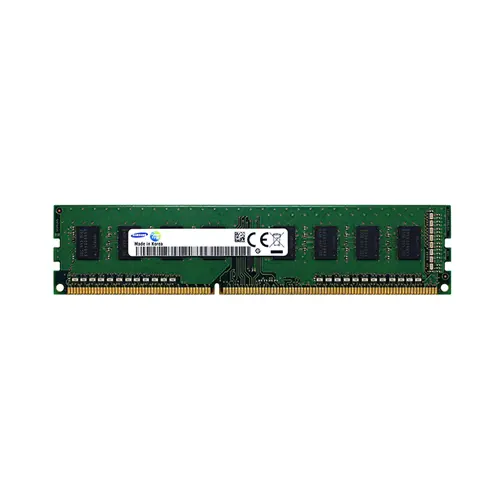
Designed for server environments requiring high data integrity, this Samsung M393B1K70EB0-CMA 8GB DDR3-1866 registered ECC module ensures reliable operation in memory-intensive workloads such as virtualization and in-memory databases. Its dual-rank x4 organization and registered signal type maintain stable signal integrity under heavy loading, while ECC protection and CL13 low latency help minimize unbuffered data errors and access delays in sustained mission-critical operations.
1. ECC error correction actively detects and corrects single-bit memory faults, preventing data corruption that would otherwise cause costly application crashes or silent data loss in transactional databases.
2. Registered signal buffering stabilizes the command and address lines during high-volume memory transactions, enabling servers to densely populate RAM slots without signal degradation under heavy virtualization loads.
3. 1866MHz transfer rate supplies ample bandwidth to feed multi-core processors concurrently, smoothing out throughput spikes during in-memory analytics and large-scale data warehousing.
4. Dual Rank x4 organization interleaves access across two sets of DRAM banks on the same channel, maximizing sustained bandwidth utilization for latency-sensitive workloads like real-time financial processing.
5. The 8GB module capacity offers a granular scaling unit, letting infrastructure architects tailor total server memory precisely to diverse container or microservice hosting needs without overprovisioning.
The Samsung M393B1K70EB0-CMA is an 8GB DDR3-1866 registered ECC RDIMM built for server environments where uptime and data precision are non-negotiable. In these settings, a single undetected memory error can silently corrupt financial records or cause a hypervisor to crash an entire virtual machine cluster. The ECC engine actively corrects single-bit errors and detects multi-bit faults, directly protecting your transactional databases and virtualized workloads from bit-flip risks that standard memory ignores. Meanwhile, the registered architecture buffers command and address signals, which means your motherboard can populate all available DIMM slots without signal degradation—this keeps you scaling memory capacity in virtualized clusters without sacrificing reliability. Its dual rank x4 organization interleaves data across internal banks, delivering higher sustained bandwidth for in-memory caches and real-time analytics, so Redis or SAP HANA can serve concurrent requests with measurably lower latency. Operating at 1866MHz with CL13 timings, this module strikes a deliberate balance between speed and power: the 1.5V supply aligns with broad platform compatibility, while the speed grade fuels responsive performance in dense data center racks where every nanosecond of database query latency compounds. In practice, that means you provision fewer nodes for the same workload, cut down on runtime corruption-induced reboots, and maintain flawless continuity in mission-critical applications.
The M393B1K70EB0-CMA is an 8GB DDR3-1866 ECC Registered RDIMM built for server platforms. Below is capacity planning guidance for common workloads.
General Virtualization
For virtualized hosts using these modules, start with six DIMMs (48GB) for basic virtual machine clusters. To avoid memory bottlenecks in larger deployments, populate all memory channels with twelve modules (96GB) per dual-socket server, leveraging ECC to protect multi-tenant workloads.
In-Memory Database
High-capacity in-memory databases require dense configurations. Populate 16 slots (128GB) using these 8GB dual-rank RDIMMs to maximize available memory on a typical two-socket system. Dual-rank x4 modules offer superior bank count, improving data access parallelism while ECC and registering guarantee stability for critical datasets.
High-Performance Computing
HPC applications prioritize bandwidth consistency. Equip each memory channel with one identical 8GB module—e.g., eight DIMMs (64GB) across eight channels—to prevent speed reduction and maintain 1866MHz operation. The registered dual-rank layout minimizes electrical loading, enabling reliable, symmetric memory access for compute-intensive parallel jobs.
Rigorously validated RDIMM for Dell PowerEdge R720/R620, HP DL380p Gen8, Cisco B200 M3.
Q: Can I mix this M393B1K70EB0-CMA with other memory modules of different brands or speeds?
A: Mixing is technically possible but not recommended. For reliable server operation, use identical modules with matching speed, rank, and ECC Registered characteristics to avoid performance degradation or instability.
Q: Is this memory compatible with my system?
A: This RDIMM works with DDR3-based server platforms supporting Registered ECC memory, such as Intel Xeon E5-2600 v1/v2 series and equivalent AMD Opteron 6300/6200 series. Verify motherboard support for PC3-14900 at 1.5V.
Q: What is the recommended DIMM population order for optimal performance?
A: Populate identical DIMMs per memory channel, starting with the first white slot of each channel for symmetric multi-channel operation. Refer to your server's technical manual for exact slot numbering to balance all memory controllers.
Q: Does this module support overclocking or XMP profiles?
A: No. This is a JEDEC-compliant server-grade Registered ECC module designed for mission-critical stability. It does not support XMP or manual overclocking and runs fixed at 1866MHz CL13 under standard 1.5V.
Q: What warranty and typical failure rate can I expect?
A: This module includes a 1-year warranty. As an enterprise-class memory with ECC, its typical failure rate is extremely low under specified conditions, ensuring high reliability for 24/7 server environments.