











 Secure payments
Standard refund policy
Trade Assurance
Secure payments
Standard refund policy
Trade Assurance
| Model | M393B1K70QB0-CMA |
|---|---|
| Product Type | Memory Module |
| Compliance Standards | EU RoHS,FCC |
| Memory Capacity | 8 GB |
| Memory Technology | DDR3 |
| Product Voltage | 1.5V |
| RAM Speed | 1866MHz |
| RAM Standard | DDR3-1866/PC3-14900 |
| Error Identifying | ECC |
| Signal Type | Registered |
| Column Access Strobe (CAS) | CL13 |
| Rank | Dual Rank x4 |
| Quantity of Pins | 240-pin |
| RAM Genre | RDIMM |
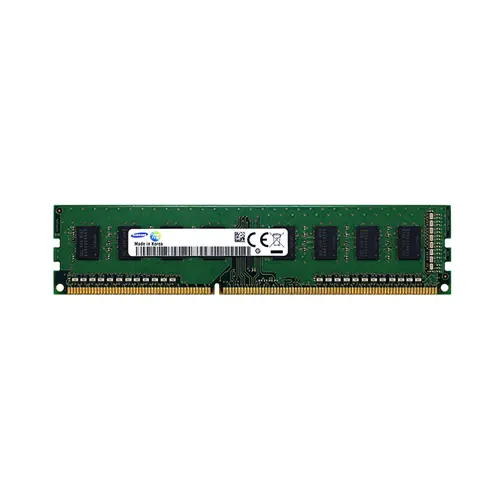
This Samsung M393B1K70QB0-CMA is a server-grade DDR3 RDIMM with ECC and Registered signaling, optimally suited for virtualization hosts, in-memory databases, and other enterprise workloads where data integrity and 24/7 stability are paramount. Its Dual Rank x4 organization improves memory interleaving for higher effective bandwidth, while the CL13 latency and 1866MHz speed deliver a solid balance of responsiveness and throughput in legacy server platforms.
1. Error-correction capabilities safeguard transactional integrity, preventing silent data corruption in mission-critical database environments.
2. Registered DIMM architecture scales reliably across dense memory configurations, preserving signal stability in multi-socket server platforms.
3. Dual rank organization interleaves memory accesses to saturate the channel, lifting throughput for virtualized workloads under concurrent tenant activity.
4. Elevated clock frequency delivers higher bandwidth, shaving response times off memory-intensive analytics and in-memory caching clusters.
5. Optimized capacity-per-module fills out server banks for a balanced memory footprint in scale-out virtual machine deployments.
The Samsung M393B1K70QB0-CMA is a server-grade DDR3 RDIMM, purpose-built for enterprise workloads where downtime is not an option. In a dense virtualization cluster, its Registered signal buffer is crucial: it isolates the memory controller from the electrical load of numerous modules, allowing you to fully populate server slots without signal degradation. This means you can confidently run more virtual machines per host, directly lowering your infrastructure cost. Meanwhile, ECC error correction silently detects and corrects single-bit memory errors caused by cosmic radiation or aging silicon. For an in-memory database like SAP HANA or Redis, a single uncorrected bit flip could corrupt a financial transaction or expose inaccurate customer records—ECC transforms that catastrophic risk into a self-healing event. The Dual Rank x4 organization further boosts throughput by enabling simultaneous bank access, keeping the memory pipeline saturated when your hypervisor or database engine triggers large block transfers. With a responsive 1866MHz clock and CL13 latency, this 8GB module delivers the predictable, low-lag performance that virtualized applications and real-time analytics demand, safeguarding your data and accelerating business insight.
General Virtualization
For a typical virtualization host, populate at least six of these 8 GB RDIMMs across three memory channels per CPU to achieve 48 GB total. This balanced configuration provides sufficient capacity for 10–15 light VMs while maintaining the bandwidth needed for hypervisor overhead. A dual-socket server should mirror this into a symmetrical 96 GB setup to avoid NUMA penalties.
In-Memory Database
Latency-sensitive in-memory databases demand maximum capacity and rank interleaving. Install 12 identical modules per two-socket server (96 GB), leveraging dual-rank x4 organization for higher bank-level parallelism. Where dataset size exceeds DIMM capacity, step to 16 GB RDIMMs; otherwise, populate all channels with identical 8 GB units to sustain 1866 MT/s at CL13 without clock throttling.
High-Performance Computing
HPC workloads favor bandwidth over raw capacity. Equip each compute node with eight modules (64 GB) in a 2‑DIMM‑per‑channel arrangement to enable lockstep 128‑bit access. The registered ECC signaling guarantees data integrity during week-long simulation runs, and the 1.5 V operating voltage keeps thermal overhead manageable in dense rack environments.
Strictly tested DDR3 server memory, compatible with Dell PowerEdge R720/R620, HP ProLiant DL380p Gen8, and Cisco UCS C220 M3.
Q: Can I mix this M393B1K70QB0-CMA with other memory modules of different brands or speeds?
A: Mixing is not recommended. This registered ECC RDIMM requires identical rank, speed, and organization for stable operation. Combining disparate modules may cause signal integrity issues and system instability in server environments.
Q: Is this memory compatible with my system?
A: This DDR3-1866 registered ECC RDIMM is compatible with select Intel Xeon E5-2600 v2 and AMD Opteron 6300 series platforms. Always verify your server motherboard's qualified vendor list to confirm 240-pin RDIMM support.
Q: What is the recommended DIMM population order for optimal performance?
A: Populate identical modules per channel, starting with the furthest slot from the CPU. Typically, fill blue DIMM slots first across all memory channels to enable balanced interleaving, referring to your server board's manual for the exact sequence.
Q: Does this module support overclocking or XMP profiles?
A: No. This is a JEDEC-compliant server memory module operating at fixed 1866MHz with CL13. It does not support overclocking or XMP profiles, prioritizing data integrity and 24/7 stability over frequency enhancement.
Q: What warranty and typical failure rate can I expect?
A: This module is backed by a one-year warranty. It demonstrates a very low annualized failure rate under specified conditions, attributable to rigorous component screening and full module testing before shipment.