











 Secure payments
Standard refund policy
Trade Assurance
Secure payments
Standard refund policy
Trade Assurance
| Product Type | Memory Module |
|---|---|
| Memory Capacity | 8 GB |
| Memory Technology | DDR3 |
| Product Voltage | 1.5V |
| RAM Speed | 1866MHz |
| RAM Standard | DDR3-1866/PC3-14900 |
| Error Identifying | ECC |
| Signal Type | Registered |
| Column Access Strobe (CAS) | CL13 |
| Rank | Dual Rank x4 |
| Quantity of Pins | 240-pin |
| RAM Genre | RDIMM |
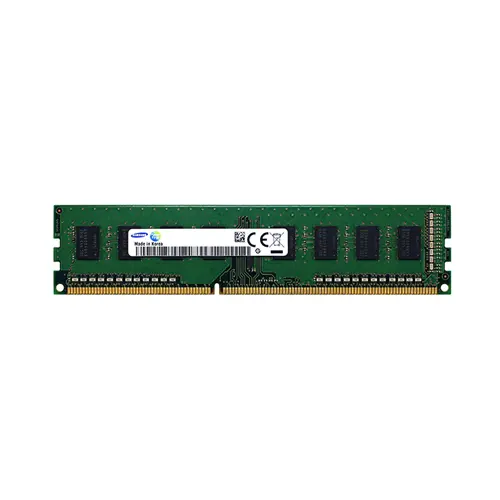
This DDR3-1866 RDIMM with ECC and Registered signal buffering is purpose‑built for legacy server platforms running memory‑intensive workloads such as virtualization, in‑memory databases, and mission‑critical enterprise applications. Its dual‑rank x4 organization and CL13 latency enhance data integrity and command/address stability under fully populated configurations, ensuring reliable operation where uncorrected errors are unacceptable.
1. ECC protection actively corrects single-bit errors in real time, giving virtualization hosts and financial databases the rock-solid data integrity needed to avoid silent corruption and unplanned outages.
2. Registered signal buffering decouples the address and command lines from the DRAM load, letting dense server nodes pack more DIMMs per channel while maintaining clean signal integrity for stable operation under continuous load.
3. Dual Rank x4 organization interleaves memory accesses across rank pairs, saturating the channel more effectively and sustaining steady bandwidth during heavy multi-tenant VM consolidation.
4. The 1866 MT/s data rate widens the available memory bandwidth per channel, directly accelerating throughput in memory-hungry workloads like large in-memory caches and real-time analytics.
5. CL13 column access latency strikes a responsive balance for DDR3, shaving critical cycles off access times and boosting the responsiveness of latency-bound enterprise applications.
The M393B1K70QB0-CMAQ8M is a server-class DDR3 Registered DIMM with four critical capabilities that safeguard your virtualized and data-intensive environments. First, its ECC error correction silently detects and fixes single-bit memory errors, preventing bit-flip corruption that could crash a virtual machine or silently alter a financial transaction—your databases stay trustworthy without constant oversight. Second, the registered signal buffer reduces electrical loading, enabling you to fully populate every memory channel for maximum capacity while keeping dozens of virtual machines stable under heavy consolidation. Third, the dual-rank x4 design leverages rank interleaving to boost effective bandwidth, so an in-memory database like Redis serves more queries per second. Finally, the 1866MHz frequency with CL13 latency hits the sweet spot for throughput and responsive access, essential for real-time analytics. Together, they transform this module into a resilient, high-performance backbone for hosting platforms and memory-hungry applications.
General Virtualization
With Registered ECC DDR3-1866 modules, populate a balanced configuration like six or eight identical 8 GB sticks for 48–64 GB total. Distribute modules evenly across memory channels (e.g., one DIMM per channel) to maximize throughput while ECC safeguards VM stability under mixed workloads.
In-Memory Database
Low-latency in-memory databases benefit from maximum capacity and dual‑rank x4 organization. Fully populate all channels with these 8 GB RDIMMs, targeting 128 GB or more, so entire datasets reside in RAM. The 1866 MT/s speed and CL13 latency help sustain high transaction rates, while ECC prevents silent data corruption.
High-Performance Computing (HPC)
For memory-bandwidth-sensitive HPC, install one 8 GB RDIMM per channel across all channels for peak bandwidth per core. Dual‑rank modules supply additional rank interleaving, improving sustained throughput. Aim for 64–128 GB total by using 8–16 sticks; register buffering allows stable high-density operation even at 1.5 V and 1866 MT/s.
Rigorously tested DDR3 server memory, compatible with Dell R720, HP DL380p Gen8, Lenovo System x3650 M4, and Supermicro X9 systems.
Q: Can I mix this M393B1K70QB0-CMAQ8M with other memory modules of different brands or speeds?
A: Mixing Registered ECC modules is strongly discouraged in server environments. Even slight variations can lead to signal integrity issues, causing instability, data corruption, or failed POST. Always use identical kits.
Q: Is this memory compatible with my system?
A: This is a 240-pin DDR3-1866 Registered ECC RDIMM. It requires server platforms with Intel C600-series or AMD SR56x0 chipsets and Xeon E5/E5-v2 or Opteron 6300 processors. Verify your motherboard’s Qualified Vendor List.
Q: What is the recommended DIMM population order for optimal performance?
A: For dual-socket systems, populate identical DIMMs per channel, usually starting with the furthest blue slots from the CPU for the first rank. Always follow the slot numbering in your server’s technical guide to maximize memory interleaving.
Q: Does this module support overclocking or XMP profiles?
A: No. This is a server-grade RDIMM with locked JEDEC timings (DDR3-1866 CL13, 1.5V). It strictly adheres to standard specifications for 24/7 operational stability. Overclocking or XMP is not supported.
Q: What warranty and typical failure rate can I expect?
A: This module carries a one-year warranty. Enterprise DDR3 RDIMMs typically demonstrate an annualized failure rate (AFR) well below 0.5% under specified operating conditions when properly installed and cooled.