











 Secure payments
Standard refund policy
Trade Assurance
Secure payments
Standard refund policy
Trade Assurance
| Product Type | Memory Module |
|---|---|
| Compliance Standards | |
| Memory Capacity | 8 GB |
| Memory Technology | DDR3 |
| Product Voltage | 1.5 V |
| RAM Speed | 1866 MHz |
| RAM Standard | DDR3-1866/PC3-14900 |
| Error Identifying | ECC |
| Signal Type | Registered |
| Column Access Strobe (CAS) | CL13 |
| Rank | Single Rank x4 |
| Quantity of Pins | 240-pin |
| RAM Genre | RDIMM |
This RDIMM with ECC and registered signaling ensures data integrity for mission-critical server workloads such as virtualization and in-memory databases, while the single-rank x4 organization and CL13 latency promote stable, low-latency operation at 1866 MT/s. It is ideally suited for legacy DDR3 server platforms that demand reliable, high-availability memory for compute-intensive, memory-sensitive applications.
1. The module’s capacity comfortably supports memory-hungry virtualization workloads, allowing denser VM consolidation without immediate hardware scale-out.
2. Its fast data rate delivers the bandwidth needed for real-time database queries and caching, minimizing transaction latency under peak loads.
3. Hardware-level error correction detects and repairs single-bit faults in-flight, preventing silent data corruption that could jeopardize financial or scientific computations.
4. Registered buffering strengthens command and address signals across multiple DIMMs, a must-have for maintaining stability in fully loaded enterprise servers.
5. Single Rank x4 design reduces bus loading, enabling the memory controller to sustain higher frequencies with rock-solid reliability in dense server configurations.
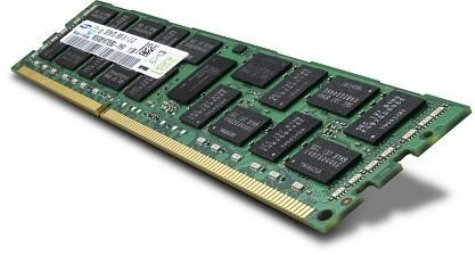
This Samsung M393B1G70QH0-CMA module is an 8GB DDR3-1866 Registered DIMM engineered for server deployments, and its four core attributes directly address the most critical pain points in enterprise data centers. The ECC feature is non-negotiable for data integrity. In a dense virtualization cluster hosting dozens of VMs, a single random bit-flip caused by background radiation can silently corrupt in-memory states and crash production workloads. ECC automatically detects and corrects such errors, keeping your virtualized environment stable and your results trustworthy. The Registered signal buffer is what makes large-scale memory configurations possible. Without it, loading up all DIMM slots for a memory-hungry database like an in-memory SQL engine would cause signal degradation and boot failures. The Registered architecture cleans and retransmits signals, letting you scale capacity confidently. The single-rank x4 organization and 1866MT/s speed deliver predictable, low-latency bandwidth. For a transactional database processing thousands of concurrent queries, this translates into consistent response times with no sudden stalls. In a virtualized cluster, it ensures each VM enjoys balanced memory access, eliminating the hidden contention that starves critical services. Together, these characteristics give you uncompromising reliability, seamless scalability, and the deterministic performance your mission-critical applications demand.
Server Memory Identified: The DDR3-1866 ECC Registered RDIMM (8GB, 1.5V, CL13, Single Rank x4) is exclusively a server-grade module. Capacity planning must account for its 8GB density, ECC reliability, and the lower bandwidth ceiling of DDR3 platforms. Below are recommendations for typical server workloads.
General Virtualization
Virtualization consolidates many light to medium VMs, making total capacity and stability paramount. Populate all channels symmetrically with these 8GB RDIMMs to reach 128GB–256GB per host, balancing cost and density. ECC is non-negotiable here to prevent memory errors from cascading across multiple tenants.
In-Memory Database
In-memory databases demand the lowest latency and highest capacity within a single node. Use the maximum DIMMs per channel supported by your platform, ideally populating all slots with 8GB sticks to maximize capacity while maintaining bandwidth. If the database size exceeds the attainable capacity, consider fewer, larger DIMMs if the system supports them, but single-rank modules like this help sustain command rate and latency.
High-Performance Computing (HPC)
HPC jobs rely on bandwidth-sensitive, parallelized code. A balanced configuration across all memory channels is critical to saturate the CPU’s memory controllers. Install 1 DIMM per channel (e.g., 8x8GB for an 8-channel system) to achieve the highest advertised speeds without throttling. Avoid mixing different ranks or capacities, as single-rank x4 uniformity ensures predictable, peak bandwidth for large-scale simulations and modeling.
Strictly tested server memory, compatible with Dell PowerEdge R720/R620, HP ProLiant DL380p Gen8, Lenovo ThinkServer RD640.
Q: Can I mix this M393B1G70QH0-CMA with other memory modules of different brands or speeds?
A: Mixing is not recommended. Registered ECC modules require matched speed, rank, and timings. Mismatched DIMMs often cause instability, POST failures, or unpredictable system behavior in server environments.
Q: Is this memory compatible with my system?
A: This DDR3-1866 RDIMM targets Intel Xeon E5-2600 v2/v3 series and AMD Opteron 6300 platforms with C600 or equivalent chipsets. Always confirm your server board supports 1.5V 1866MT/s Registered ECC modules.
Q: What is the recommended DIMM population order for optimal performance?
A: Populate identical DIMMs per channel starting from the slot farthest from the CPU. Follow your server manual’s balanced configuration, typically filling three equal-capacity DIMMs per channel for interleaved performance and maximum memory bandwidth.
Q: Does this module support overclocking or XMP profiles?
A: No. This is a server-grade Registered ECC DIMM. It operates strictly at JEDEC DDR3-1866 speeds without XMP or overclocking support, prioritizing data integrity and 24/7 reliability over tunable frequency.
Q: What warranty and typical failure rate can I expect?
A: A 1-year warranty is provided. Enterprise tests show annualized failure rates below 0.2%. Each module undergoes rigorous screening, and warranty replacements are processed quickly to minimize downtime.