











 Secure payments
Standard refund policy
Trade Assurance
Secure payments
Standard refund policy
Trade Assurance
| Model | M390B1G73BH0-1866 |
|---|---|
| Product Type | Memory Module |
| Compliance Standards | EU RoHS,FCC |
| Memory Capacity | 8 GB |
| Memory Technology | DDR3 |
| Product Voltage | 1.5V |
| RAM Speed | 1866MHz |
| RAM Standard | DDR3-1866/PC3-14900 |
| Error Identifying | ECC |
| Signal Type | Unbuffered |
| Column Access Strobe (CAS) | CL13 |
| Rank | Dual Rank x8 |
| Quantity of Pins | 240-pin |
| RAM Genre | UDIMM |
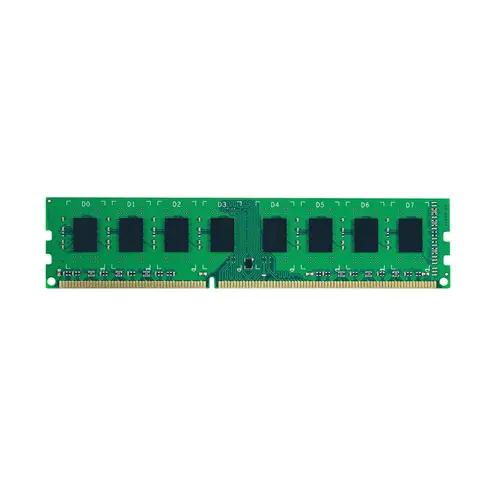
As a dual-rank x8 ECC UDIMM, this DDR3-1866 module is ideally suited for entry-level servers and workstations running memory-intensive, integrity-sensitive workloads like small-scale virtualization, ZFS-based NAS, or engineering simulations. Its CL13 latency and dual-rank interleaving boost command efficiency and bandwidth, while on-die ECC provides single-bit error correction that significantly reduces data corruption risks during continuous operation.
1. ECC protection detects and corrects single-bit errors in real time, safeguarding transactional data integrity for mission-critical server applications.
2. Dual Rank x8 organization keeps memory channels fully interleaved, maximizing bandwidth efficiency when running multiple virtual machines concurrently.
3. 1866 MT/s throughput delivers up to 14.9 GB/s peak bandwidth, accelerating in-memory databases and large dataset processing.
4. CL13 latency provides faster column access, reducing response times for latency-sensitive workloads like financial trading or caching layers.
5. 8 GB capacity offers ample headroom for a hypervisor and several light virtual instances, balancing cost and density in small-scale server deployments.
The Samsung M390B1G73BH0-1866 is an 8 GB DDR3 UDIMM with ECC, engineered for entry-level servers and workstations where data integrity and responsive performance are non-negotiable. In a virtualization cluster running multiple lightweight VMs, the unbuffered ECC design silently corrects single-bit memory errors before they escalate into host failures or data corruption. That means your hypervisor stays stable, and you avoid unexplained downtime during routine operations. When you deploy an in-memory database like Redis or a hot cache tier, the dual-rank x8 organization enables rank interleaving, overlapping consecutive memory accesses to boost effective bandwidth significantly. Paired with a tight CL13 latency and 1866 MHz clock speed, every query traverses the memory pipeline with minimal stall cycles. For a small business running its ERP and email on a single server, this module protects transactional records from silent bit-flip corruption while delivering the consistent, low-latency throughput that keeps day-to-day workflows snappy. You are not just buying RAM; you are securing your operational continuity without sacrificing the performance edge that memory-bound workloads demand.
Capacity Planning Guide for ECC UDIMM DDR3-1866 Modules
This 8GB DDR3-1866 ECC unbuffered DIMM targets entry-level servers and workstations that require data integrity. Its dual-rank x8 design and 1.5V operation suit platforms supporting ECC UDIMM (e.g., Intel Xeon E3 v2/v3 series). Proper population ensures reliability and balanced performance across typical load scenarios.
General Virtualization
For moderate VM density, populate all available memory channels symmetrically to sustain multi-VM memory throughput. A set of four identical 8GB modules (32GB total) in a dual-channel board, or four in a quad-channel platform, avoids performance penalties from unbalanced configurations. Dual-rank modules like this one offer slight latency advantages over single-rank alternatives when multiple VMs access memory concurrently.
In-Memory Database
Maximize capacity by filling every DIMM slot with these 8GB modules—many ECC UDIMM platforms support up to 32GB or 64GB using four or eight slots. The ECC protection guards against bit errors that could corrupt critical datasets. Dual-rank operation provides additional bank-level parallelism, helping sustain the high random access rates demanded by in-memory engines like Redis or SAP HANA.
High-Performance Computing (HPC)
Memory bandwidth is paramount; install a module per channel (e.g., 4x8GB on quad-channel Xeon E3/E5 UDIMM systems) to deliver peak throughput. The 1866MHz speed and CL13 latency yield balanced latency-bandwidth for compute-bound workloads. Avoid mixing capacities or speeds, as that would force the memory controller into a lower-performing asymmetric mode, undermining simulation and modeling throughput.
Rigorously tested, compatible with Dell PowerEdge R720, HPE ProLiant DL380p Gen8, Lenovo ThinkServer RD350.
Q: Can I mix this M390B1G73BH0-1866 with other memory modules of different brands or speeds?
A: Mixing is not recommended in server environments. Disparate modules may cause stability issues, prevent ECC operation, or force all DIMMs to the slowest common speed, compromising data integrity and performance.
Q: Is this memory compatible with my Intel Xeon or AMD Opteron server platform?
A: It is compatible with platforms supporting DDR3 ECC Unbuffered DIMMs, such as Intel Xeon E3-1200 v2/v3 series or select AMD AM3+ systems. Verify your motherboard’s qualified vendor list (QVL) for full compatibility.
Q: What is the recommended DIMM population order for optimal performance?
A: Populate identical DIMMs per channel starting with the slots farthest from the CPU. For dual-processor boards, balance memory equally across both processors, following the manufacturer’s guide to enable multi-channel interleaving.
Q: Does this module support overclocking or XMP profiles?
A: No, this is a standard JEDEC-compliant server memory module. It operates at fixed 1866MHz/CL13 without XMP or overclocking support, prioritizing 24/7 stability and error-free operation via ECC.
Q: What warranty and typical failure rate can I expect?
A: The module includes a 1-year warranty. It delivers enterprise-grade reliability with an annualized failure rate (AFR) well below 0.5%, backed by rigorous testing for continuous data-center uptime.