











 Secure payments
Standard refund policy
Trade Assurance
Secure payments
Standard refund policy
Trade Assurance
| Product Type | Memory Module |
|---|---|
| Memory Capacity | 8 GB |
| Memory Technology | DDR3 |
| Product Voltage | 1.5V |
| RAM Speed | 800MHz |
| RAM Standard | DDR3-800/PC3-6400 |
| Error Identifying | ECC |
| Signal Type | Registered |
| Column Access Strobe (CAS) | CL6 |
| Rank | Quad Rank x8 |
| Quantity of Pins | 240-pin |
| RAM Genre | VLP RDIMM |
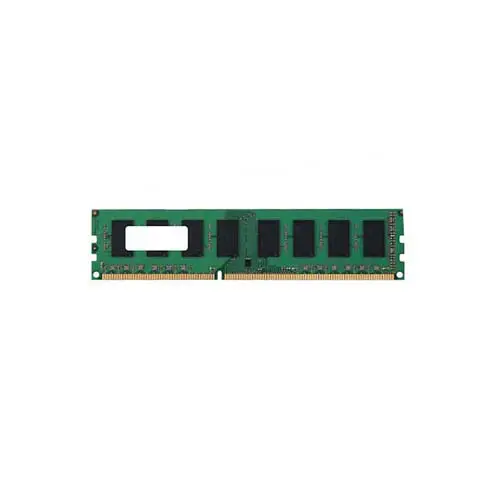
This DDR3-800 Registered ECC VLP RDIMM is a legacy server-grade module ideally suited for dense 1U/2U rack servers running virtualization or in-memory database workloads where physical space and data integrity are critical. Its quad-rank x8 configuration with CAS latency of 6 delivers robust signal integrity through registered buffering, while ECC protection ensures end-to-end error correction for mission-critical operations.
1. ECC protection detects and corrects single-bit errors in real time, preserving data integrity for mission-critical databases and financial transactions.
2. Registered signal buffering isolates memory loads from the CPU, enabling high-capacity configurations essential for dense virtualization clusters.
3. Quad Rank x8 organization packs more logical ranks per module, maximizing total server memory capacity without exceeding channel rank limits.
4. VLP RDIMM form factor reduces physical height to fit compact blade and 1U chassis, improving airflow and thermal headroom in tightly packed racks.
5. An 8 GB capacity per stick balances cost and density, allowing flexible scaling for moderate workload consolidation in departmental servers.
In server environments like VMware ESXi clusters or Redis in-memory databases, memory reliability and density are paramount. The Samsung M392B1K73BM1-YF7, an 8GB DDR3 VLP RDIMM, brings four critical features to mitigate real-world risks. ECC corrects single-bit errors automatically—without it, a cosmic-ray-induced bit flip could silently corrupt virtual machine states or financial transactions in a Redis node. Registered buffering stabilizes signal integrity when populating all DIMM slots, enabling consistent 192GB+ capacities needed for high-density virtualization without unexpected crashes. Its quad-rank design packs more memory ranks per module, maximizing capacity in servers with limited slots, a must for scaling database workloads. The very-low-profile form factor fits 1U rack servers, preserving airflow and preventing thermal throttling that could cripple performance during sustained analytics loads. For data centers, this translates to hardened uptime, data integrity, and efficient thermal management.
This is an 8GB DDR3-800 Registered ECC VLP RDIMM, confirmed by its 240-pin form factor, ECC, registered signaling, and very low profile. As a server-grade module, it is ideal for dense rack and blade deployments. Below are capacity planning recommendations for typical server workloads.
General Virtualization
Virtualization benefits most from high capacity. Observe quad-rank limits and install up to two DIMMs per memory channel. In a dual-socket server with 12 channels, 24 modules deliver 192 GB, comfortably hosting dozens of VMs. Configure BIOS for capacity optimization and avoid mixing with non-ECC or unbuffered modules.
In-Memory Database
Maximize total RAM within platform constraints. A balanced 24-module layout across both CPUs yields 192 GB, suitable for mid-size in-memory databases. The CL6 latency is acceptable, but the 800 MHz bandwidth may limit high-throughput transactional workloads. Populate channels identically per socket to minimize NUMA latency.
High-Performance Computing
The 800 MHz data rate creates a bandwidth ceiling unsuitable for floating-point-heavy HPC. However, capacity-driven workflows like graph analytics or genome assembly can benefit. Populate all memory controllers evenly, achieving up to 192 GB per node. Leverage the VLP height for high-density cluster blades where large memory trumps peak transfer speed.
Rigorously tested server memory, compatible with Dell PowerEdge R710, HP DL380 G7, IBM x3650 M3, and similar DDR3 platforms.
Q: Can I mix this M392B1K73BM1-YF7 with other memory modules of different brands or speeds?
A: Mixing modules is not recommended for registered server memory. Different brands, speeds, or ranks may cause instability. For guaranteed compatibility, use identical M392B1K73BM1-YF7 part numbers across all channels.
Q: Is this memory compatible with my Intel Xeon or AMD Opteron server platform?
A: This M392B1K73BM1-YF7 is a DDR3-800 VLP RDIMM with ECC. It is compatible with servers that support DDR3 registered DIMMs at 1.5V. Please verify against your motherboard's qualified vendor list to ensure platform support.
Q: What is the recommended DIMM population order for optimal performance?
A: For optimal performance with quad-rank VLP RDIMMs, populate identical sticks per channel first, typically filling the farthest slot in each memory channel. Always consult your server board manual for the specific balanced population sequence.
Q: Does this module support overclocking or XMP profiles?
A: No. This is a server-grade registered ECC module built for 24/7 stability. It operates at standard JEDEC DDR3-800 timings (CL6) and does not support XMP or overclocking, as reliability is prioritized over higher speeds.
Q: What warranty and typical failure rate can I expect?
A: This module includes a one-year warranty. It is manufactured to strict server-class standards, delivering an annualized failure rate (AFR) well below industry averages under normal operating conditions and within specified environmental parameters.