











 Secure payments
Standard refund policy
Trade Assurance
Secure payments
Standard refund policy
Trade Assurance
| Product Type | Memory Module |
|---|---|
| Memory Capacity | 8 GB |
| Memory Technology | DDR3 |
| Product Voltage | 1.5V |
| RAM Speed | 800MHz |
| RAM Standard | DDR3-800/PC3-6400 |
| Error Identifying | ECC |
| Signal Type | Registered |
| Column Access Strobe (CAS) | CL5 |
| Rank | Quad Rank x4 |
| Quantity of Pins | 240-pin |
| RAM Genre | RDIMM |
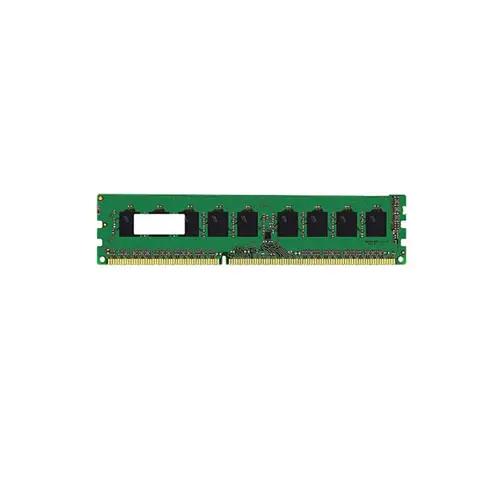
This is a server-grade DDR3-800 Registered DIMM with ECC, engineered for legacy enterprise platforms requiring high data integrity in virtualized environments or memory-resident databases. Its quad-rank x4 organization maximizes memory density per channel, while the registered signal type and CL5 latency ensure stable operation under heavy, sustained workloads.
1. ECC protection detects and corrects single-bit errors in real time, preserving data integrity for always-on virtualization hosts and eliminating silent data corruption risks in transactional databases.
2. Registered signal buffering stabilizes the command and address bus under full-load memory configurations, enabling reliable operation across all DIMM slots in multi-socket enterprise servers.
3. The 8GB capacity per module allows IT architects to reach high total memory footprints with fewer modules, driving denser virtual machine consolidation on legacy server platforms.
4. Quad Rank x4 organization multiplies independent bank groups, deepening memory-level parallelism to sustain bandwidth under the mixed read/write patterns of heavy virtualization and containerized workloads.
5. CL5 latency cuts column access delay to a minimal five cycles, sharpening the responsiveness of latency-sensitive server applications such as in-memory caching and real-time financial processing.
The Samsung M393B1K70CH0-YF7 is a server-grade Registered DIMM, purpose-built for enterprise environments where reliability is not negotiable. Its four defining characteristics translate directly into reduced downtime and consistent performance under punishing workloads. First, ECC error correction actively detects and corrects single-bit memory errors, the kind of silent data corruption that can crash a virtual machine host or introduce inaccuracies in a financial trading database during a 24/7 operation. Second, the Registered signal buffer stabilizes the command and address lines, allowing a server to populate all 24 memory slots without signal degradation; this is what makes dense virtualization clusters possible, where you need 192 GB or more of RAM to host dozens of guests on a single node. Third, the quad-rank x4 organization enables deeper memory interleaving, boosting effective bandwidth for in-memory databases like Redis or SAP HANA when sub-millisecond response times are mandatory. Finally, the 1.5V standard voltage and DDR3-800 CL5 timing offer a mature, low-power thermal profile that keeps cooling costs down in crammed rack environments while delivering deterministic, low-latency access. What this means for you is a memory foundation that refuses to compromise when your revenue depends on data integrity and service availability in scenarios like virtualized server farms or high-frequency transactional databases.
Server Memory Identified: The provided specifications (DDR3-800, ECC, Registered, Quad Rank x4 RDIMM) are typical of legacy server platforms. Capacity planning must leverage the reliability and multi-rank interleaving benefits of RDIMMs while respecting population constraints on older memory controllers.
General Virtualization
Populate all memory channels symmetrically to maximize bandwidth for numerous VMs. Given the 8GB Quad Rank DIMMs, use balanced configurations like six or twelve modules (48GB/96GB) to enable channel interleaving without exceeding per-channel rank limits. Prioritize capacity over raw speed, as hypervisors benefit more from ample headroom than from slight frequency gains.
In-Memory Database
Maximize total capacity and rank interleaving to feed the CPU with minimal latency under heavy dataset loads. Populate three DIMMs per channel where supported (e.g., 24x 8GB for 192GB) to harness the high rank count for parallelization. Plan for headroom exceeding your dataset size to accommodate in-memory caching and indexing overhead, avoiding swap to disk at all costs.
High-Performance Computing
Configure for peak memory bandwidth using the minimum viable population that still engages all memory channels. Install one Quad Rank DIMM per channel (e.g., 8x 8GB for 64GB on a dual-socket platform) to achieve 100% channel utilization while keeping total ranks manageable at high command rates. This ensures compute-bound tasks like CFD or genome sequencing are fed data swiftly without risking memory controller overloading.
Strictly tested server memory, compatible with Dell PowerEdge R710, HP ProLiant DL380 G7, and more.
Q: Can I mix this M393B1K70CH0-YF7 with other memory modules of different brands or speeds?
A: Mixing RDIMMs of different brands or speeds is not recommended. The system will default to the slowest DIMM’s speed and may face stability issues. For mission-critical servers, use identical part numbers to ensure validated signal integrity.
Q: Is this memory compatible with my system?
A: This DDR3-800 Registered ECC RDIMM (1.5V) is designed for specific Intel Xeon 5500/5600 or AMD Opteron 6000 series platforms. Verify your server board’s QVL for quad-rank x4 support, as not all memory controllers manage quad-rank DIMMs correctly.
Q: What is the recommended DIMM population order for optimal performance?
A: Populate identical quad-rank DIMMs per channel, starting with the slot farthest from the CPU. On dual-socket servers, balance across memory banks. Due to this being a quad-rank module, expect speed drops if fully populating all channels.
Q: Does this module support overclocking or XMP profiles?
A: No. This is a server-grade Registered ECC DIMM operating at JEDEC standard DDR3-800. It does not support XMP or overclocking, as reliability and data integrity are prioritized over frequency adjustments in enterprise environments.
Q: What warranty and typical failure rate can I expect?
A: This module includes a one-year warranty. Enterprise RDIMMs have a very low annualized failure rate, typically under 0.5%, thanks to rigorous screening, ECC correction, and conservative clocking. Proper cooling further extends service life.