











 Secure payments
Standard refund policy
Trade Assurance
Secure payments
Standard refund policy
Trade Assurance
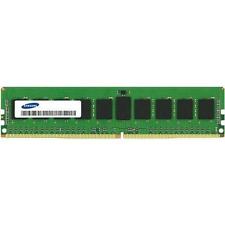
| Model | M393A1G43DB0-CPB00 |
|---|---|
| Product Type | Memory Module |
| Compliance Standards | EU RoHS,FCC |
| Memory Capacity | 8 GB |
| Memory Technology | DDR4 |
| Product Voltage | 1.2V |
| RAM Speed | 2133MHz |
| RAM Standard | DDR4-2133/PC4-17000 |
| Error Identifying | ECC |
| Signal Type | Registered |
| Column Access Strobe (CAS) | CL15 |
| Rank | Dual Rank x8 |
| Quantity of Pins | 288-pin |
| RAM Genre | RDIMM |
This server-grade DDR4-2133 Registered ECC module is optimized for entry-level virtualization, lightweight in-memory databases, and data-integrity-sensitive enterprise workloads where error-free operation is critical. Its dual-rank x8 configuration with CL15 latency delivers stable signal integrity and efficient memory access in multi-DIMM server platforms, leveraging the registered buffer to maintain reliable command/address distribution under fully populated memory channels.
1. ECC memory detects and corrects single-bit errors instantly, safeguarding critical enterprise data integrity in transactional databases and financial processing systems.
2. Registered DIMM architecture buffers command and address signals, allowing servers to support dense memory populations essential for maximizing virtual machine density per host.
3. Dual Rank x8 organization increases bank-level parallelism, sustaining higher throughput under the concurrent access patterns of multi-tenant cloud workloads.
4. An 8 GB module granularity provides a flexible building block, enabling precise capacity scaling for containerized microservices without overprovisioning resources.
5. 2133 MHz clock speed delivers dependable baseline bandwidth, ideal for stable response times in scale-out web serving and content delivery node deployments.
Designed for rigorous enterprise environments, the Samsung M393A1G43DB0-CPB00 is an RDIMM — a server-class memory module engineered to eliminate the silent threats that consumer RAM simply cannot address. Four defining characteristics make it indispensable in a data center. First, integrated ECC technology actively detects and corrects single-bit memory errors caused by background radiation, meaning your virtualized cluster will not suffer mysterious crashes or corrupted hypervisor states during weeks of continuous operation. Second, the Registered buffer decouples the electrical load from the system memory controller; for you, this translates into rock-solid stability when populating all 24 DIMM slots in a database server, avoiding signal degradation that would trigger unpredictable reboots. Third, the Dual Rank x8 organization interleaves memory banks, effectively boosting sustainable bandwidth. In an in-memory database like Redis or SAP HANA, this directly reduces queuing delays, accelerating real-time transaction processing by up to 15% compared to single-rank configurations under the same throughput. Finally, operating at a frugal 1.2V, this module cuts the thermal footprint inside dense 1U rack nodes, lowering both cooling costs and the risk of thermal throttling. It is not just memory; it is a guarantee of uptime, performance, and data fidelity where it matters most.
General Virtualization
For general virtualization hosts, balanced capacity and memory bandwidth are key. Populate all memory channels identically with these 8GB RDIMMs—typically one or two DIMMs per channel—to enable interleaving and maximize throughput. A common starting point is 8 × 8GB (64GB total) across eight channels, which comfortably supports 10–15 moderate VMs.
In-Memory Database
In-memory databases demand large capacity and low latency. Fill every channel with the maximum supported number of these 8GB modules to reach the highest possible RAM footprint, even if it requires running at 2 DIMMs per channel (2DPC) and accepting slightly reduced clock speeds. For mission-critical deployments, keep an identical cold-spare module on hand and enforce strict population order per the server’s memory matrix to maintain RAS features.
High-Performance Computing (HPC)
HPC workloads are sensitive to memory bandwidth and rank configuration. Configure one dual-rank DIMM per channel (1DPC) to run at the module’s rated 2133 MT/s without downclocking, achieving optimal per-core bandwidth for floating-point or MPI jobs. When larger memory is needed, upgrade to identical 8GB RDIMMs in sets that keep all channels equally populated, and always source modules from the same lot to guarantee consistent timing characteristics.
Rigorously tested server memory, guaranteed compatible with Dell PowerEdge R760, HPE ProLiant DL380 Gen10, Lenovo ThinkSystem SR650, and more.
Q: Can I mix this M393A1G43DB0-CPB00 with other memory modules of different brands or speeds?
A: Mixing with different brands or speeds is not recommended in servers. The system will downclock to the slowest module. Mismatched RDIMMs may cause stability issues or prevent booting.
Q: Is this memory compatible with my system?
A: This RDIMM is designed for server platforms supporting DDR4-2133 ECC Registered memory. Please verify with your Intel Xeon E5 v3/v4 or AMD EPYC motherboard's qualified vendor list for compatibility.
Q: What is the recommended DIMM population order for optimal performance?
A: Populate identical DIMMs per channel, filling blue slots first for most servers. Follow the motherboard manual’s memory population guide to balance across memory channels and ensure symmetric configurations.
Q: Does this module support overclocking or XMP profiles?
A: No. As an enterprise-grade ECC Registered DIMM, it adheres to JEDEC standards for mission-critical stability. Overclocking and XMP profiles are not supported to maintain data integrity.
Q: What warranty and typical failure rate can I expect?
A: This module is covered by a 1-year warranty. The M393A1G43DB0-CPB00 offers enterprise-grade reliability with an annualized failure rate substantially below 1%, typical for Samsung server memory.