











 Secure payments
Standard refund policy
Trade Assurance
Secure payments
Standard refund policy
Trade Assurance
| Product Type | Memory Module |
|---|---|
| Compliance Standards | RoHS,CE,WEEE |
| Memory Capacity | 8 GB |
| Memory Technology | DDR4 |
| Product Voltage | 1.2 V |
| RAM Speed | 2133 MHz |
| RAM Standard | DDR4-2133/PC4-17000 |
| Error Identifying | ECC |
| Signal Type | Registered |
| Column Access Strobe (CAS) | CL15 |
| Rank | Single Rank x4 |
| Quantity of Pins | 288-pin |
| RAM Genre | RDIMM |
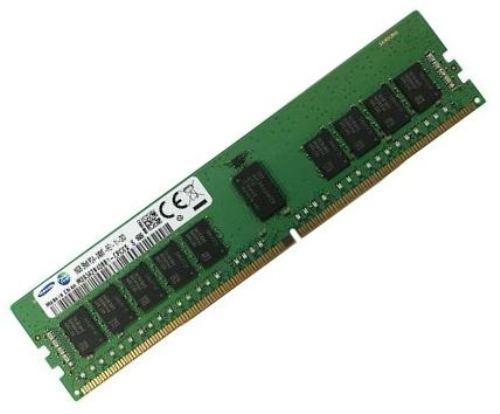
This RDIMM is engineered for server platforms requiring robust data integrity, making it ideal for virtualization, in-memory databases, and mission-critical enterprise workloads. The registered signal type combined with ECC and a single-rank x4 configuration ensures stable operation at 2133 MT/s with CL15 latency, effectively minimizing electrical loading on the memory bus while detecting and correcting single-bit errors.
1. Registered DIMM architecture buffers command and address signals, preserving electrical integrity across fully loaded memory channels so server platforms can scale capacity without sacrificing stability.
2. Hardware ECC detection and correction intercepts single-bit errors in real time, guarding virtualized workloads and in-memory databases against silent data corruption.
3. The 2133 MT/s data rate delivers a steady bandwidth baseline that keeps concurrent transactional queries flowing smoothly in mid-density rack servers.
4. Single Rank x4 organization confines chip-level faults to a narrow 4-bit lane, reinforcing symbol-based error recovery and strengthening uptime for always-on services.
5. Operating at just 1.2 volts, the module minimizes per-slot power draw and cumulative thermal output, which directly lowers cooling demands in dense data-center footprints.
As a server-grade registered DIMM, the Samsung M393A1G40DB0-CPB0Q brings four critical capabilities together to solve real pains in the data center. For a virtualization cluster running dozens of VMs on a single host, its ECC engine is non-negotiable: it actively detects and corrects single-bit errors caused by background radiation, preventing silent data corruption that could cascade into guest OS crashes or file system inconsistencies—what could be a nightly troubleshooting nightmare becomes a non-event. Equally vital is the Registered buffer, which stabilizes command and address signals when populating all 24 DIMM slots per server, letting you scale to hundreds of gigabytes without signal degradation; in an in-memory database like Redis or SAP HANA, that means predictable query latency even under full slot utilization. Operating at 1.2 V DDR4, this module lowers thermal footprint per node, directly trimming cooling OpEx in dense rack deployments. The 2133 MT/s speed with CL15 latency and single-rank x4 organization delivers balanced bandwidth and bank-level parallelism for mixed workloads, ensuring your transactional database and real-time analytics engines both see consistent response times without adding disruptive heat or power draw. For IT architects, this translates into a memory foundation that prioritizes uptime, density, and manageable TCO.
General Virtualization
For dense VM hosting, populate your server with balanced DIMMs across all memory channels to maximize bandwidth. A common configuration uses eight or more of these 8 GB RDIMMs per socket, delivering 64–128 GB total capacity while maintaining registered ECC reliability for multi-tenant workloads.
In-Memory Database
In-memory databases like Redis or SAP HANA demand both capacity and data integrity. Deploy six to eight modules per CPU to reach 48–64 GB, ensuring low latency with CL15 and single-rank access. The ECC and registered design prevent silent data corruption, which is critical for transactional consistency.
High-Performance Computing (HPC)
HPC clusters rely on memory bandwidth and error resilience during long compute runs. Fully populate each memory channel with one DIMM per channel (1DPC) using these registered modules to achieve optimal throughput. For capacity‑bound simulations, scale to 128 GB or more across all slots, always keeping symmetric ranks for uniform performance.
This server memory passed rigorous testing, compatible with Dell PowerEdge R740/R640, HPE ProLiant DL380 Gen10, Lenovo ThinkSystem SR650, and more.
Q: Can I mix this M393A1G40DB0-CPB0Q with other memory modules of different brands or speeds?
A: Mixing RDIMMs of different brands or speeds is not recommended. It can cause instability or boot failures. For server environments, identical modules are required to ensure reliable, validated performance.
Q: Is this memory compatible with my system?
A: This DDR4-2133 Registered ECC RDIMM is compatible with servers using Intel Xeon E5-2600 v3/v4 or similar platforms that support PC4-17000. Please verify your server board's qualified vendor list.
Q: What is the recommended DIMM population order for optimal performance?
A: Populate DIMMs following your server manual, typically filling first slot per channel (e.g., blue slots) to balance memory channels and enable interleaving. Always refer to the platform's population guidelines.
Q: Does this module support overclocking or XMP profiles?
A: No. This is a JEDEC-compliant server RDIMM designed for stability at 2133MHz CL15. It does not support overclocking or XMP profiles, as server platforms prioritize reliability over high frequency.
Q: What warranty and typical failure rate can I expect?
A: This module includes a one-year warranty. Enterprise-grade RDIMMs exhibit very low failure rates, typically with an annualized failure rate (AFR) below 0.5% under proper operating conditions.