











 Secure payments
Standard refund policy
Trade Assurance
Secure payments
Standard refund policy
Trade Assurance
| Model | M393A1G43DB0-CPB0 |
|---|---|
| Product Type | Memory Module |
| Compliance Standards | EU RoHS,FCC |
| Memory Capacity | 8 GB |
| Memory Technology | DDR4 |
| Product Voltage | 1.2V |
| RAM Speed | 2133MHz |
| RAM Standard | DDR4-2133/PC4-17000 |
| Error Identifying | ECC |
| Signal Type | Registered |
| Column Access Strobe (CAS) | CL15 |
| Rank | Dual Rank x8 |
| Quantity of Pins | 288-pin |
| RAM Genre | RDIMM |
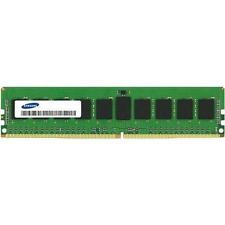
The Samsung M393A1G43DB0-CPB0 is an 8GB DDR4-2133 registered ECC RDIMM built for server platforms, ideally suited for virtualization clusters and in-memory databases where data integrity is non-negotiable. Its dual-rank x8 configuration increases interleaving efficiency for better throughput, while the registered signal buffering and integrated ECC actively eliminate single-bit errors, ensuring stable 24/7 operation in dense rack deployments.
1. RDIMM architecture with registered signal buffering stabilizes high-density memory configurations, letting enterprise servers scale to support more virtual machines without compromising command integrity.
2. ECC protection continuously corrects single-bit errors, preserving data accuracy in critical workloads like financial ledger processing or in-memory databases.
3. 8 GB capacity per stick hits a cost-efficient sweet spot for virtualized environments, allowing fine-grained memory allocation across lightweight containers and microservices.
4. 2133 MHz transfer rate delivers consistent bandwidth that keeps mainstream server applications responsive under sustained client loads.
5. Dual Rank x8 organization banks memory cells in parallel, elevating effective throughput and smoothing latency spikes during heavy multi-tenant operations.
The Samsung M393A1G43DB0-CPB0 is a server-grade DDR4 Registered DIMM engineered to eliminate the memory vulnerabilities that keep IT administrators awake at night. Its four defining characteristics—ECC error correction, registered signal buffering, dual-rank organization, and 1.2V low-voltage efficiency—directly answer the demands of mission-critical enterprise workloads. In a virtualization cluster running dozens of VMs, a silent single-bit flip in memory can cascade into hypervisor crashes and unnoticed data corruption. The integrated ECC detects and corrects those errors on the fly, preserving transactional integrity and preventing costly, unplanned downtime. Registered buffering relieves the CPU’s memory controller of electrical load, permitting full-channel population with higher capacities—crucial for scaling to hundreds of gigabytes for dense server consolidation. For in-memory databases like Redis or SAP HANA, where microseconds matter, the dual-rank architecture leverages bank interleaving: while one rank processes a read command, the other can pre-charge or refresh, boosting sustained bandwidth and keeping query latency consistently low under concurrent access. Meanwhile, the 1.2V operation reduces thermal footprint inside crowded racks, trimming cooling OPEX. These features collectively transform virtualized environments and real-time analytics from potential reliability risks into a stable, high-performance asset.
General Virtualization
Populate one 8GB Registered ECC DIMM per memory channel on a typical dual-socket server, using 12 modules to deliver 96 GB of reliable capacity. This balanced configuration preserves full 2133 MT/s speed while supporting moderate VM consolidation with hardware error correction. For higher density, install a second DIMM per channel, but be prepared for a slight frequency downshift under increased channel loading.
In-Memory Database
Maximize capacity by filling all available DIMM slots with these 8 GB RDIMMs; a 24-slot server yields 192 GB for large datasets. Running two DIMMs per channel may force the memory speed to 1866 MT/s or lower, so validate latency sensitivity with your database workload before deploying. When extreme capacity is required, this dense population offers a cost-effective path if the slight bandwidth reduction is acceptable.
High-Performance Computing (HPC)
Use a single 8 GB RDIMM per channel to sustain the full 2133 MT/s bandwidth that HPC applications demand, achieving 96 GB on a 12-channel node. This uniform, low-latency setup suits parallel simulation and modeling codes. Scale out with identically configured nodes rather than mixing capacities, preserving consistent inter-node performance for tightly coupled workloads.
Rigorously tested – compatible with servers such as Dell PowerEdge R740, HPE ProLiant DL380 Gen10, Lenovo ThinkSystem SR650, and Cisco UCS C220 M5.
Q: Can I mix this M393A1G43DB0-CPB0 with other memory modules of different brands or speeds?
A: Mixing is not recommended. The system defaults to the lowest speed and mixing RDIMMs can cause instability. For enterprise reliability, use identical Samsung modules with matching rank and ECC.
Q: Is this memory compatible with my Intel Xeon or AMD EPYC server platform?
A: This DDR4-2133 Registered ECC module supports Intel Xeon E5-2600 v3/v4 and compatible AMD EPYC platforms using 288-pin slots. Confirm with your server board’s qualified vendor list for guaranteed compatibility.
Q: What is the recommended DIMM population order for optimal performance?
A: Install identical DIMMs across balanced memory channels, typically populating the farthest slot from the CPU first per channel (e.g., A1, B1). Refer to your server manual for interleaving and channel matching guidance.
Q: Does this module support overclocking or XMP profiles?
A: No. This Samsung server RDIMM follows JEDEC specifications exclusively and does not support XMP or overclocking. It runs at fixed 2133MHz CL15 to ensure mission‑critical stability and data integrity.
Q: What warranty and typical failure rate can I expect?
A: It includes a one‑year warranty. As an enterprise‑class Samsung memory module, the annualized failure rate is extremely low, typically under 0.5%, designed for continuous 24/7 data center operation.