











 Secure payments
Standard refund policy
Trade Assurance
Secure payments
Standard refund policy
Trade Assurance
| Product Type | Memory Module |
|---|---|
| Memory Capacity | 8 GB |
| Memory Technology | DDR4 |
| Product Voltage | 1.2 V |
| RAM Speed | 2133 MHz |
| RAM Standard | DDR4-2133/PC4-17000 |
| Error Identifying | ECC |
| Signal Type | Unbuffered |
| Column Access Strobe (CAS) | CL15 |
| Rank | Dual Rank x8 |
| Quantity of Pins | 288-pin |
| RAM Genre | UDIMM |
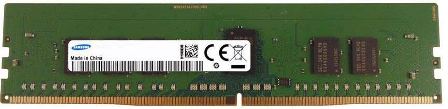
This unbuffered ECC UDIMM is engineered for entry-level servers and workstations where data integrity is critical, making it well-suited for light virtualization, NAS storage, and memory-sensitive applications that cannot tolerate silent bit errors. Its dual-rank x8 organization improves memory interleaving for better bandwidth utilization, while the ECC technology at a low 1.2V ensures reliable error correction with energy-efficient operation.
1. ECC error correction actively detects and fixes single-bit memory faults, providing the data integrity foundation required for stable long-running server workloads and financial transaction processing.
2. Eight gigabyte capacity supports lean virtualized environments and dedicated light server roles, keeping power and cost under control while maintaining reliable uptime.
3. DDR4-2133 speed supplies consistent memory bandwidth that eliminates bottlenecks in concurrent request handling, ideal for small business servers and edge deployments.
4. Dual rank x8 organization enables rank interleaving, raising effective memory throughput and reducing access latency under mixed read/write server loads.
5. Unbuffered UDIMM architecture simplifies signal paths to the memory controller, ensuring wide motherboard compatibility and straightforward validation in entry-level server builds.
The Samsung M391A1G43EB1-CPB is a server and workstation-class DDR4 2133 MT/s ECC Unbuffered DIMM, engineered for platforms where data integrity and responsive performance are non-negotiable. Its error-correcting code (ECC) actively detects and repairs single-bit memory faults, directly preventing silent data corruption inside a virtualized cluster or an in-memory database such as Redis. That means a flipped bit in a financial transaction or a hypervisor table will not cascade into application crashes or costly inaccuracies. The unbuffered architecture eliminates the register chip delay found in conventional server memory, so your virtual machines and database queries execute with lower latency—a tangible difference when hosting multiple virtual desktops under load. Dual-rank x8 organization interleaves banks to deliver higher sustained bandwidth, resolving throughput bottlenecks during peak transactional processing so that your services stay snappy. Finally, the 1.2 V ultra-low operating voltage significantly reduces power draw and thermal output, allowing dense rack deployments or always-on small office servers to lower cooling costs and extend hardware lifespan without compromising stability.
General Virtualization
For a host running multiple VMs with moderate overcommitment, install matched pairs of these 8 GB ECC UDIMMs to maintain dual-channel performance and reliable memory isolation. A typical 4-socket single-socket server board would benefit from four modules (32 GB total), allowing room for a hypervisor plus 6–8 light Linux guests. Always populate identical sticks to preserve ECC scrubbing and avoid multi-bit error risks.
In-Memory Database
Low-latency databases like Redis or Memcached thrive on capacity, but ECC UDIMMs restrict total scalability compared to RDIMMs. Deploy the maximum supported configuration—commonly 4×8 GB on entry-level server boards—to hit 32 GB while keeping data integrity. For larger working sets, consider upgrading to 16 GB UDIMMs or a platform that accepts registered DIMMs, as 2133 MT/s dual-rank modules already minimize rank-switching penalties.
High-Performance Computing
HPC workloads that demand bit-perfect results need ECC; populate channels evenly to maximize memory bandwidth. On a quad-channel motherboard, install four 8 GB dual-rank ×8 UDIMMs for 32 GB of balanced capacity. The 1.2 V operating voltage and CL15 latency keep power per node low in dense clusters, but verify BIOS support for 2133 MT/s speeds without downclocking when all slots are filled.
Rigorously tested server ECC UDIMM, compatible with Dell PowerEdge R230/R330/T330, HPE ProLiant ML30 Gen9, Lenovo ThinkServer TS150.
Q: Can I mix this M391A1G43EB1-CPB with other memory modules of different brands or speeds?
A: Mixing is not advised. ECC UDIMMs require identical speed, rank, and voltage for stability. Mixing with non‑ECC modules will disable error correction and may cause system boot failures.
Q: Is this memory compatible with my system?
A: This 8GB DDR4‑2133 ECC UDIMM fits Intel Xeon E3‑1200 v5/v6 platforms with C232/C236 chipsets, or select AMD Ryzen PRO boards. Confirm your board explicitly supports DDR4 ECC Unbuffered memory.
Q: What is the recommended DIMM population order for optimal performance?
A: For dual‑channel platforms, use identical modules in matched sockets (typically same color). With this dual‑rank DIMM, populate one module per channel to preserve full memory bandwidth and balanced access.
Q: Does this module support overclocking or XMP profiles?
A: No. This JEDEC‑standard server module runs at fixed DDR4‑2133 CL15. Overclocking is unsupported and can undermine ECC data integrity; XMP is not available on enterprise UDIMMs.
Q: What warranty and typical failure rate can I expect?
A: It carries a 1‑year warranty. Genuine Samsung server DRAM like this typically shows an AFR below 0.2% in controlled environments, ensuring exceptional long‑term reliability for critical workloads.