











 Secure payments
Standard refund policy
Trade Assurance
Secure payments
Standard refund policy
Trade Assurance
| Model | M393A1G40EB1-CPB3Q |
|---|---|
| Product Type | Memory Module |
| Compliance Standards | CE,WEEE,RoHS |
| Memory Capacity | 8 GB |
| Memory Technology | DDR4 |
| Product Voltage | 1.2V |
| RAM Speed | 2133MHz |
| RAM Standard | DDR4-2133/PC4-17000 |
| Error Identifying | ECC |
| Signal Type | Registered |
| Column Access Strobe (CAS) | CL15 |
| Rank | Single Rank x4 |
| Quantity of Pins | 288-pin |
| RAM Genre | RDIMM |
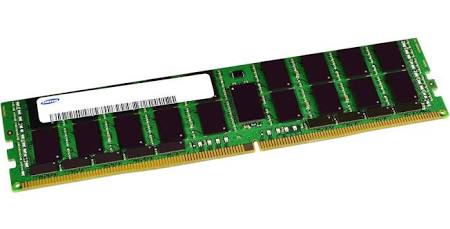
This Samsung DDR4-2133 Registered DIMM with ECC is purpose-built for enterprise servers and is ideally suited for virtualization, in-memory databases, and workloads demanding stringent data integrity. Its registered signal buffer stabilizes high-capacity memory configurations, while the Single Rank x4 organization and CL15 CAS latency deliver consistent, low-latency access critical for 24/7 operation.
1. ECC error correction silently detects and fixes single-bit memory faults, preventing data corruption in transactional databases and financial workloads where uptime is non-negotiable.
2. Registered signal buffering reduces electrical load on the memory controller, enabling fully populated servers to scale RAM capacity for dense virtualization without compromising signal integrity.
3. Single Rank x4 organization keeps the memory bus lightly loaded, allowing multiple DIMMs per channel to run at full speed for memory-hungry analytics and large in-memory caches.
4. DDR4-2133 delivers a steady 17 GB/s of bandwidth, satisfying the concurrent throughput demands of multi-tenant cloud instances and real-time stream processing.
5. 1.2V operation trims power consumption per DIMM, helping hyperscale data centers reduce cooling overhead and meet strict energy efficiency goals over thousands of nodes.
When you’re running a dense virtualization cluster or an in-memory database like SAP HANA, memory errors aren’t an inconvenience—they’re a risk to business continuity. The Samsung M393A1G40EB1-CPB3Q is engineered specifically for these environments. As a DDR4-2133 Registered ECC RDIMM, its four defining characteristics directly address real server pain points. First, ECC protection detects and corrects single-bit errors in real time, preventing silent data corruption that could flip a financial transaction or corrupt a database index—a non-negotiable safeguard for any mission-critical workload. Second, the Registered signal buffer stabilizes the command and address lines, enabling you to populate all 24 DIMM slots in a dual-socket server without signal degradation. That scalability is what lets you allocate 1.5 TB of RAM to a single virtualized SAP instance with confidence. Third, the 1.2V DDR4 operating voltage delivers tangible OpEx savings: across a rack of 40 servers, the cumulative power reduction versus older 1.5V DDR3 directly lowers cooling and electricity bills. Finally, the Single‑Rank x4 organization ensures consistent, predictable latency and bandwidth under heavy queue depth—critical for in-memory analytics where microsecond delays compound. This module isn’t just memory; it’s the foundation for data integrity, massive scalable capacity, energy efficiency, and uncompromising performance in your data center.
General Virtualization
For light to moderate VM densities, populate the server with eight modules (64 GB) in a balanced configuration across all memory channels. This ensures dual-channel or quad-channel optimization depending on the platform, with ECC and registered DIMMs guaranteeing data integrity and stability for multiple guest operating systems.
In-Memory Database
In-memory workloads like Redis or SAP HANA demand large capacities and high availability. Install at least 16 modules (128 GB) spanning all channels to maximize bandwidth while reserving slots for future expansion. The RDIMM’s registered signaling enables reliable operation with fully-loaded ranks, critical for holding entire datasets in RAM.
High-Performance Computing (HPC)
HPC clusters benefit from low-latency, error-free transactions. Deploy 12 to 24 modules (96–192 GB) depending on node count, populating all memory channels identically for symmetric multiprocessing. The single-rank x4 design reduces electrical loading, allowing slightly higher clock margins during sustained floating-point or MPI workloads under ECC protection.
Stringently tested for compatibility with Dell PowerEdge R730, HPE ProLiant DL380 Gen9, Lenovo System x3650 M5, and similar servers.
Q: Can I mix this M393A1G40EB1-CPB3Q with other memory modules of different brands or speeds in my server?
A: Mixing this module with different brands or speeds is not advised for servers. Different timings can cause instability or ECC errors. For maximum reliability, use identical Samsung modules with the same part number.
Q: Is this memory compatible with my Intel Xeon or AMD EPYC server platform?
A: This Samsung DDR4-2133 Registered ECC memory is compatible with servers using Intel Xeon E5-2600 v3/v4 or newer, and select AMD EPYC platforms that support 2133MHz RDIMMs. Verify your motherboard supports ECC RDIMM.
Q: What is the recommended DIMM population order for optimal performance in a server?
A: Populate identical DIMMs per channel, starting with the first slot (often blue). For dual-processor servers, balance memory across CPUs. Refer to your server manual for exact order to maintain ECC and full speed.
Q: Does this module support overclocking or XMP profiles?
A: No, this Registered ECC module operates at JEDEC-standard 2133MHz. Overclocking and XMP profiles are not supported, as server memory prioritizes stability and data integrity over higher frequencies.
Q: What warranty and typical failure rate can I expect from this server memory?
A: This module includes a 1-year warranty. Enterprise DDR4 RDIMMs like the M393A1G40EB1-CPB3Q typically have an annualized failure rate below 0.5%, owing to rigorous testing and integrated ECC protection.