











 Secure payments
Standard refund policy
Trade Assurance
Secure payments
Standard refund policy
Trade Assurance
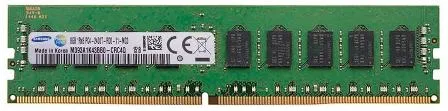
| Model | M393A1K43BB0-CRC4Q |
|---|---|
| Product Type | Memory Module |
| Compliance Standards | CE,WEEE,RoHS |
| Memory Capacity | 8 GB |
| Memory Technology | DDR4 |
| Product Voltage | 1.2V |
| RAM Speed | 2400MHz |
| RAM Standard | DDR4-2400/PC4-19200 |
| Error Identifying | ECC |
| Signal Type | Registered |
| Column Access Strobe (CAS) | CL17 |
| Rank | Single Rank x8 |
| Quantity of Pins | 288-pin |
| RAM Genre | RDIMM |
Designed as a server-grade DDR4-2400 Registered DIMM with ECC, this module is ideally suited for virtualization hosts, in-memory databases, and enterprise workloads where data integrity and uptime are critical. Its single-rank x8 configuration minimizes electrical loading on the memory bus, while the registered signal type and CL17 latency ensure stable, efficient command/address handling in densely populated multi-DIMM server platforms.
1. 8 GB capacity per module allows balanced memory distribution across server nodes, preventing resource starvation for lightweight containerized applications.
2. 2400 MHz memory speed ensures stable throughput for simultaneous VM operations, avoiding performance jitter during peak database queries.
3. ECC error detection and correction eliminate silent data corruption risks, preserving transaction integrity in financial processing systems.
4. Registered signal buffering enables higher module density per memory channel, sustaining reliable operation when scaling up to multi-terabyte server footprints.
5. Single Rank x8 organization reduces electrical load on the memory bus, improving signal quality and overall platform uptime under 24/7 operation.
The M393A1K43BB0-CRC4Q is an 8GB DDR4-2400 Registered DIMM (RDIMM), clearly designed for server environments where uptime and data integrity are absolute priorities. Its four defining characteristics translate directly into reliability and performance in critical deployments.
First, Error Correcting Code (ECC) technology detects and corrects single-bit memory errors automatically. In a virtualization cluster hosting dozens of VMs, a silent bit flip in unprotected memory can corrupt a live database transaction or destabilize an entire hypervisor node. ECC eliminates that risk, keeping your services consistent. Second, the Registered (buffered) signal type stabilizes the command and address buses, allowing a server to support larger total memory capacities without signal degradation. When you scale a bare-metal database server to hundreds of gigabytes, Registered buffering ensures predictable access timing, which prevents intermittent boot failures and data corruption under heavy population. Third, operating at a low 1.2V, it reduces thermal load inside dense rack servers, preserving long-term hardware reliability while lowering datacenter energy costs. Finally, the Single Rank x8 organization with a CAS latency of CL17 offers a balanced path to steady 2400MT/s bandwidth. For an in-memory database like Redis or SAP HANA, this means consistent, snappy query responses even as concurrent client sessions climb, because rank and timing are tuned for sustained throughput rather than peaky overclocks. In essence, this module turns the headaches of server memory scaling—unpredictable failures, thermal runaway, and performance jitter—into a quiet, calculable foundation.
General Virtualization
Populate at least one DIMM per memory channel to balance capacity and bandwidth. Using 12 of these 8 GB RDIMMs in a dual‑socket server yields 96 GB, sufficient for 20+ typical VMs. For larger deployments, fill two DIMMs per channel to reach 192 GB, though the speed may drop to 1866 MT/s.
In-Memory Database
Maximize capacity by filling all available DIMM slots. A dual‑socket platform with 16 slots, using 2 DIMMs per channel, provides 128 GB of ECC memory for caching hot datasets. Always use identical modules to ensure stable ECC operation and avoid mixing ranks.
High Performance Computing
Install one 8 GB RDIMM per channel to sustain full 2400 MT/s memory speed, delivering up to 96 GB in a 12‑channel server. Avoid populating two DIMMs per channel unless capacity is critical, as it forces lower clock speeds and reduces bandwidth for latency‑sensitive simulations.
Rigorously tested for server compatibility with Dell PowerEdge R740, HPE ProLiant DL380 Gen10, Lenovo ThinkSystem SR650.
Q: Can I mix this M393A1K43BB0-CRC4Q with other memory modules of different brands or speeds?
A: We strongly advise against mixing modules with different brands or speeds. Mismatched DIMMs can cause instability on server platforms and may overstress the integrated memory controller.
Q: Is this memory compatible with my system?
A: It is compatible with servers using Intel Xeon E5-2600 v3/v4 or AMD EPYC platforms that require 288-pin DDR4 Registered ECC RDIMMs. Verify support for 2400MT/s in your model’s Qualified Vendor List.
Q: What is the recommended DIMM population order for optimal performance?
A: For balanced performance, populate identical DIMMs in the first slot of each memory channel (e.g., A1, B1). Always consult your server board’s manual, as correct ordering maximizes interleaving and throughput.
Q: Does this module support overclocking or XMP profiles?
A: No. As an enterprise-grade Registered ECC RDIMM, it adheres strictly to JEDEC DDR4-2400 standards and does not support overclocking or Intel XMP 2.0 profiles for guaranteed data integrity.
Q: What warranty and typical failure rate can I expect?
A: This module includes a 1-year warranty. Samsung server memory exhibits a very low annualized failure rate, typically below 0.5%, ensuring reliable 24/7 operation in demanding data center environments.