











 Secure payments
Standard refund policy
Trade Assurance
Secure payments
Standard refund policy
Trade Assurance
| Product Type | Memory Module |
|---|---|
| Memory Capacity | 8 GB |
| Memory Technology | DDR4 |
| Product Voltage | 1.2 V |
| RAM Speed | 2400 MHz |
| RAM Standard | DDR4-2400/PC4-19200 |
| Error Identifying | ECC |
| Signal Type | Registered |
| Column Access Strobe (CAS) | CL17 |
| Rank | Dual Rank x8 |
| Quantity of Pins | 288-pin |
| RAM Genre | RDIMM |
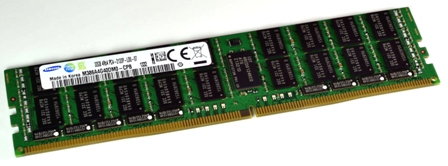
This DDR4-2400 Registered ECC module with dual-rank x8 organization is optimized for enterprise servers and workstations running memory-intensive workloads such as virtualization and in-memory databases, ensuring high data integrity through hardware error correction. The registered signal topology combined with dual-rank interleaving enhances stability under heavy loads, while the modest CL17 latency at 1.2V balances power efficiency and reliable command scheduling in dense multi-DIMM configurations.
1. Registered signal type buffers the command/address bus, ensuring stable operation when populating all DIMM slots in a dense server node.
2. ECC error correction detects and corrects single-bit errors on the fly, preserving data integrity for mission-critical enterprise databases.
3. Dual Rank x8 organization leverages rank interleaving to boost effective memory bandwidth, lowering latency under heavy virtualization workloads.
4. DDR4 technology delivers higher frequency headroom and lower power per gigabit, shrinking the total cost of ownership in hyper-scale data centers.
5. 2400 MT/s transfer speed offers a sweet spot of throughput and compatibility, sustaining consistent application performance across mixed-generation server fleets.
The M393A1G43EB1-CRC0Q is a server RDIMM whose ECC, registered buffering, dual‑rank architecture, and efficient 1.2 V operation resolve the critical pain points of data‑center workloads. ECC directly protects your in‑memory databases such as Redis or SAP HANA from silent data corruption; a single‑bit flip in a cached financial transaction could propagate errors to permanent storage, but this module corrects them inline, preserving transactional accuracy and preventing costly audit failures. The registered clock driver stabilizes high‑density configurations, so when you fully populate channels for a VMware or KVM host running dozens of virtual machines, it eliminates the signal noise that causes unbuffered DIMMs to trigger hypervisor crashes and unplanned downtime. Its dual‑rank x8 design enables rank interleaving—the memory controller overlaps commands between ranks, boosting effective bandwidth for concurrent database queries and rapid VM memory swapping without adding extra modules. Finally, the 1.2 V DDR4‑2400 specification keeps thermal load and power draw firmly in check, directly lowering cooling opex as you scale your virtualization cluster or real‑time analytics farm. For environments where every transaction and guest instance counts, these four attributes transform raw silicon into a pillar of reliability, throughput, and density.
General Virtualization
For a typical hypervisor hosting mixed workloads, populate all memory channels with identical 8GB RDIMMs to maximize bandwidth and maintain NUMA balance. Aim for at least four modules per CPU (e.g., 32GB total) to service a moderate number of VMs, scaling up to eight or more modules as guest density increases, while leaving room for future expansion.
In-Memory Database
Low-latency in-memory databases demand both capacity and consistent access times; deploy the full channel count per socket with 8GB dual-rank modules to exploit rank interleaving and avoid memory bus throttling. Target 64–256GB configurations using twelve or more RDIMMs to hold entire datasets in DRAM, reducing swap and yielding predictable query performance under heavy concurrency.
High-Performance Computing
HPC clusters benefit from balanced memory bandwidth rather than sheer capacity per node. Install one 8GB dual-rank RDIMM per channel (typically six or eight modules per CPU) to sustain peak throughput for memory-bound simulations. In scale-out environments where cost and power matter, this module size provides sufficient headroom for MPI tasks while keeping per-node density aligned with fabric and storage throughput.
Rigorously tested, this 8GB DDR4 RDIMM is verified compatible with Dell PowerEdge R740, HPE ProLiant DL380 Gen10, Lenovo ThinkSystem SR650.
Q: Can I mix this M393A1G43EB1-CRC0Q with other memory modules of different brands or speeds?
A: Mixing different brands or speeds is strongly discouraged. This registered ECC RDIMM requires identical modules to ensure signal integrity, stability, and to prevent system boot failures or data errors.
Q: Is this memory compatible with my system?
A: This module is designed for server platforms using Intel Xeon Scalable or AMD EPYC processors that support DDR4-2400 ECC Registered DIMMs. Please verify your motherboard supports 288-pin RDIMMs at 1.2V.
Q: What is the recommended DIMM population order for optimal performance?
A: Follow your server motherboard’s population guide—typically, balance identical DIMMs across all memory channels, populating the furthest slot per channel first. Symmetric configurations maximize bandwidth and ensure correct ECC operation.
Q: Does this module support overclocking or XMP profiles?
A: No, this is a JEDEC-compliant server-grade ECC RDIMM built for maximum stability. It does not support XMP or overclocking; it runs strictly at the factory-defined CL17 timings and 1.2V.
Q: What warranty and typical failure rate can I expect?
A: This module includes a one-year warranty. Enterprise-class ECC memory typically exhibits an annualized failure rate (AFR) well below 0.5%, ensuring reliable long-term operation under validated server workloads.