











 Secure payments
Standard refund policy
Trade Assurance
Secure payments
Standard refund policy
Trade Assurance
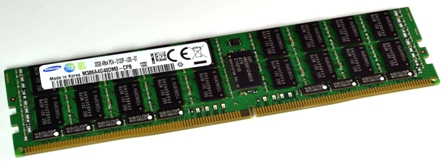
| Model | M393A1G43EB1-CRC40 |
|---|---|
| Product Type | Memory Module |
| Compliance Standards | EU RoHS,FCC |
| Memory Capacity | 8 GB |
| Memory Technology | DDR4 |
| Product Voltage | 1.2V |
| RAM Speed | 2400MHz |
| RAM Standard | DDR4-2400/PC4-19200 |
| Error Identifying | ECC |
| Signal Type | Registered |
| Column Access Strobe (CAS) | CL17 |
| Rank | Dual Rank x8 |
| Quantity of Pins | 288-pin |
| RAM Genre | RDIMM |
Designed as a server-grade RDIMM, this Samsung DDR4-2400 module (M393A1G43EB1-CRC40) is optimized for enterprise virtualization, in-memory databases, and data-critical workloads where registered ECC ensures end-to-end data integrity. Its dual-rank x8 configuration enhances interleaving bandwidth, while the registered buffer and low CL17 latency deliver stable, high-throughput performance under the relentless demands of 24/7 server operation.
1. ECC protection silently detects and corrects single-bit memory errors, preventing silent data corruption in financial transactions and database operations that demand 24/7 uptime.
2. Registered signal type buffers address and command lines, enabling stable operation with high-density DIMM populations essential for large-scale virtualization hosts.
3. Dual Rank x8 organization interleaves memory accesses across two internal ranks, effectively boosting sustainable bandwidth under the heavily threaded workloads of a multi-tenant cloud server.
4. 8GB module capacity strikes a practical balance for scale-out deployments, allowing fine-grained memory provisioning per virtual machine without over-allocating expensive resources.
5. 2400MHz clock speed delivers a solid baseline of 19.2 GB/s throughput per channel, keeping latency-sensitive enterprise applications responsive during peak utilization.
Based on its RDIMM form factor, ECC, and Registered signal type, the M393A1G43EB1-CRC40 is definitively a server-grade memory module. While its 8GB capacity may seem modest, the module’s engineering directly tackles the real-world priorities of IT administrators: preserving data integrity under relentless loads and ensuring platform stability at scale.
The first critical feature is ECC error correction. In a memory-centric database like Redis or SAP HANA, a single undetected bit-flip caused by cosmic radiation can silently corrupt a financial transaction or a customer record, leading to irreversible logical errors. ECC actively scans and repairs these single-bit errors in real time, transforming a potential business disaster into an insignificant background event. The second is the Registered buffer, which re-drives command and address signals. When you populate a dual-socket virtualization cluster with 24 DIMMs to run dozens of virtual machines, regular unbuffered memory succumbs to signal degradation and instability. This Registered buffer ensures clean, synchronized communication, allowing the hypervisor to manage dense workloads without unexpected memory failures that would crash your entire service stack. The Dual Rank x8 organization then boosts bandwidth through rank interleaving, overlapping consecutive data accesses so that a heavily-loaded SQL server sees significantly lower latency during massive concurrent queries. Finally, the standard 1.2V operating voltage and 2400MHz speed hit the efficiency sweet spot, driving performance while keeping thermal output low in densely racked servers where every watt of cooling power counts toward operational cost.
General Virtualization
For consolidated virtual machines running web servers, lightweight databases, or business applications, density matters more than raw speed. Using 16GB or 32GB RDIMMs from the same product family (DDR4-2400, Dual Rank x8) populates channels evenly. A typical dual‑socket system with 8 memory channels benefits from one DIMM per channel (1DPC), delivering balanced capacity and latency while leaving room for future scaling without sacrificing memory bandwidth.
In-Memory Database
Predictable low latency and data integrity are paramount for platforms like SAP HANA or Redis. Populate all memory channels symmetrically with identical 8GB/16GB registered DIMMs at 1DPC to guarantee consistent 2400MT/s operation and error correction. For larger datasets, replace with higher‑capacity RDIMMs rather than mixing DIMM sizes, which can force slower speeds or interleaving imbalances. Minimum 128GB total is common, scaled linearly by doubling module count across empty channels.
High-Performance Computing
HPC workloads such as CFD or molecular dynamics strain memory bandwidth above all else. Install at least one DIMM per channel—ideally the same 8GB RDIMMs—to fully utilize the CPU’s memory controllers. Avoid populating more than two DIMMs per channel, as 2DPC configurations often drop the clock to 1866MHz. The 2400MHz clock and dual‑rank design provide strong streaming throughput; for capacity‑bound HPC, select 32GB modules that maintain the same rank and speed rating to avoid bandwidth degradation.
Rigorously tested server memory for Dell PowerEdge R740, HPE ProLiant DL380 Gen10, Lenovo ThinkSystem SR650.
Q: Can I mix this M393A1G43EB1-CRC40 with other memory modules of different brands or speeds?
A: Mixing is not recommended for server environments. For stability, use identical modules with the same part number, speed, and rank to avoid signal integrity issues and potential ECC errors.
Q: Is this memory compatible with my system?
A: This DDR4-2400 ECC Registered RDIMM is compatible with server platforms from Intel Xeon E5-2600 v3/v4, Scalable, and AMD EPYC 7001/7002 that require 288-pin registered memory.
Q: What is the recommended DIMM population order for optimal performance?
A: Follow your server motherboard manual. Generally, populate identical DIMMs per channel, filling blue slots first, then black, to maintain balanced memory channels and ensure reliable ECC operation.
Q: Does this module support overclocking or XMP profiles?
A: No. This is a JEDEC-compliant registered server module running at its native 2400MHz speed. It does not support overclocking or XMP profiles, prioritizing data integrity and 24/7 stability.
Q: What warranty and typical failure rate can I expect?
A: The module carries a 1-year warranty. Thanks to enterprise-grade components and rigorous testing, it delivers a very low annualized failure rate, ensuring high mission-critical reliability.